Scientific confidence: High
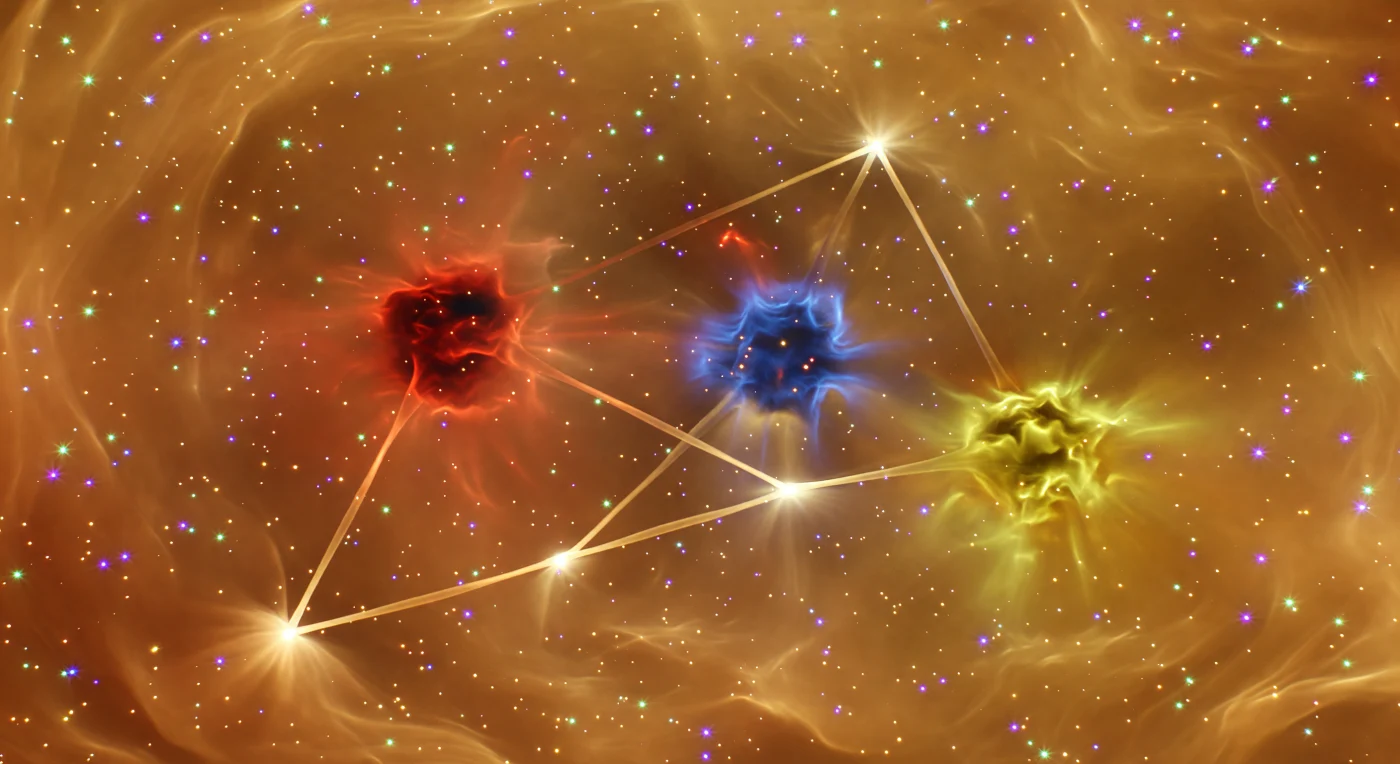
Inside the resting proton, three blazing quark-like nodes drift through a glowing amber haze that seems to radiate from everywhere at once, with no horizon, edge, or external light source. Fine flux tubes bind them in shifting triangular paths, tightening and rerouting as the strong force confines color charge and continually reshapes the field between them. The surrounding medium is not empty space but a seething quantum vacuum, alive with brief paired flashes of particle and antiparticle energy that bloom and vanish in complementary colors. The result feels like floating within a warm, self-illuminated storm of matter and force, where solidity gives way to restless field dynamics and every direction remains boundless.
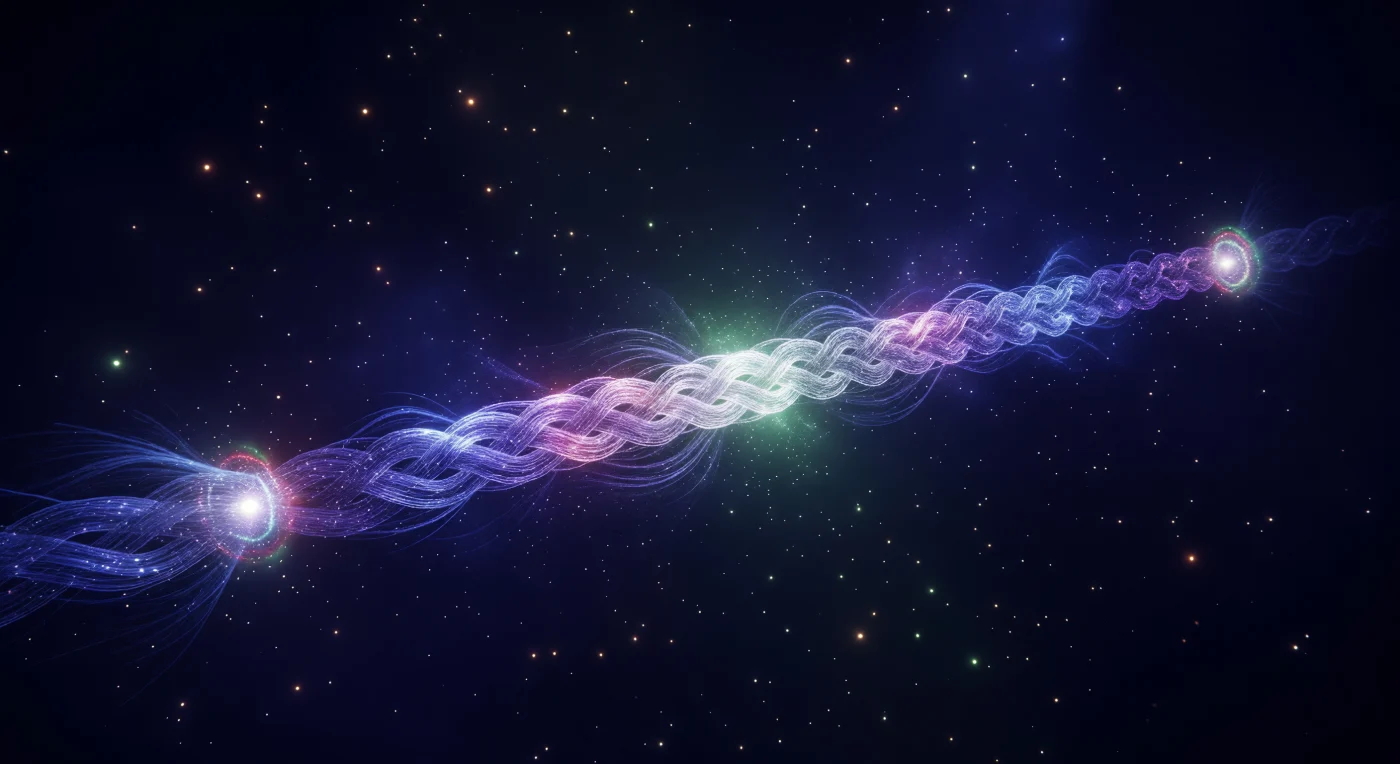
A single gluon flux tube fills the view like a living pillar of braided violet and white, stretching between two blinding quark endpoints and tapering into electric-blue haze at its edges. Its corded surface shivers with transverse quantum vibrations, the standing waves of confined chromodynamic field energy tightening and loosening along the length as if the vacuum itself were under tension. Around it, the deep indigo void is not empty but seeded with brief, flickering sparks from virtual fluctuations that appear and vanish in an instant. Near the middle, the tube flares emerald-white, a bright knot of rising field energy that signals string breaking and the sudden possibility of quark–antiquark pair production.
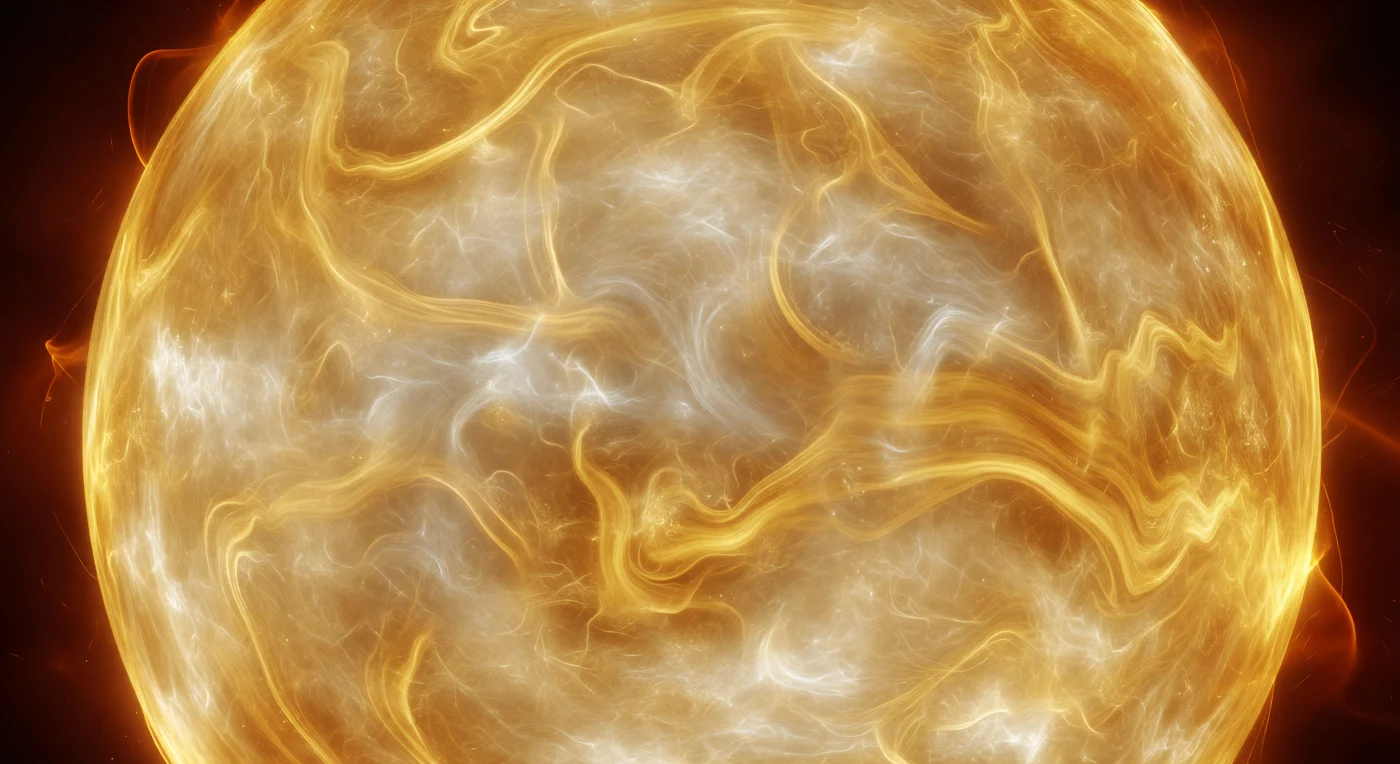
The viewer is immersed in a blinding white-gold quark-gluon plasma droplet, where no shadows can form because the medium itself is continuously radiating from seething color charges at extreme temperature. Dark amber streamlines thread through the brilliance as coherent vortices in the collective elliptic flow, their slower channels hinting at organized motion within what is otherwise a violently hot, nearly uniform fire. Along the curved boundary, the luminosity shifts into a sharp red-orange shell that cools through orange-brown as hadronization begins, marking the droplet’s edge not as a wall but as a fading transition between phases of matter. The whole scene feels like standing inside a star compressed to an almost unimaginable thickness, where depth is measured in color gradations and the boundaries of substance are only just beginning to reappear.
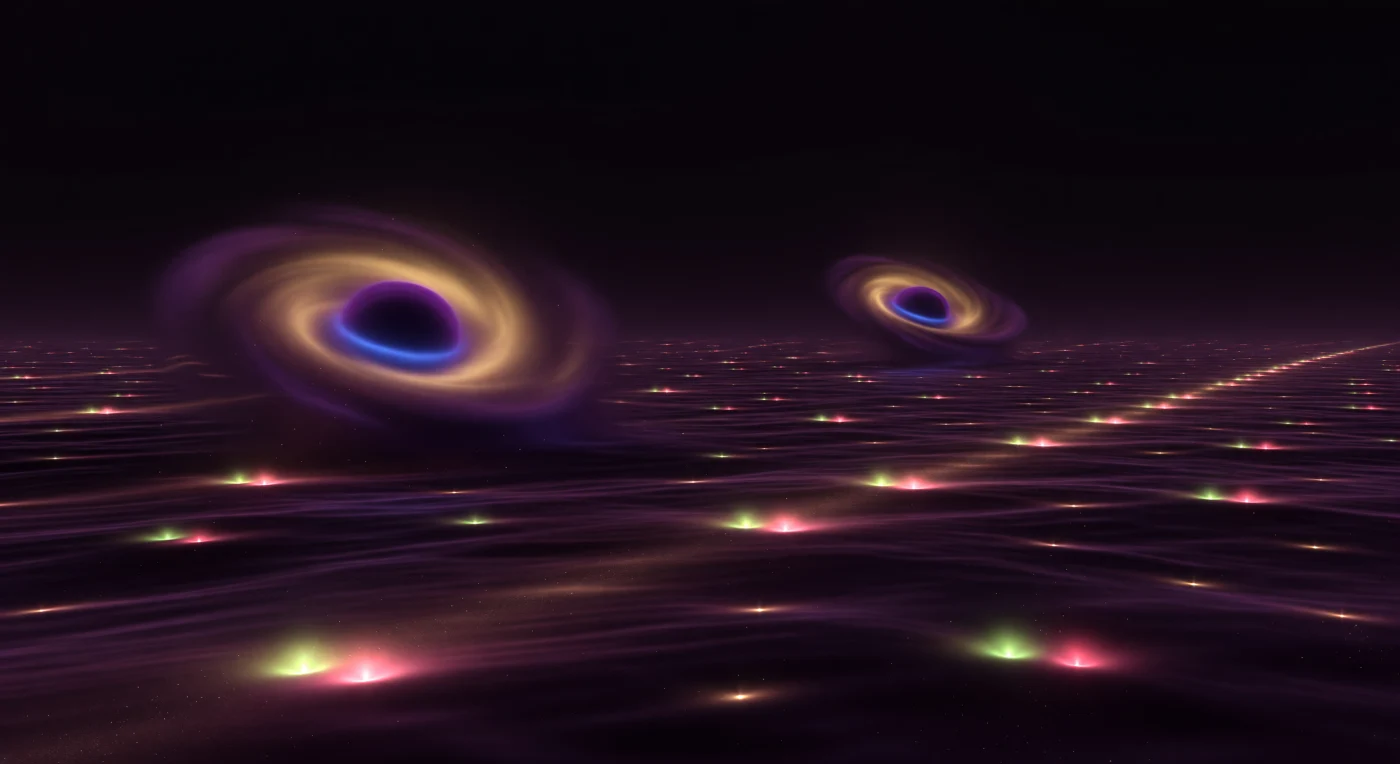
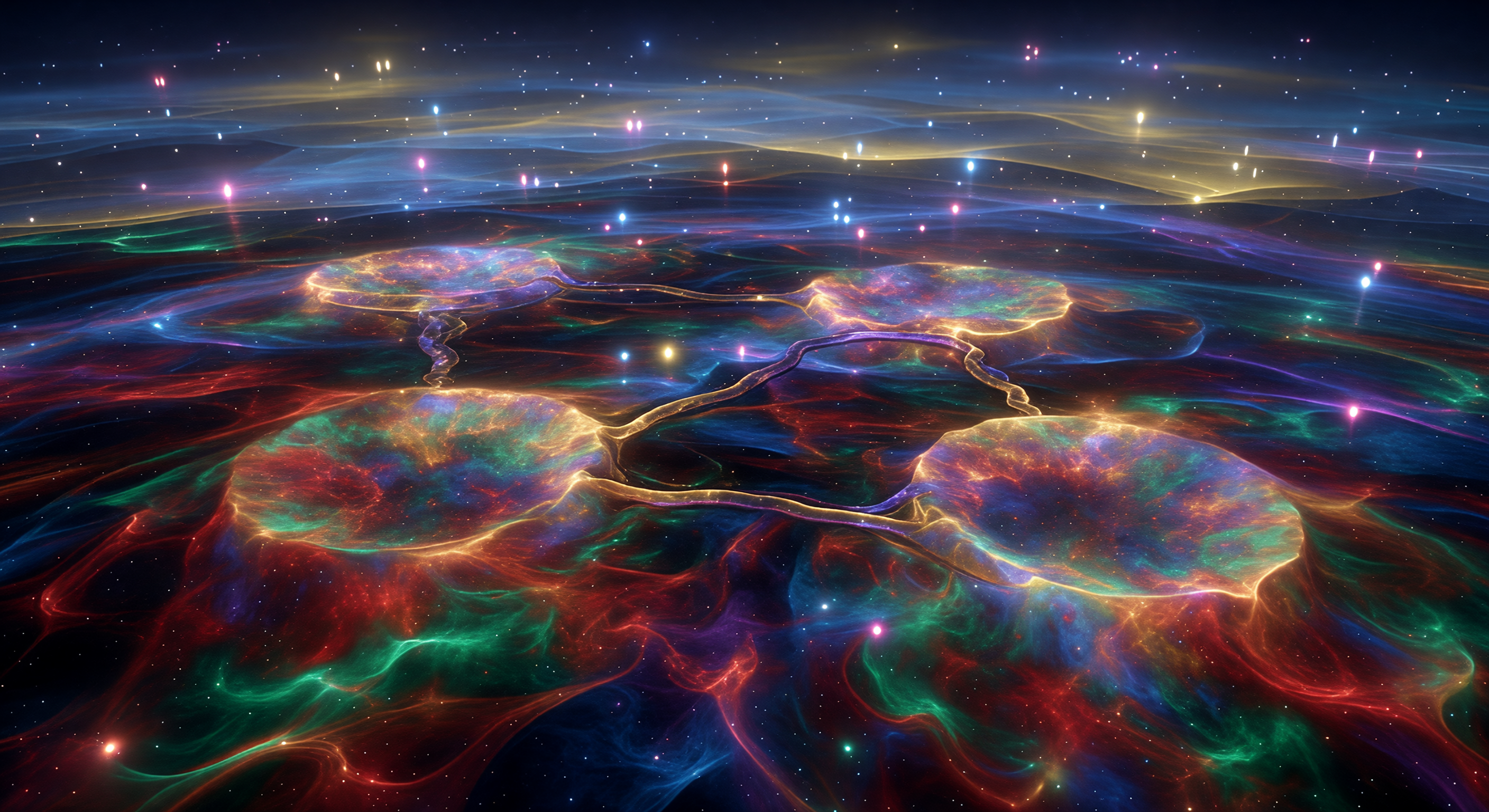
The viewer stands on a near-black magenta expanse that is not soil but the restless QCD vacuum itself, a field-formed membrane rippling with low, tessellated waves. All around, paired green-red and blue-yellow flashes erupt and vanish in yoctoseconds, marking virtual quark-antiquark creation and annihilation as the strong force churns beneath the surface. Every few moments, a deep purple instanton condenses into a spiral sphere, exhaling radial gluon field lines before dissolving back into the dark, while a faint amber diagonal grain reveals the vacuum’s chiral asymmetry. The whole scene feels impossibly close and vast at once, as if the observer were immersed inside the invisible machinery that gives hadrons their mass, color, and structure.
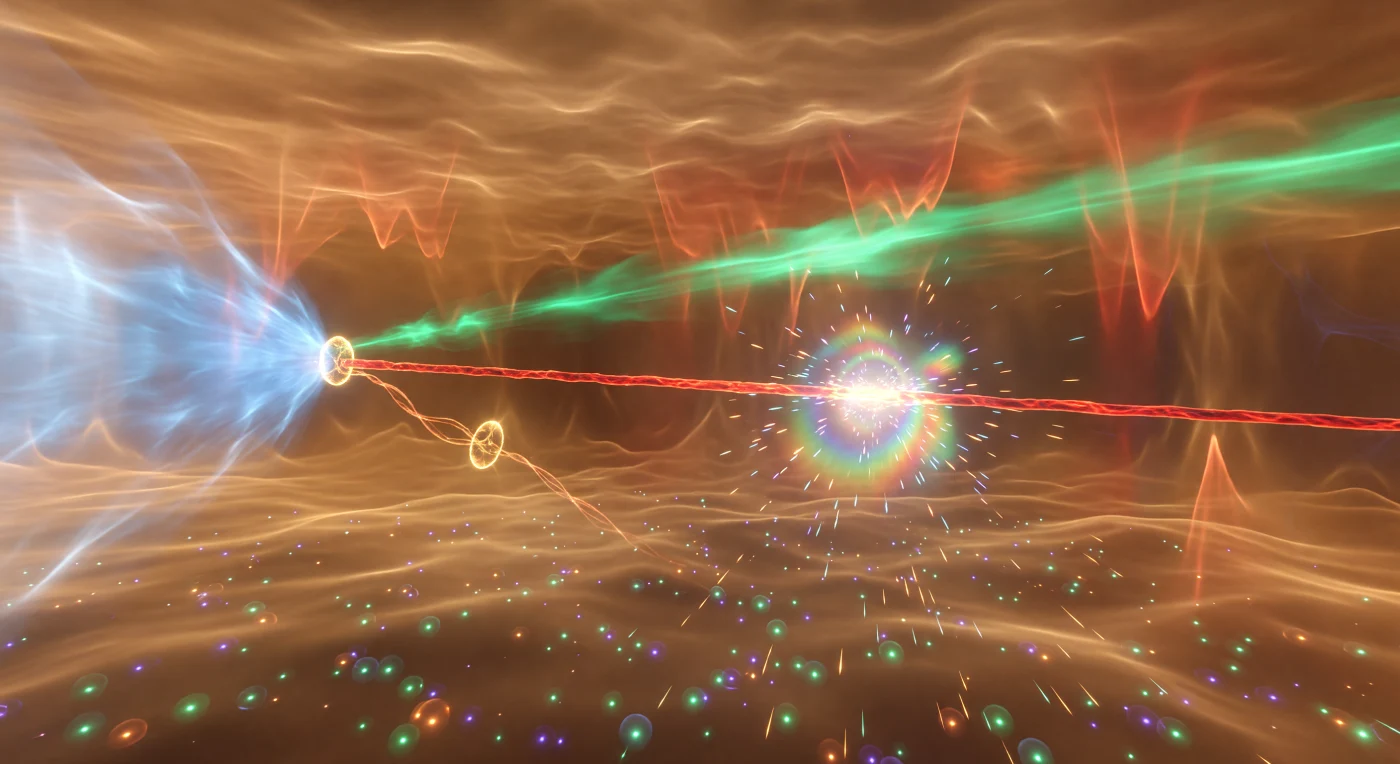
Inside the proton, the viewer sees a turbulent amber-and-copper sea of gluon fields, threaded by translucent veils of confinement and filled with flickering virtual pairs that appear and vanish like sparks in dark water. A blue-white electromagnetic front slams in from the left, couples through a golden virtual photon to one valence quark, and hurls it away as a blazing emerald jet while a crimson flux tube stretches behind it under the tension of color confinement. That string then snaps in a white flash, converting stored field energy into a spray of multicolored pions that fan outward through the haze, while the two remaining quarks gather and re-braid their bonds in the warm glow behind the scatter point. The whole event feels less like an object breaking than a brief, violent rearrangement of fields within a living interior, where distances are measured in ripples of color and every structure is made of energy in motion.
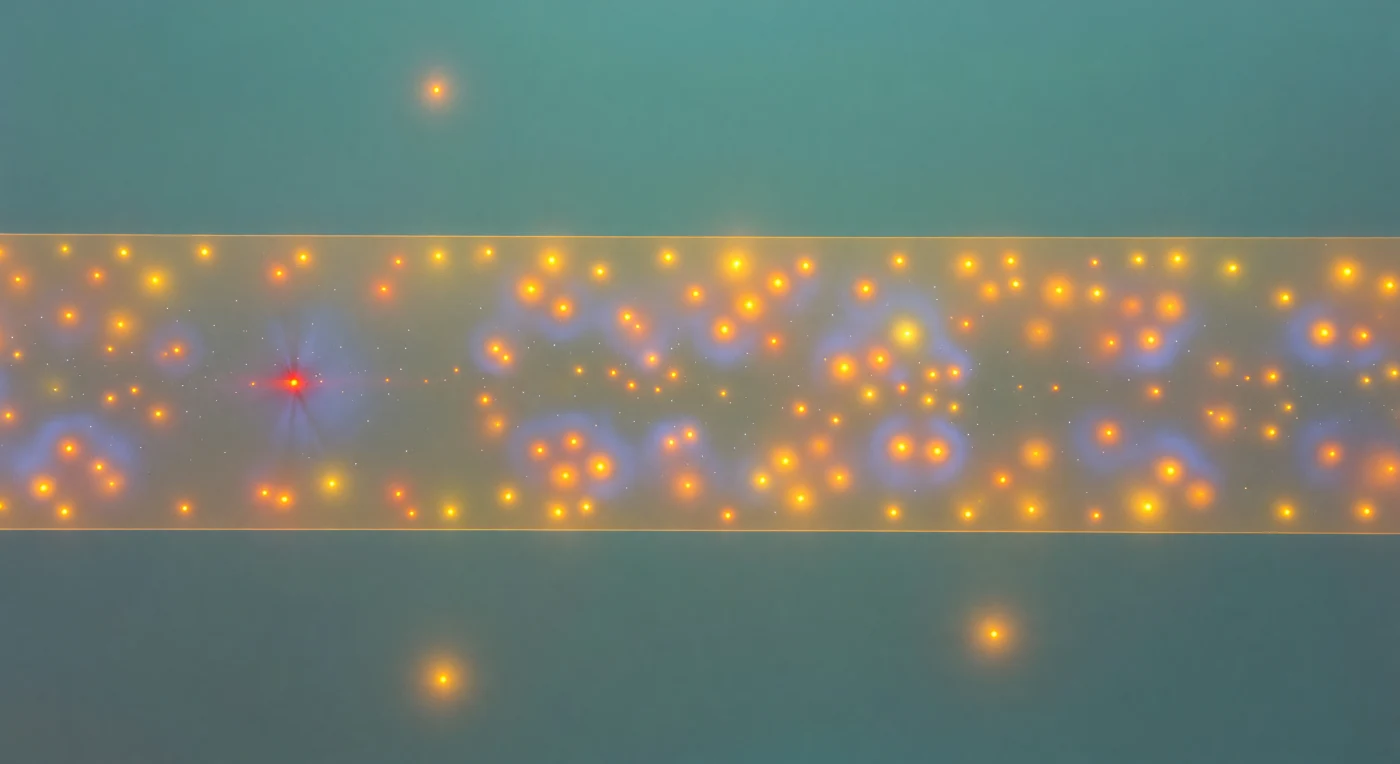
Ahead of you stretches a vast, wafer-thin wall of luminous matter, so compressed by near-light-speed motion that it seems almost without thickness, only a bright amber-gold membrane filling the entire forward view. Within it, dense nuclear cores burn as rounded nodes of warm light, each wrapped in a soft blue-violet haze of electron probability and surrounded by granular field shimmer where the strong and electromagnetic interactions blur together. The sheet slides through your perspective in near silence, its only motion a faint heat-haze distortion and a slow, almost geological shift of hue that washes across the whole scene like a living spectrum. Far off to one side, a single red-amber spark flares and dies in an instant, a rare weak-interaction event flashing and vanishing before the quiet gold-and-violet expanse resumes its eerie, boundless drift.
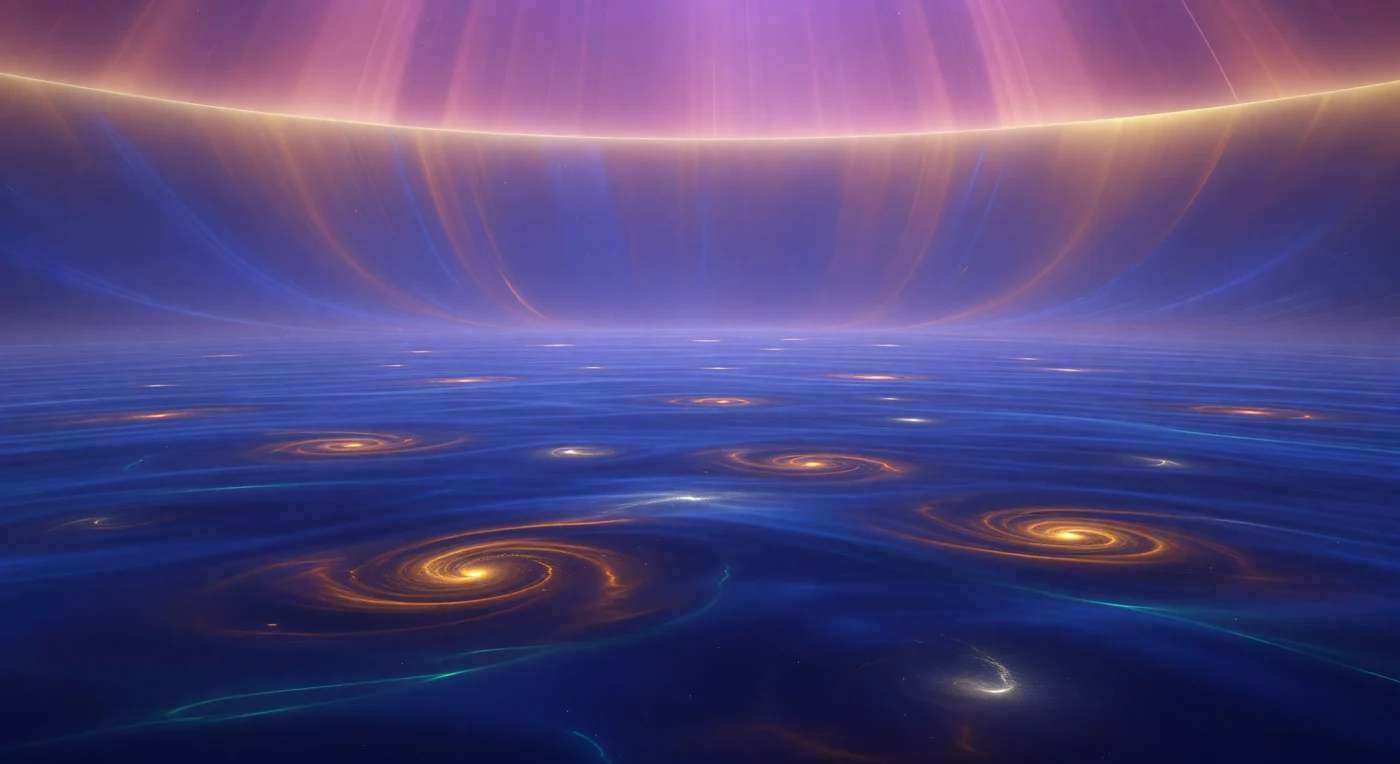
You drift across the floor of the Higgs field, an immense indigo expanse that feels less like a liquid than a luminous, living medium breathing at the lowest possible energy. Tiny particles crossing it leave signatures proportional to their mass: heavy ones carve warm amber vortices and deeper ripples, while lighter ones pass with only a faint silver whisper in the blue-violet surface. Above you, the Mexican-hat brim arches into a vast rose and amethyst dome, its unreachable crown fading into the symmetric, unbroken phase far overhead. The scene makes the hierarchy of mass feel tangible, as if the universe itself were a bowl-shaped landscape where the vacuum has settled into its quietest possible state.
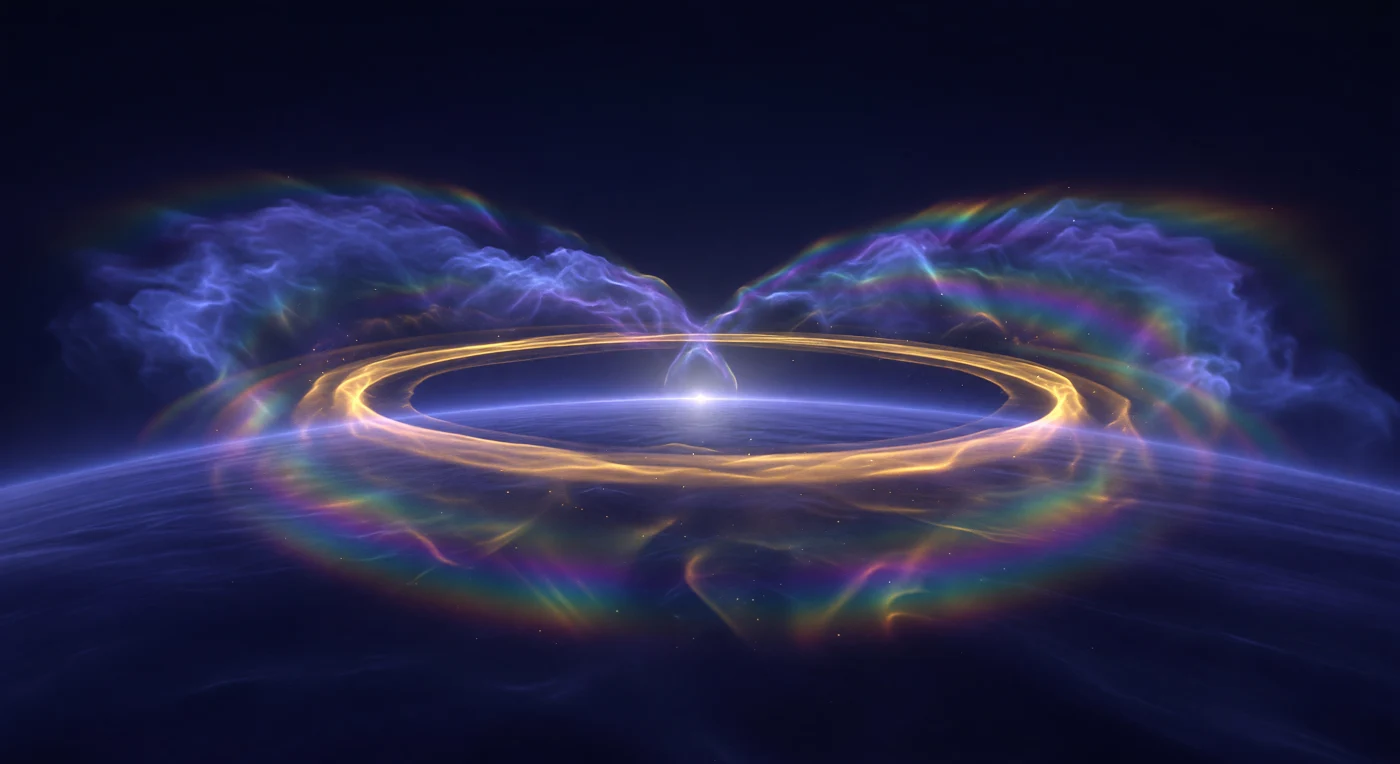
Two immense blue-violet wave-clouds surge inward from opposite sides of the void, their translucent field edges fraying into interference ripples as they compress toward a single blinding point at the center. At the instant of annihilation, the collision converts mass-energy into a pair of golden gamma-ray wavefronts that race away in opposite directions, broad rings of radiation expanding through the scene at light speed. Around them, the dark indigo vacuum flares into a thin prismatic corona as the quantum vacuum briefly polarizes, with virtual electron-positron pairs stirred by the transient field before the glow subsides. The whole chamber feels cathedral-scale and bottomless, yet every contour is made of fluctuations, probabilities, and fields rather than solid matter.
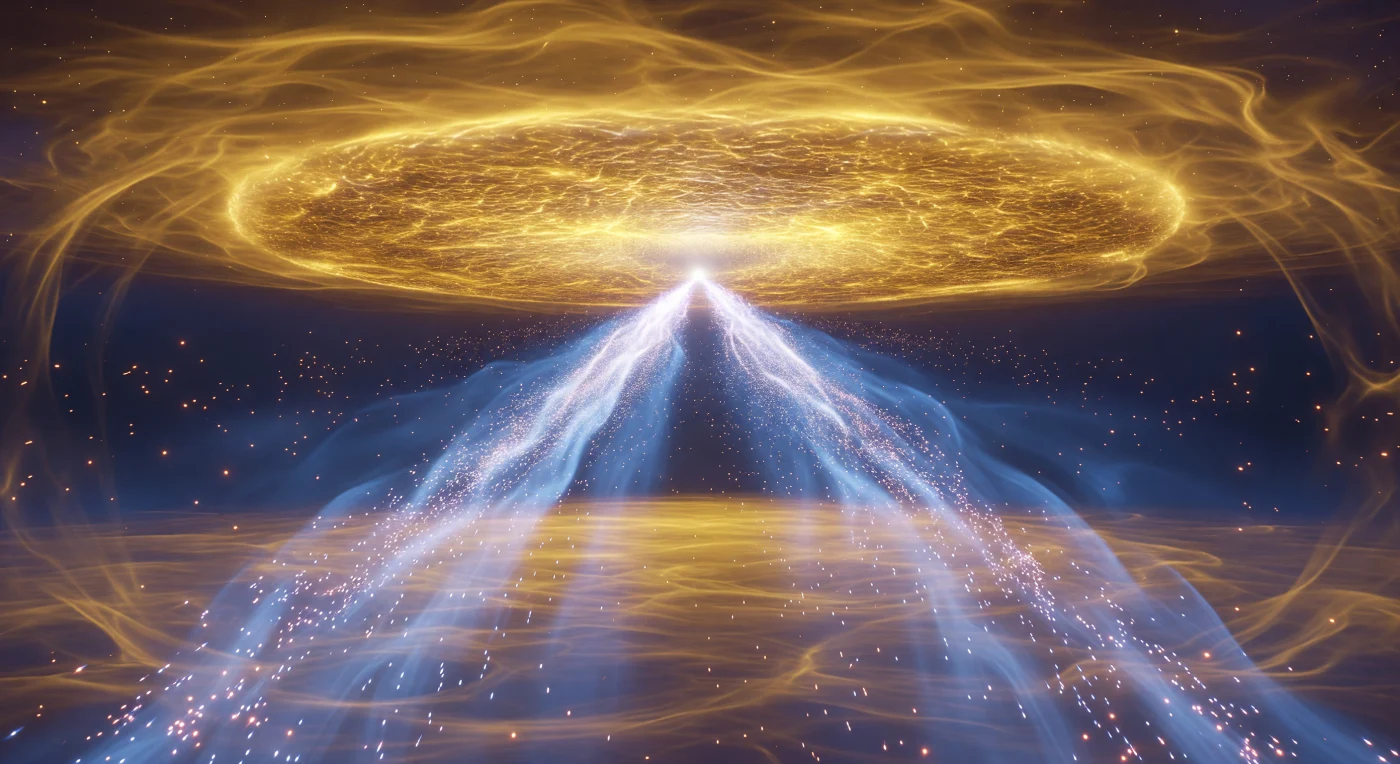
You are swept inside a proton compressed into a luminous amber-gold disc, where the “air” is really a dense churn of quark and gluon fields threading through the QCD vacuum. Ahead, another proton slams in as a flattened wall of blazing field energy, and their contact detonates into a white-hot point that briefly overwhelms everything around it. From that flash, twin blue-white jets spear outward in opposite directions, each a narrowing storm of fragmenting partons that hadronize into countless tiny sparks while softer red-orange debris fans away. The surrounding vacuum, momentarily ionized by the collision, glows with a cold blue haze before sinking back into darkness, leaving only the sense of immense energy compressed into an almost unimaginably tiny world.
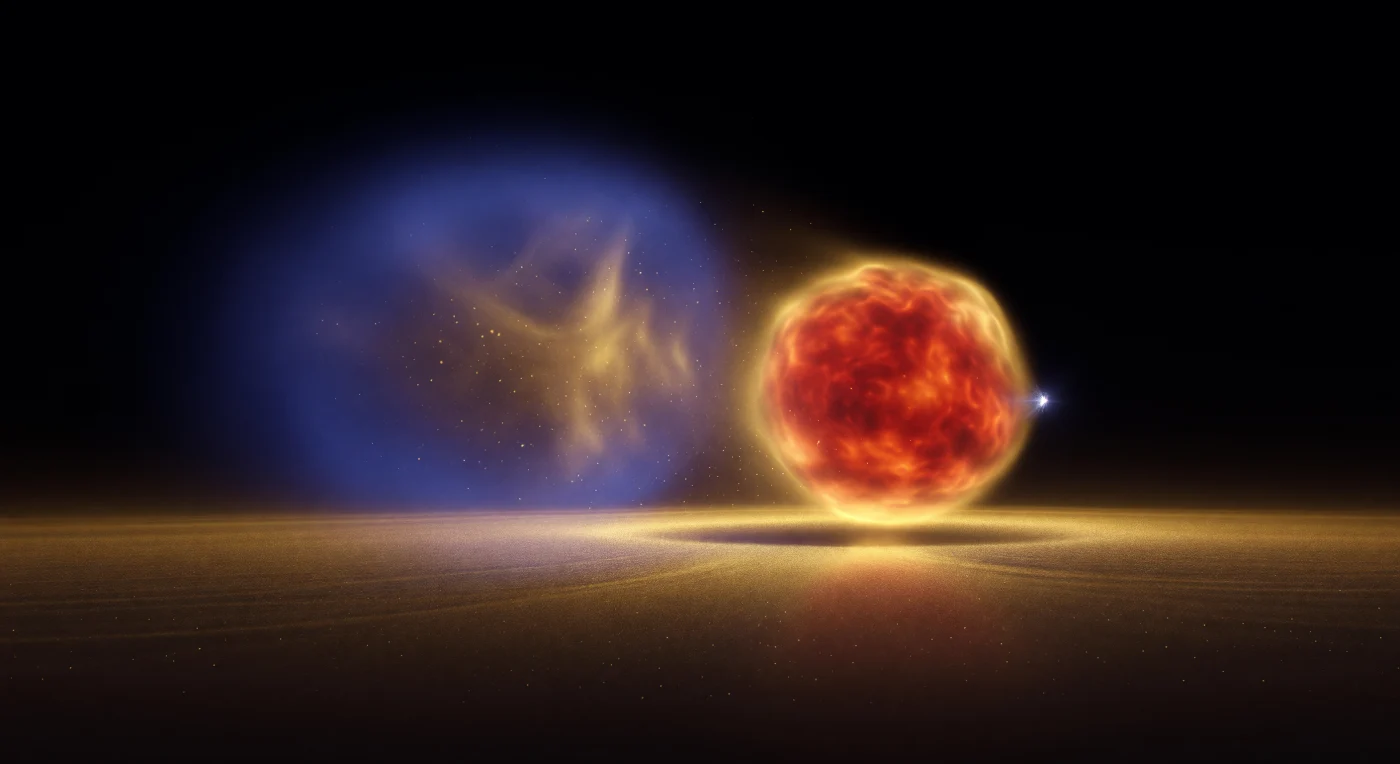
The viewer is suspended beside a weak-interaction vertex where a blue-violet down-quark field node subtly warms toward blue-gold as it transforms into an up-quark, while a dense red-amber W-minus boson bursts free from the exchange. In its wake, the boson’s brief passage is felt as a sharp blue-white electron spark and an adjacent absence where an antineutrino escapes without leaving light, only a faint shadow-depression in the surrounding field texture. Everything sits against near-absolute blackness, so the luminous gradients seem to hang in void rather than space, making the event feel both intimate and impossibly energetic. At this depth, matter is not solid but a restless choreography of quark fields, gauge bosons, and vacuum fluctuations, each change happening so fast that identity itself appears to flicker.
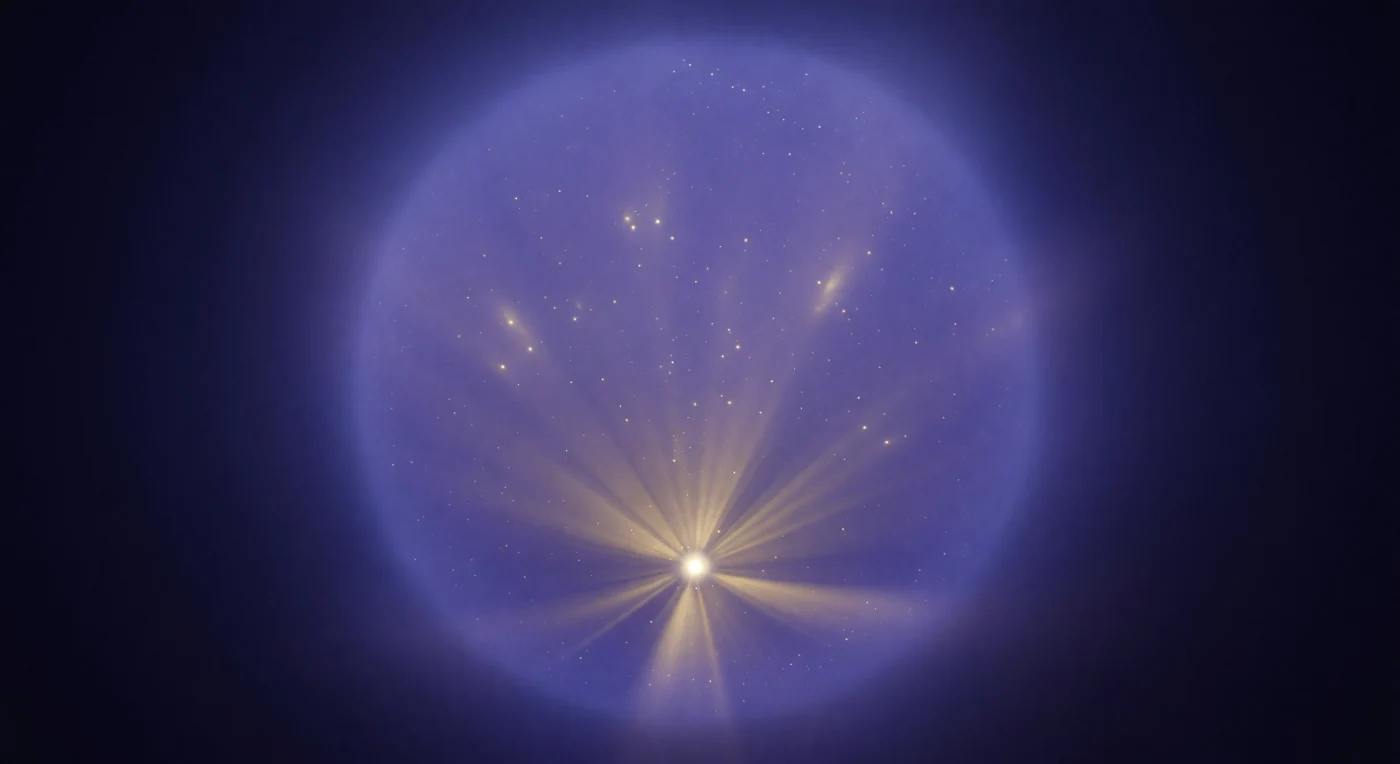
The viewer is immersed inside a vast, spherically symmetric haze of deep blue-violet light, as if floating within the probability cloud that defines a hydrogen electron rather than inside any ordinary room. No floor or wall appears; instead, the fog thickens toward the center, where a distant proton burns as a hard white-gold point and sends faint golden field threads outward through the luminous medium. The surrounding volume breathes with barely visible quantum shimmer, a subtle instability that hints at vacuum fluctuations and the Lamb shift changing the energy of the bound state. Farther out, the glow fades smoothly into featureless black, making the space feel at once intimate and immeasurably deep, like drifting through the interior of an invisible sphere of chance.
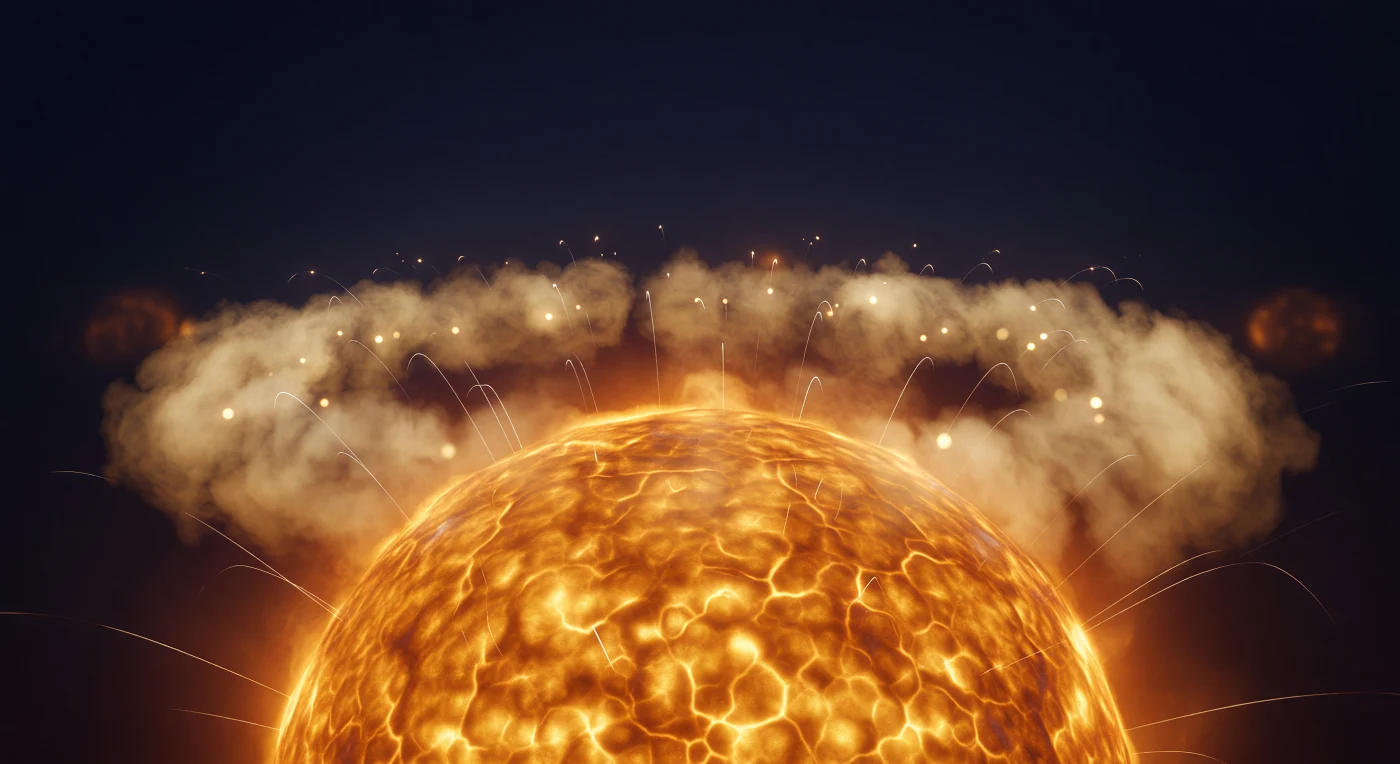
Before you looms an iron nucleus as a trembling amber sphere, its surface soft and breathing rather than sharply bounded, brightening in slow pulses as collective nucleon motion ripples through tightly packed matter. Around it hangs a thick golden-white hadronic corona, where brief white pion arcs flare outward for a heartbeat, curve away, and vanish back into the cloud or into neighboring nucleons just beyond view. The cloud thins toward its outer edge into cream-orange wisps, then gives way to a profound indigo vacuum that feels less empty than pressurized and alive. There is no sky or ground here, only the nucleus filling your field of view like a compressed star, radiating its own fierce interior luminosity into the surrounding dark.
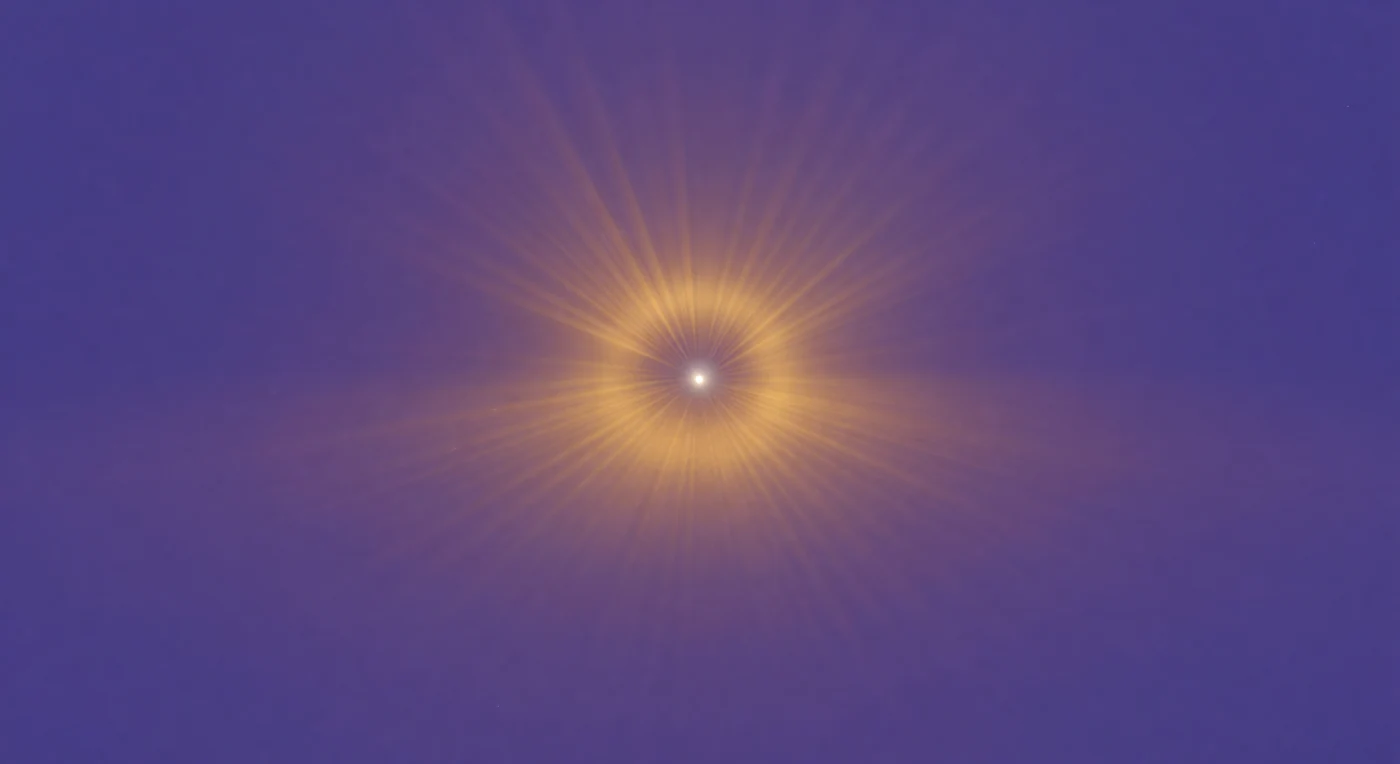
You see a perfectly symmetric violet vacuum stretching outward like an endless, glassy interior, with a single white-gold monopole suspended near the center as the only unmistakable feature in the field. From its core, amber field lines radiate in all directions without any opposing pole, not as solid strands but as luminous gradients that fade through gold and copper into the cool unified backdrop, revealing the topology of a magnetic source in a grand-unified regime. Close to the core, a twisted halo of warm amber marks the scalar field where symmetry is disturbed and then slowly relaxes back into the surrounding deep violet, as if the medium itself is unwinding from an extreme state of tension. The result feels both intimate and cosmic: a realm where force, vacuum, and particle blur together, and the monopole’s own emission becomes the only light in an otherwise perfect stillness.
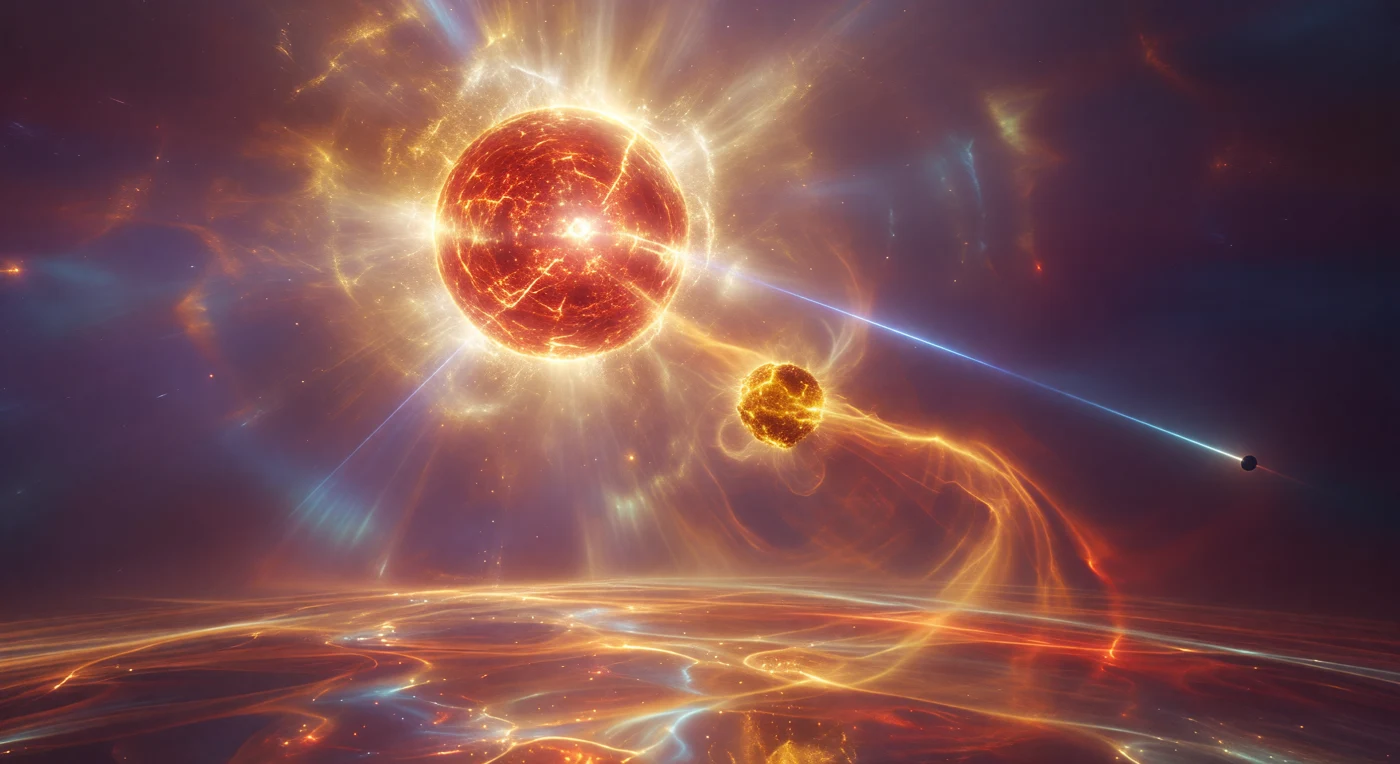
A blinding gold-white core floods the scene, and from it a sudden crimson-amber sphere blossoms where a top quark has just given way. One branch snaps into a razor-thin blue-white lepton flash, while the neutrino leaves only a dark, empty notch in the violet haze, and the bottom-quark remnant drifts onward as a deeper amber knot dragging a glowing gluon wake behind it. Nothing here is solid in the usual sense: the “ground” is a restless lattice of field energy, and the surrounding vacuum shimmers with residual violet light from a decay too brief and violent to fully contain. The whole frame feels intimate and overwhelming at once, as if you are pressed against the birth of a particle event so concentrated that space itself seems to recoil.
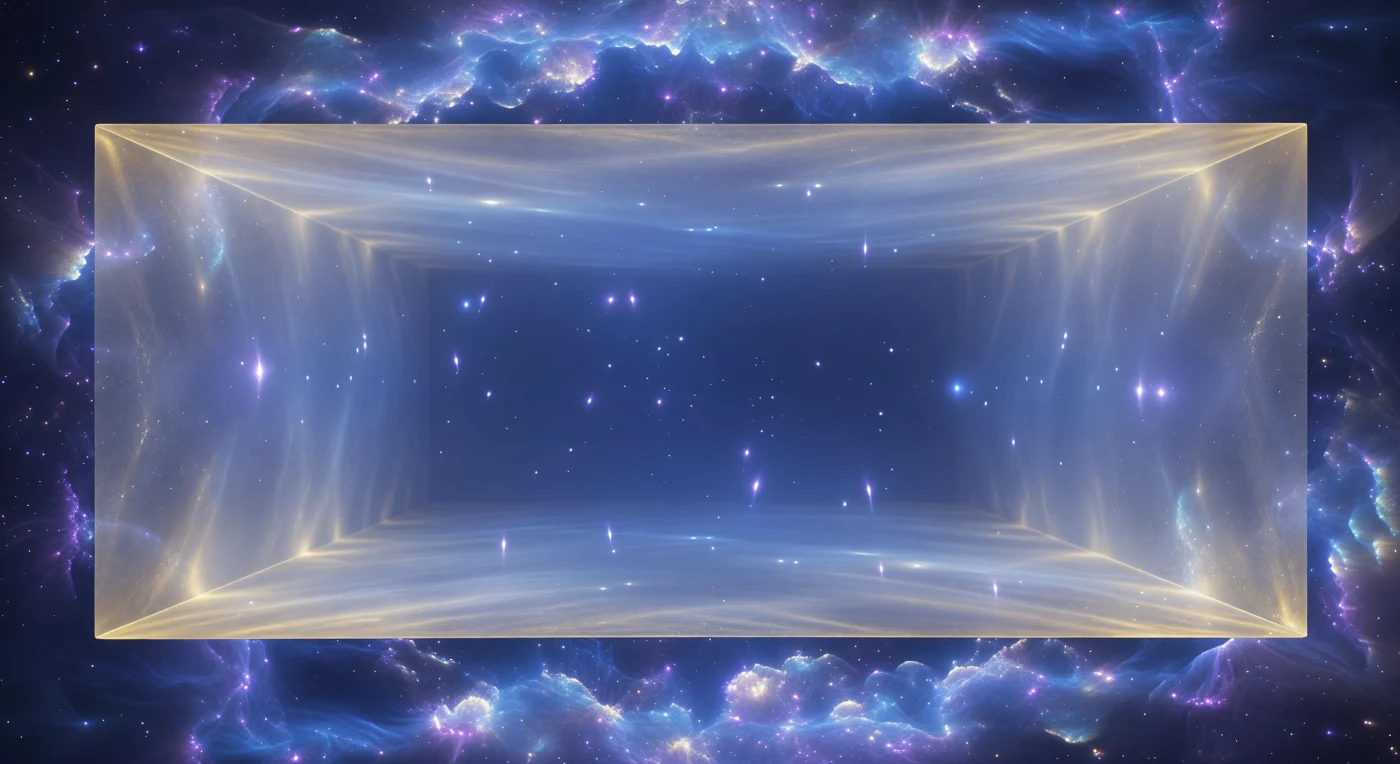
The viewer is suspended between two vast, semi-transparent conducting planes, where the gap itself feels like a narrow, cathedral-like void washed in deep indigo light. Inside this constrained vacuum, the background is noticeably darker and quieter than the flickering blue-violet field beyond, because boundary conditions suppress the longest-wavelength virtual photon modes. Small, truncated sparks of pale violet flare and die before they can fully form, leaving faint ghostly traces in the stillness, while the inner faces of the plates carry a soft blue-white glow that marks the measurable Casimir pressure. The result is an immersive contrast between an overactive quantum outside and an emptied, pressurized interior, as if the vacuum has been partially subtracted rather than filled.