Scientific confidence: High
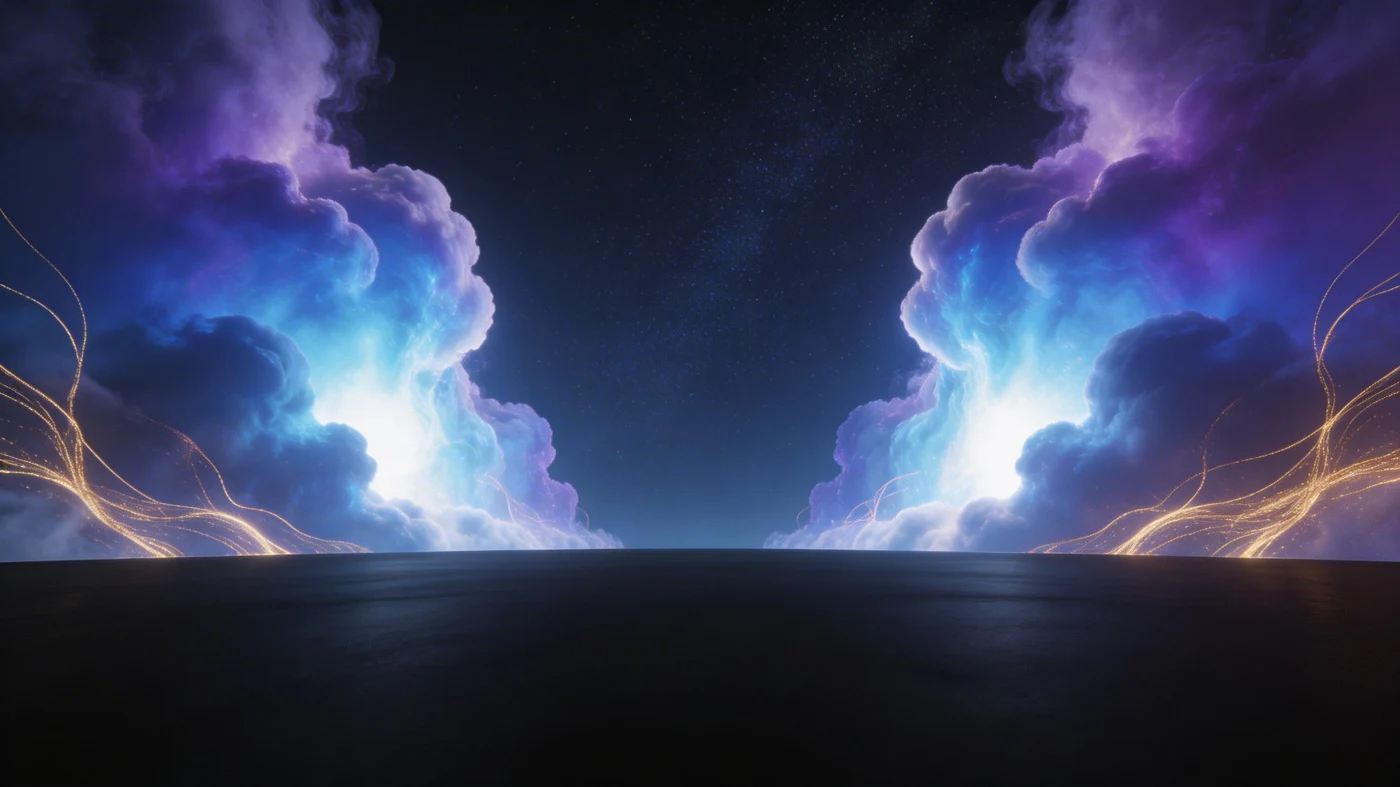
The viewer stands on a perfectly flat nodal plane where the hydrogen 2p orbital’s probability density falls to zero, rendered as a featureless black void that contains no matter and no measurable surface texture. On both sides, two towering lobes of electron cloud rise like mirrored mesas, their inner faces brightest where the wavefunction’s amplitude is greatest and their outer edges thinning into violet wisps as the probability fades toward zero. Fine gold filaments thread through the scene as Coulomb field lines from the unseen nucleus, emphasizing that this is not a solid landscape but a standing quantum pattern of charge and likelihood. The symmetry, stillness, and immense apparent scale make the empty plane feel like a forbidden boundary between regions of high electronic presence, suspended in a vacuum shaped by atomic forces.
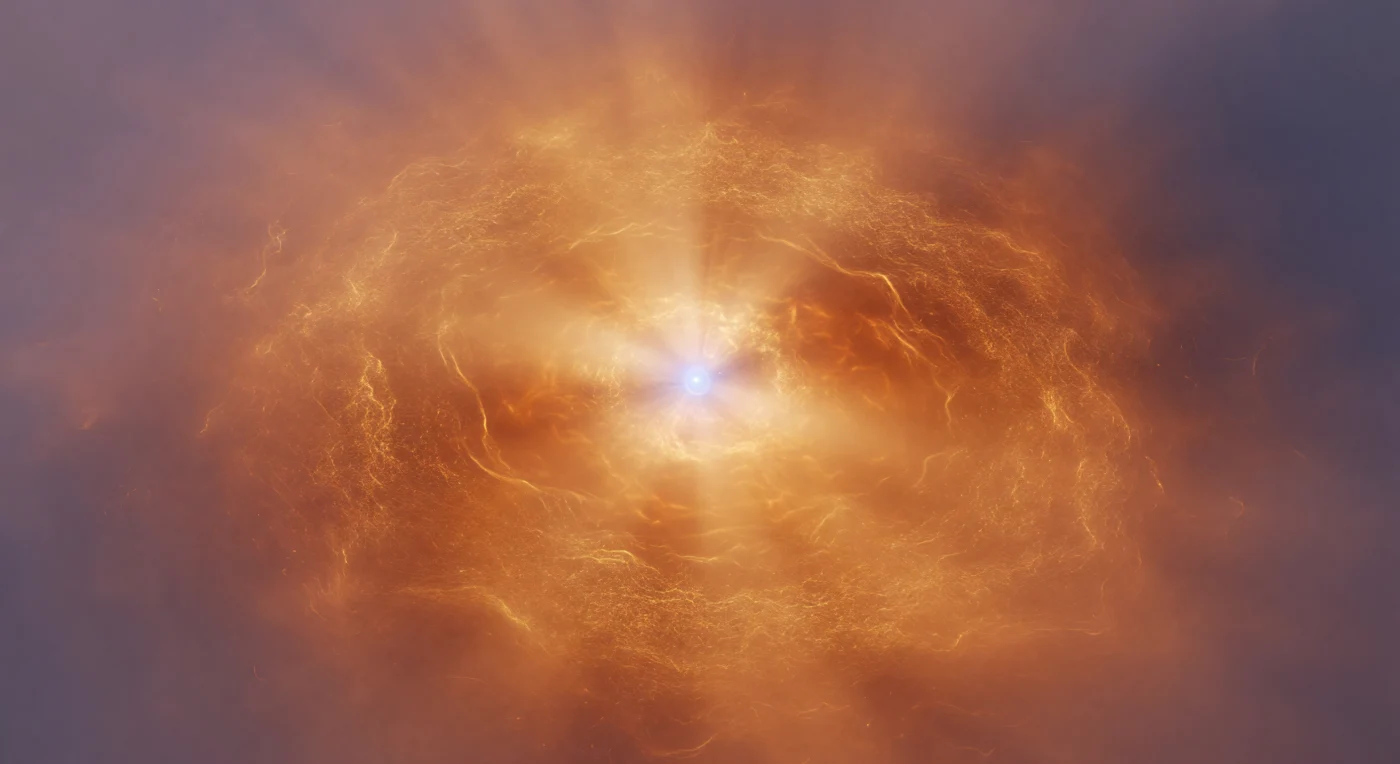
The viewer drifts inside a vast amber-gold probability cloud that thickens toward the center, as if suspended in heated glass lit from within. Below and ahead, the haze intensifies into molten orange-white around a blinding blue-white proton, while outward it thins through copper, burnt sienna, and violet-black emptiness at the edges. This is the hydrogen ground state made visible: not a solid shell, but a quantum field of electron probability with no hard boundary, textured by fine interference ripples and vacuum-like shimmer. The result feels both immense and intimate, a luminous, unstable interior where position is defined only by gradients of likelihood and electromagnetic force.
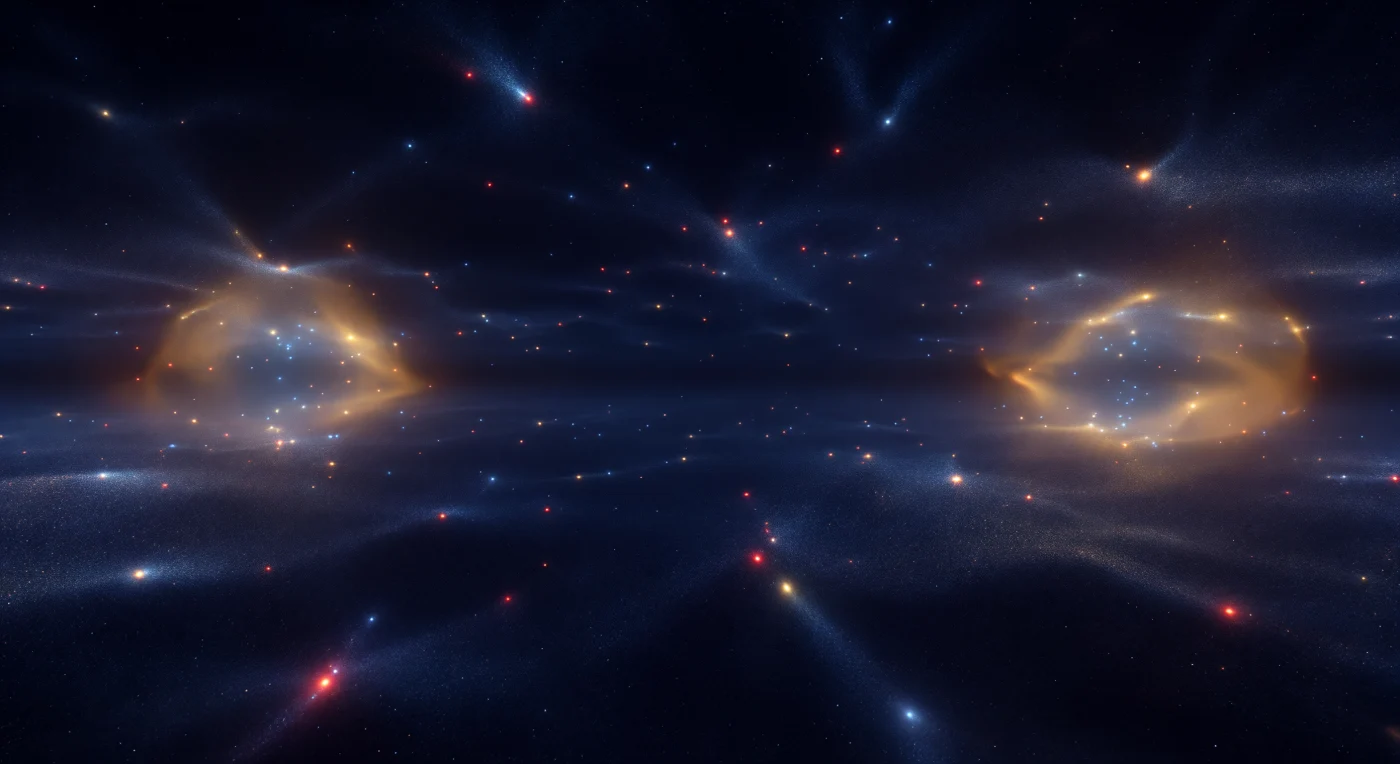
Floating in the vacuum between atoms, the viewer sees not emptiness but a deep sapphire-black field textured by a ceaseless glitter of quantum fluctuations, each tiny crimson-and-cyan flicker a virtual particle pair appearing and vanishing before it can be resolved. The darkness is not smooth; it has a fine grain, a living iridescence that reflects the restless activity of the electromagnetic field even in the absence of matter. Far away, two warm amber probability clouds glow on opposite horizons, not as solid objects but as broad regions of electron likelihood, their soft gradients revealing where an electron is more or less likely to be found. The result is an immense, silent immersion in which space itself feels active and alive, with scale conveyed by the vast distances to the nearest nuclei and the impossibly brief lifetime of every flash.
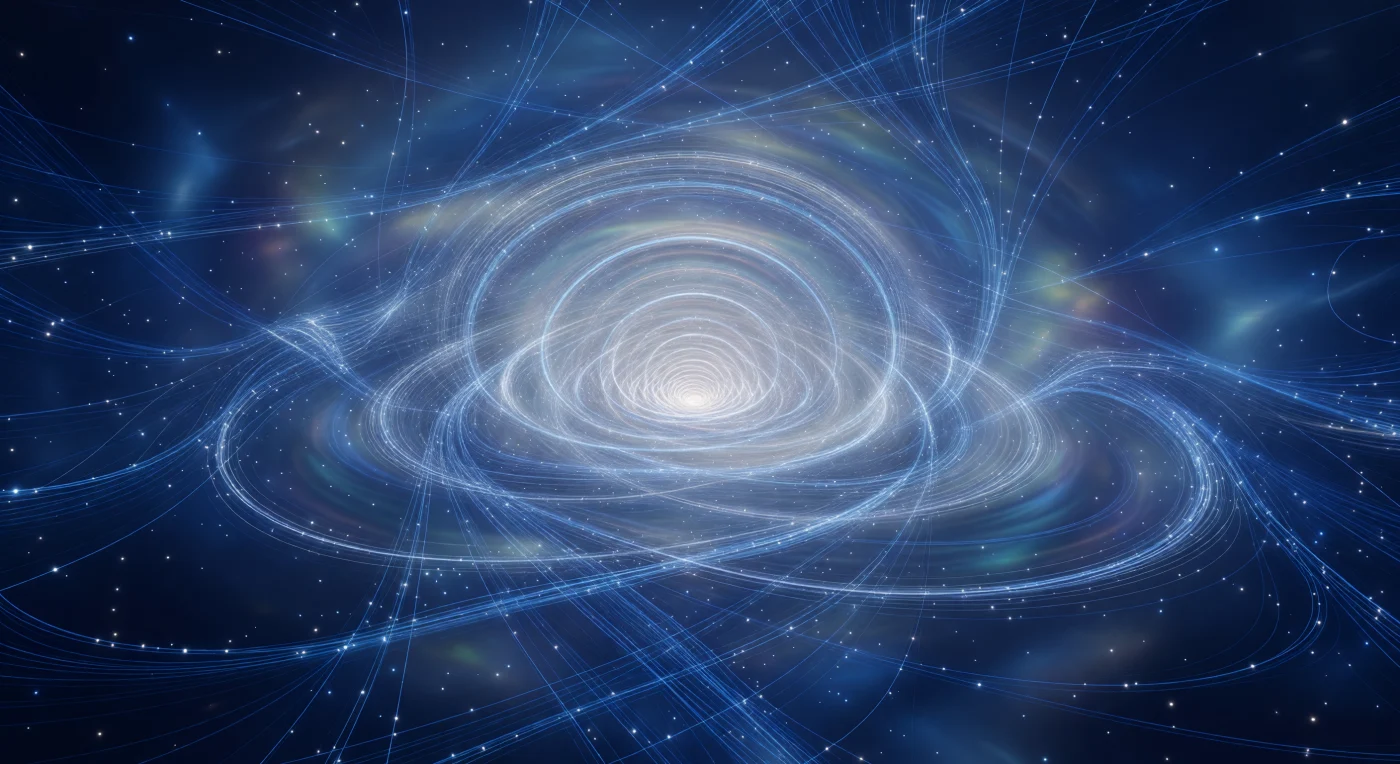
From a distance of one picometer — just below the Compton wavelength where quantum field theory fully supplants classical electrodynamics — the observer does not encounter an object so much as a phenomenon: a radial convergence of electromagnetic field lines pressing inward from every direction simultaneously, their density and curvature increasing without pause toward a center that refuses to resolve into any definable surface. These luminous cords, rendered visible here by sheer energy density rather than any conventional illumination, transition from sparse indigo filaments at the periphery through braided cerulean curtains at mid-range into a searing white-gold incandescence at the convergence point, tracing the Coulomb field of a particle whose experimental charge radius is bounded below 10⁻²² meters — effectively a mathematical point radiating an influence that warps the geometry of everything around it. Drifting through the inner zone, a faint opalescent shimmer marks the vacuum polarization plasma, where the field intensity is sufficient to briefly promote virtual electron-positron pairs out of the quantum vacuum on timescales of roughly 10⁻²¹ seconds, their collective presence softening the singularity into something almost atmospheric, a pearlescent aureole of interference color suspended in what classical physics would call empty space. There is no horizon, no ground, no sky — only a spherical storm of converging field geometry, the observer suspended at its center, surrounded by a medium that is simultaneously the hardest and softest thing conceivable: sharp fiber-optic filaments of quantized field intensity embedded in a volumetric haze of vacuum fluctuation, the whole scene frozen at a moment of absolute dynamic tension that is, in fact, eternal.
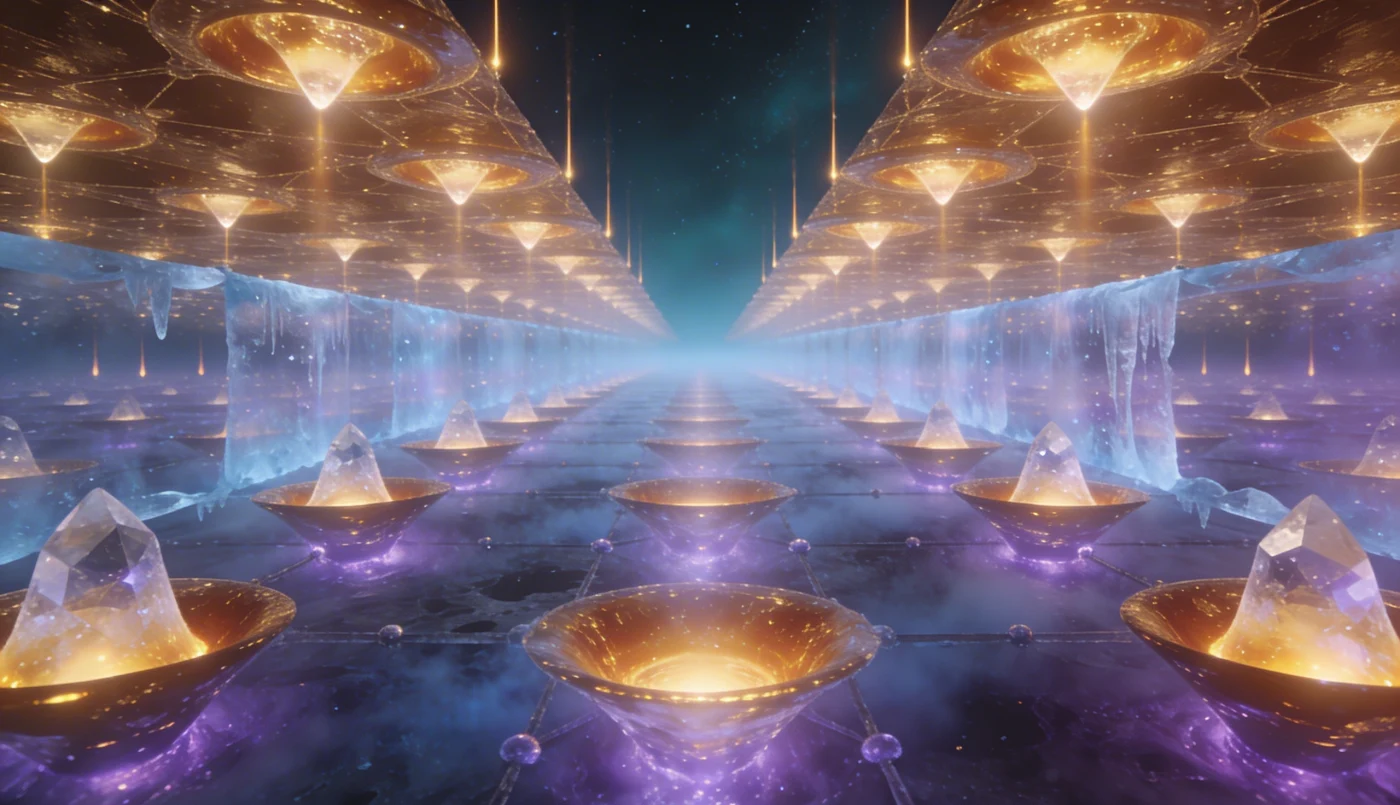
The viewer stands suspended within a copper crystal's interior, gazing across an infinite ordered plain of amber-gold potential wells that repeat with absolute geometric precision in every direction — each glowing cone descending into its own luminous throat, separated from the next by pale cerulean barriers like frozen curtains of aurora light, the entire lattice stretching to an imperceptible vanishing point 3.6 ångströms from one node to the next. This is the quantum mechanical reality of a Bloch wave electron at the Fermi energy: rather than residing at any single copper ion site, the electron exists as a coherent wavefunction smeared across the entire periodic crystal, its probability amplitude rising and falling in phase with the underlying ionic potential, obeying Bloch's theorem such that the wave carries a precise crystal momentum while inheriting the full translational symmetry of the lattice. The diffuse violet-indigo luminescence pooling heaviest at each lattice node is not metaphor but physics — the probability density |ψ|² genuinely concentrates near the positively charged copper ion cores, where electrostatic attraction deepens the potential wells, while thinning across the interstitial barriers where conduction electrons carry current as a collective quantum fluid. The gentle phonon breathing visible in the pulsing walls — each golden cone swelling and contracting by fractions — reflects the thermal oscillations of copper ions around their equilibrium positions at room temperature, quantized lattice vibrations that scatter Bloch electrons and give copper its finite electrical resistivity. To inhabit this scale is to dissolve into the mathematics of condensed matter: no fixed location, no classical trajectory, only a breathing interference pattern sustained across ten billion unit cells simultaneously.
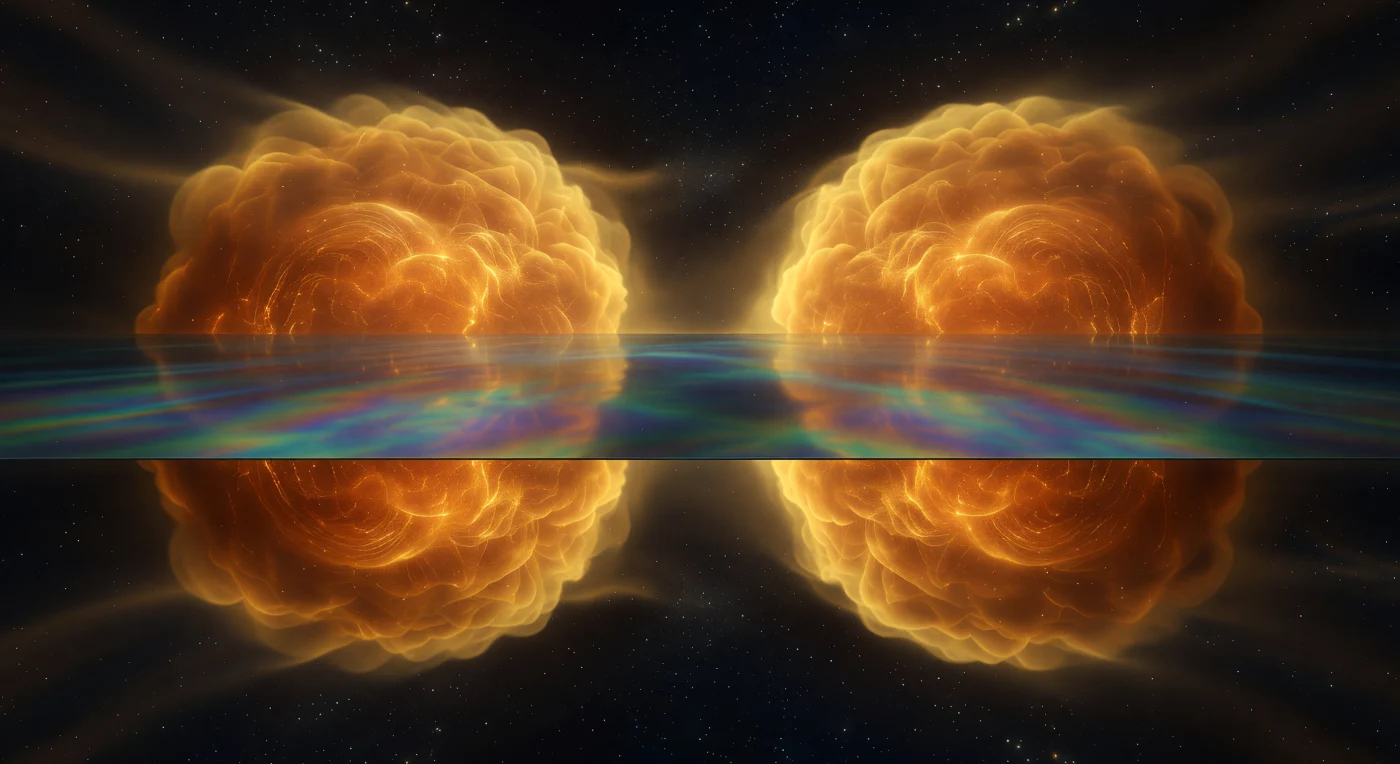
Directly before you, an obsidian plane bisects the universe with impossible authority — not built, not placed, but *enforced* by the antisymmetry requirement that governs all fermionic matter: two electrons sharing identical spin quantum numbers cannot occupy the same quantum state, and the geometry of this prohibition crystallizes here as a mirror-wall of absolute zero probability, its face cycling through peacock blues and bruised violets in cold iridescent waves, returning the warm amber light of each approaching electron cloud as something slightly diminished, slightly colder, as though the reflection has been taxed. From both horizons, vast honeyed formations breathe and pulse — their interiors shot through with threads of molten copper and burnt sienna, their outer edges dissolving into saffron probability fog — these are not particles in any classical sense but smeared excitations of the electron quantum field, each one a standing wave of amplitude whose density peaks at its luminous core and feathers outward into near-nothingness. The Pauli exclusion principle that erected this wall operates at the femtometer scale and below, where the quantum vacuum itself is not empty but alive with virtual pair fluctuations twinkling at attosecond intervals throughout the surrounding darkness, giving the void a phosphorescent inhabited depth. Both amber masses have already responded to the forbidden boundary by bunching and spreading laterally at their outer flanks, their inner faces retreating, leaving a ghostly penumbra of near-zero probability between themselves and the surface they cannot touch, cannot breach, cannot even approach without the antisymmetry condition evacuating all probability from the intervening space with surgical completeness. The scene holds in one breathless frozen instant — two luminous worlds permanently barred from convergence by the most fundamental geometric constraint written into the fabric of matter itself, a law that has no mechanism, no enforcement agent, no physicality beyond the cold mathematical fact that identical-spin fermions simply do not share territory.
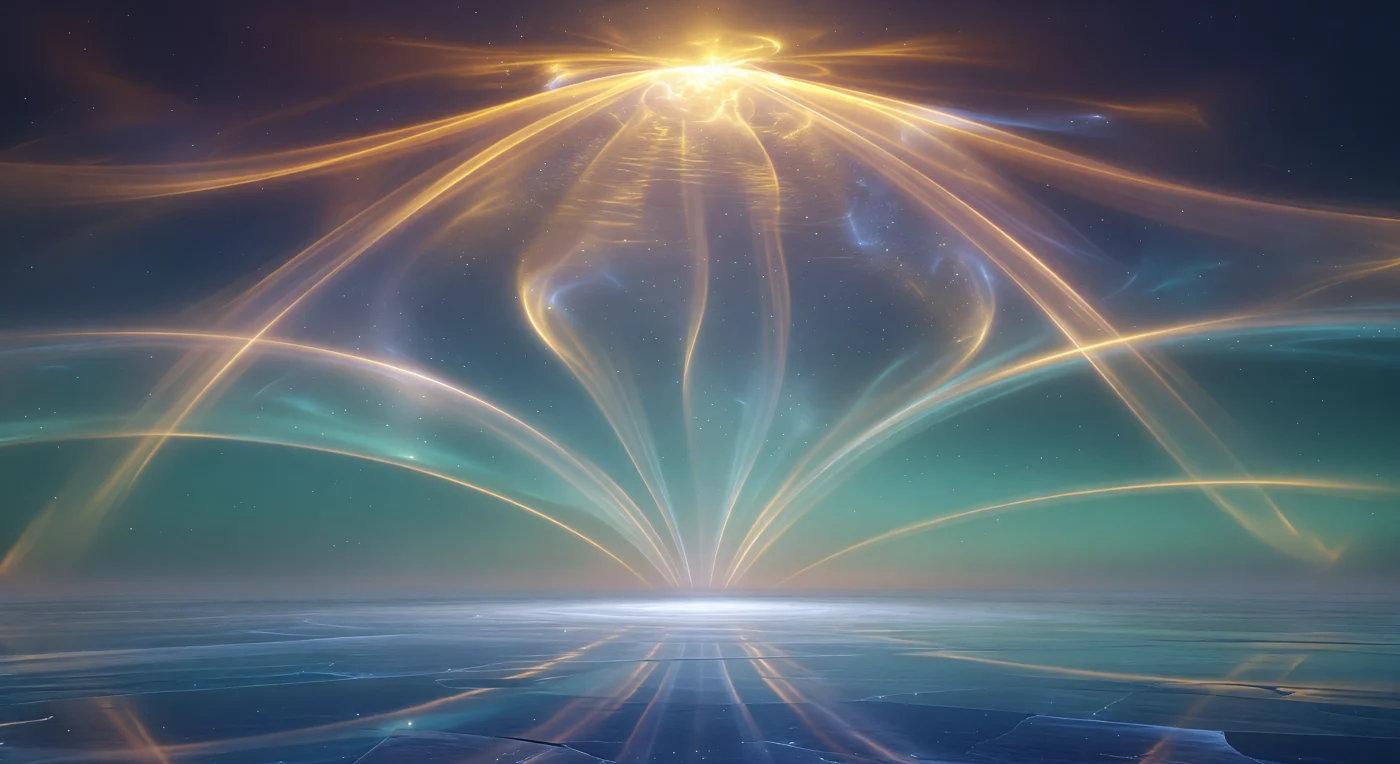
Standing at the magnetic pole of a single electron, the observer is enveloped in a blazing aureole of concentrated field energy — a crown of molten gold and white-hot incandescence directly overhead where the intrinsic magnetic dipole moment of the particle, a fixed quantum property arising from the electron's spin-½ nature with magnitude one Bohr magneton (9.274 × 10⁻²⁴ J/T), reaches its maximum field density. From this polar apex, luminous field-line arcs sweep outward in long parabolic ribbons through a cold aquamarine equatorial medium, their warm gold cooling through apricot and teal as field strength falls with distance, the line density faithfully encoding the dipole's 1/r³ geometry across a space measured in femtometers yet experienced here with the grandeur of a planetary magnetosphere. The vacuum between arcs is not empty but faintly opalescent — a phosphorescent quantum shimmer arising from the perpetual statistical churn of virtual particle pairs condensing and annihilating on zeptosecond timescales, leaving only a diffuse bioluminescent grain as their collective signature in the QED field. Below, the field lines converge again at the south pole into a quieter disc of pale silver-blue radiance, the geometry closing with the mathematical inevitability of a pure dipole, while a glassy indigo ground mirrors the entire arc architecture — gold zenith above, silver nadir below — in fractured panels that remind the observer that every surface at this scale is less a boundary than a probability amplitude caught mid-collapse.
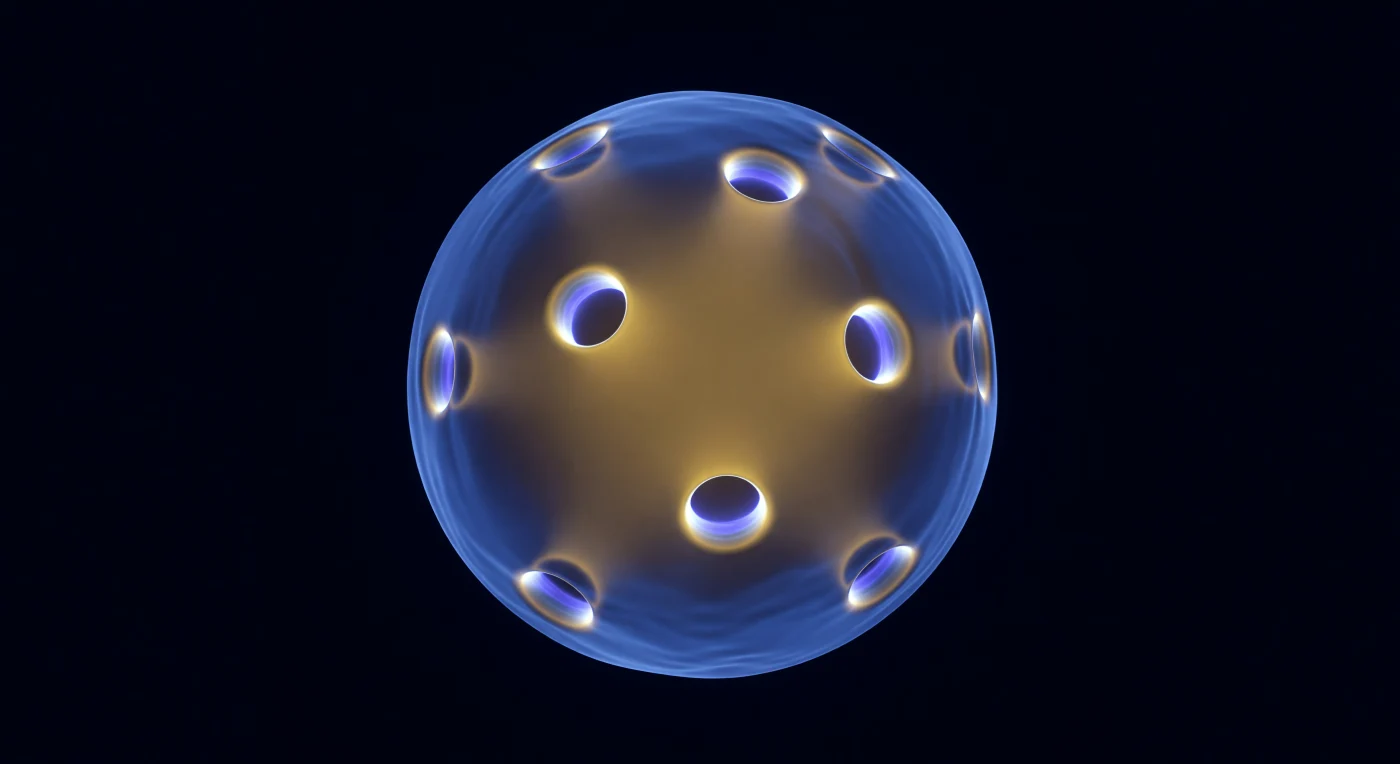
Before you hangs an object that should not exist in any space the eye knows how to read — a vast, self-luminous sphere of electric blue, hovering without support or shadow in a void that offers no reference, its glossy surface pressing outward with a slow, barely perceptible shimmer as though something enormous breathes within. This is the Fermi surface of copper, rendered not in physical space but in momentum space — a mathematical frontier separating occupied electron states from empty ones, made visible as a topological sculpture in k-space, where every point on the surface represents not a location but a quantum of motion. Eight perfectly circular necks puncture the sphere at precise geometric positions, each one a tunnel boring through into the neighboring Brillouin zone, their throats glowing from cool blue through violet into a white-hot rim where the topology tightens and electron transport concentrates with the authority of physical law. Through the translucent skin where the curvature grazes your angle of view, the interior radiates a warm amber-gold — the Fermi sea, all occupied momentum states packed below the threshold energy, their collective warmth bleeding outward to meet the cold blue of the surface in a narrow halo of greenish-white at every tunnel's edge. What you are witnessing is the quantum mechanical identity of conduction itself: copper conducts electricity the way it does precisely because this surface has this shape, these necks, this topology — a structure that exists nowhere you could point to, yet governs every spark and signal that has ever moved through the metal.
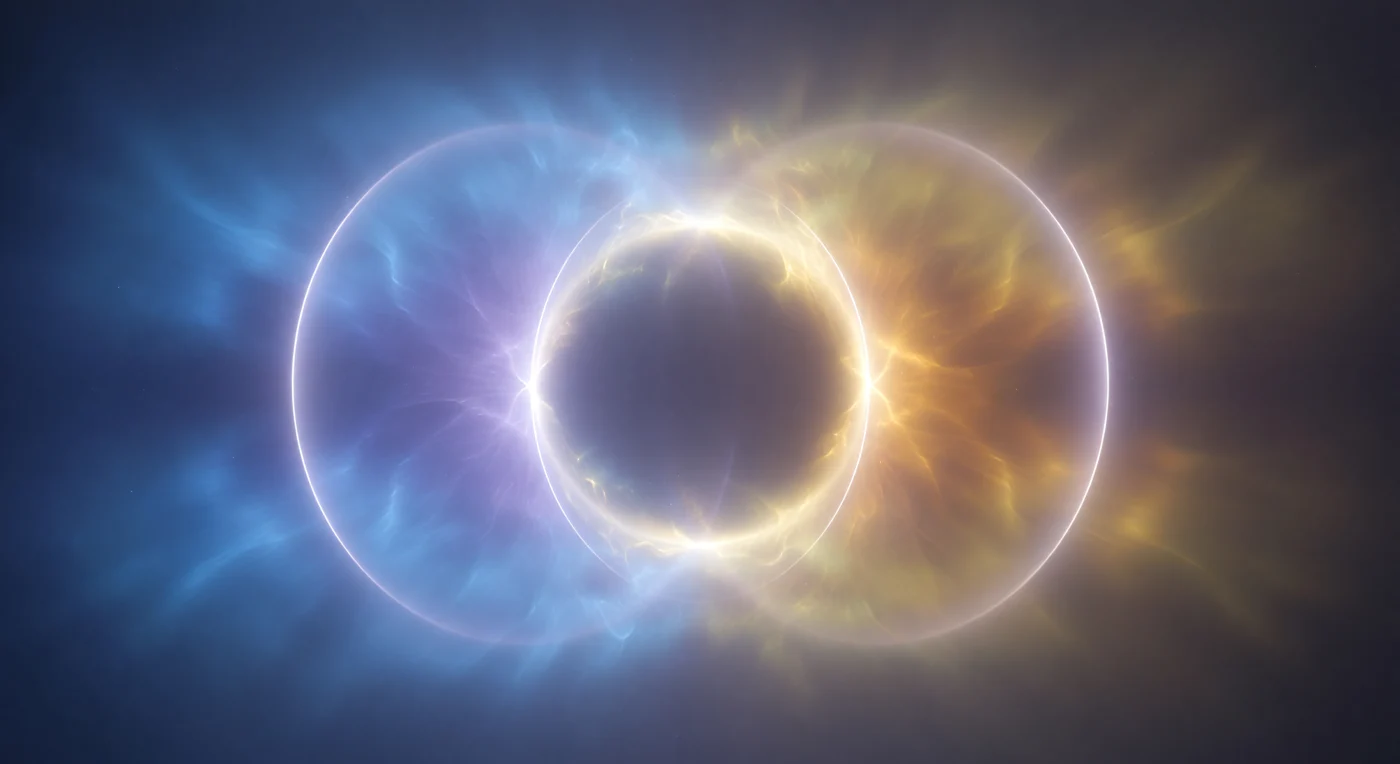
You stand suspended at the exact center of what was, an instant ago, a collision between two conjugate clouds of quantum probability — an electron and its antimatter twin, a positron, each a smeared excitation of the same underlying field but carrying opposite charge, opposite chirality, perfect mutual cancellation written into their structure from the beginning. The annihilation is not an explosion in any classical sense: it is a topological subtraction, a moment in which two field configurations of equal and opposite sign meet, interfere completely, and convert their combined rest-mass energy — 1.022 MeV total, exactly — into two gamma-ray photons emitted at 511 keV each, back-to-back, conserving momentum with a precision that brooks no deviation, because the laws enforcing it operate at the level of Lorentz symmetry itself. Those departing discs of gamma-white are not light in any familiar sense but hard photons whose wavelengths measure in picometers, propagating outward through a medium that is no longer a medium — the quantum vacuum behind them swept clean of the field gradients that the electron and positron carried, the electromagnetic stress-energy they embodied now translated entirely into radiation and gone. What lingers are the iridescent interference fringes of the residual vector potential, dying standing waves in the electromagnetic field that dissipate over attoseconds as the vacuum relaxes back to its ground state, its virtual-particle foam reasserting itself as a barely perceptible granularity — the only texture remaining in a space from which two entire particles have been permanently subtracted, leaving nothing but cold, structureless quantum emptiness and the receding light of their vanishing.
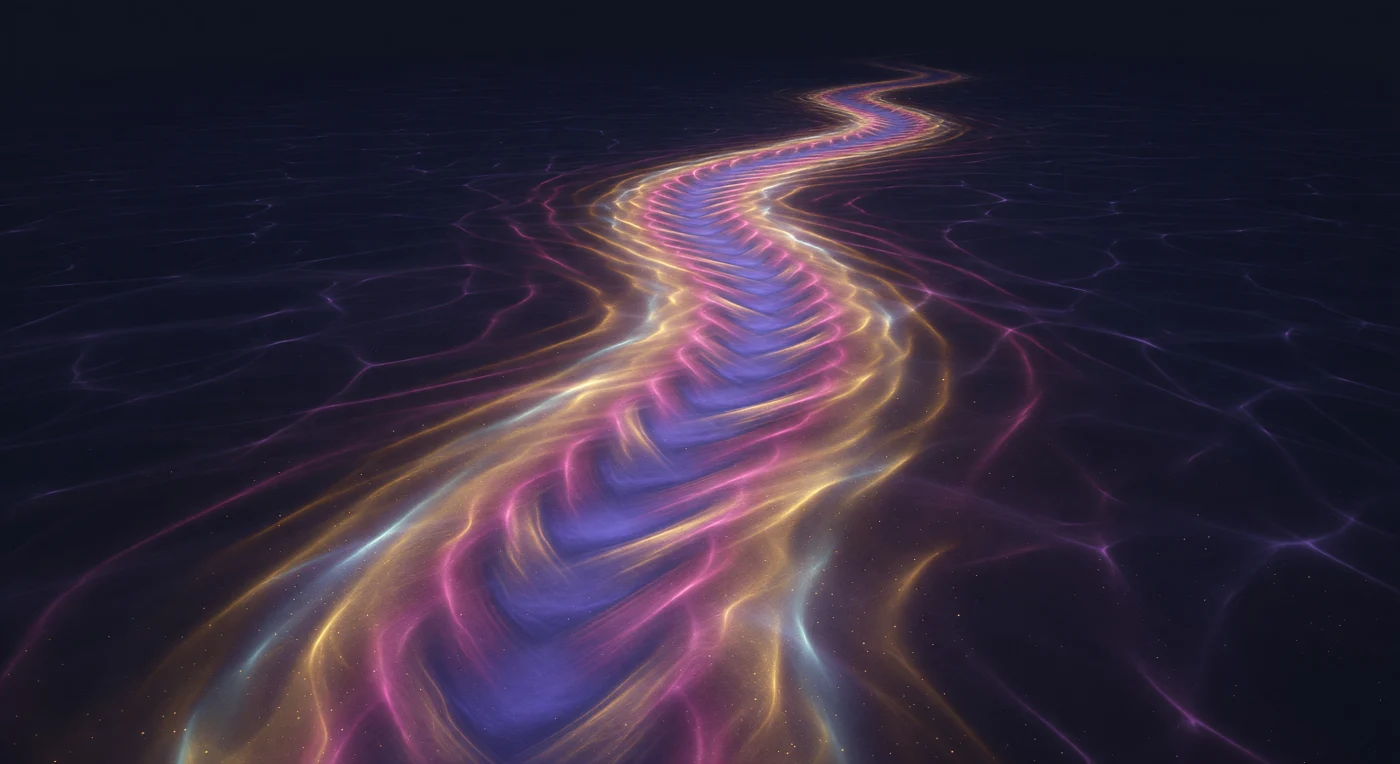
Ahead of you, stretching into a darkness that is not quite empty, a braided column of light winds through the quantum vacuum like a river of barely-contained energy — its cool violet core burning with the coherence of a mean trajectory, wrapped in churning bands of amber-gold and deep magenta that oscillate so rapidly their individual motion dissolves into a cylindrical halo of smeared brilliance. This is Zitterbewegung: the trembling motion predicted by Dirac's relativistic equation for a free electron, arising from the interference between positive and negative energy components of its spinor wavefunction, oscillating at a frequency near 10²¹ Hz — a timescale so compressed it falls far below anything attosecond laser pulses can yet resolve, leaving only the blurred penumbra you see as physical evidence of the faster order beneath. The ribbon's amplitude of trembling is not noise but geometry, its magnitude set precisely by the electron's Compton wavelength — roughly 2.43 × 10⁻¹² meters — the scale at which quantum field effects overwhelm any classical description of a trajectory. Around the ribbon, the surrounding vacuum is not still: a gossamer shimmer of pale gold motes appears and dissolves at the limits of perception, virtual pairs flickering through existence on zeptosecond timescales, agitated by the ribbon's oscillating field into soft concentric shells of warmth that fade outward through rose and deep violet into the cold, unperturbed indigo-black of the quantum ground state. What you witness is not a particle moving through space but a self-interference pattern — a luminous, inexhaustible signature of a point-like excitation whose position, momentum, and path are simultaneously more real and less resoluble than anything the classical world permits.
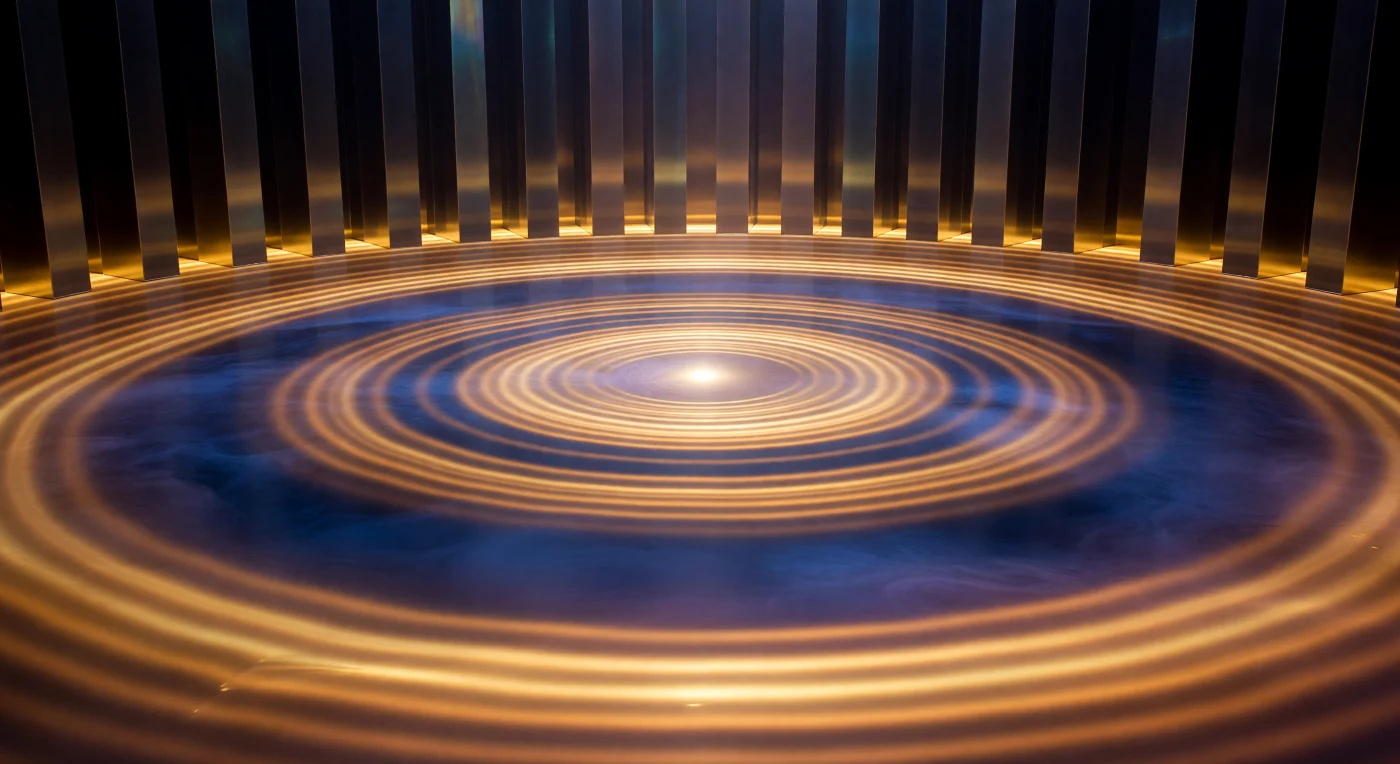
The observer stands inside a vast circular arena bounded by a ring of towering iron-atom monoliths, their cold graphite surfaces catching the upwelling glow from below as they close off the world in an unbroken obsidian rampart. Across the entire floor, concentric rings of standing probability density radiate outward from a blazing central node in perfect Bessel-function geometry — warm amber-gold crests raised like polished brass ridgelines alternating with deep cobalt-indigo troughs that absorb light as though filled with dark, still water. This is the quantum corral first imaged by Don Eigman and colleagues at IBM in 1993, a ring of 48 iron atoms positioned with atomic-force precision on a copper surface to confine surface-state electrons, whose probability density self-organizes into exactly these interference fringes — not a metaphor, but a direct topographic map of the electron wavefunction rendered visible by a scanning tunneling microscope. The rings broaden and breathe near the center, then tighten and compress toward the enclosing wall where the wavefunction rebounds from the iron boundary and reinforces itself, crowding into a fine-banded collar of alternating fire and shadow. A topaz-tinted haze hangs at knee height across the interior, densest above the amber crests where the electron is most likely to be found, thinning to near-invisibility above the troughs — probability made luminous, confinement made cathedral.
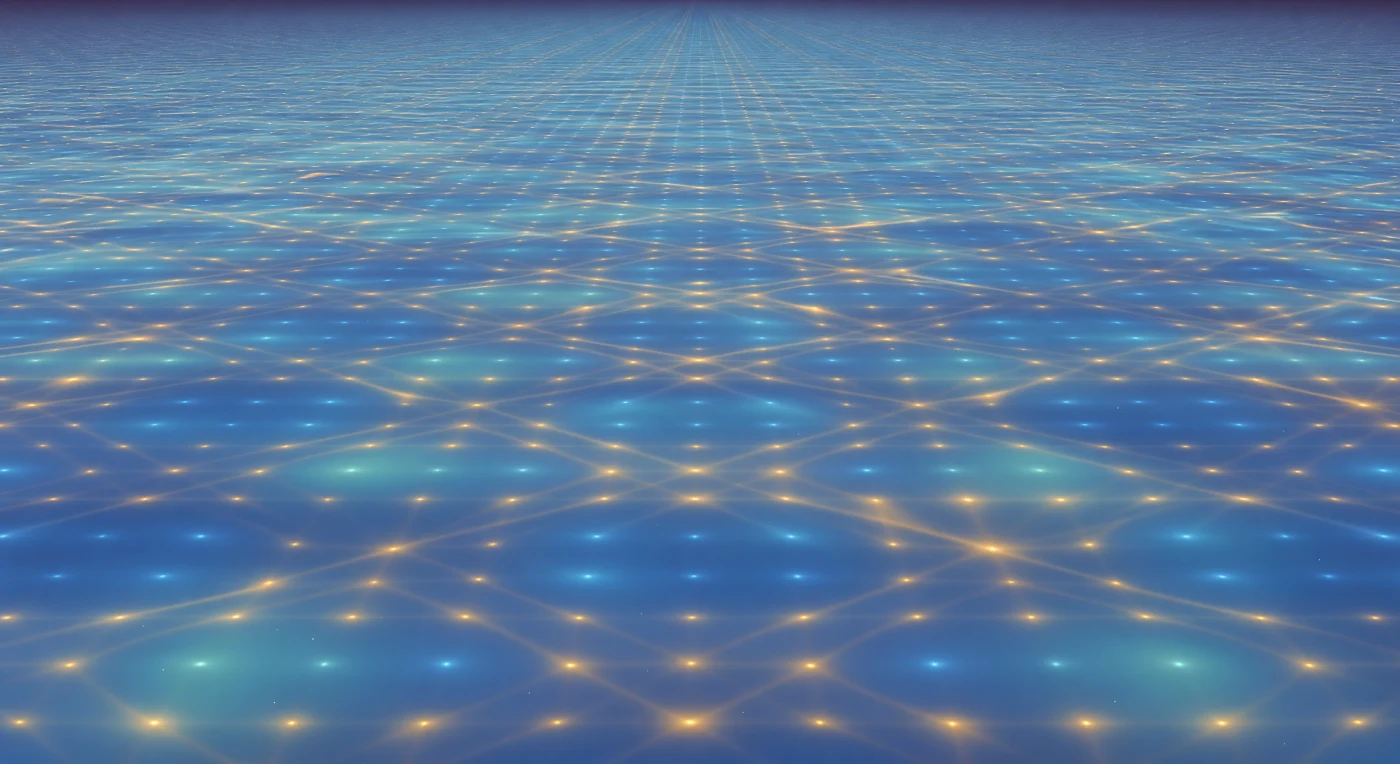
The view from within this place offers no horizon in any ordinary sense — only an unbroken expanse of self-luminous sapphire fluid extending equally in every direction, glowing not because light falls upon it from outside but because coherence itself is the source, the medium, and the message. This is the BCS condensate: billions upon billions of electrons paired by lattice phonons into Cooper pairs, surrendering their individual quantum identities to participate in a single macroscopic wavefunction that spans the entire niobium crystal without interruption or decay. The slow color drift overhead — cobalt deepening through aquamarine into indigo — is not an optical trick but the visible signature of a global phase, the same quantum phase rotating uniformly across distances measured in coherence lengths, each spanning hundreds of nanometers yet feeling here like continental shelves of pure probability. Embedded in the luminous blue, the ionic lattice announces itself as warm amber-gold nodes pulsing with phonon vibrations — the very vibrations responsible for mediating the attractive interaction between paired electrons, those gentle sinusoidal compressions threading through the scaffold like a slow mechanical breath that paradoxically sustains rather than disrupts the coherent sea around them. Nothing flows here with friction; nothing scatters, nothing dissipates — the condensate accommodates the lattice's heartbeat and closes around it without a ripple, a state of quantum matter so profoundly ordered that resistance, in any classical sense, has ceased to be a meaningful concept.
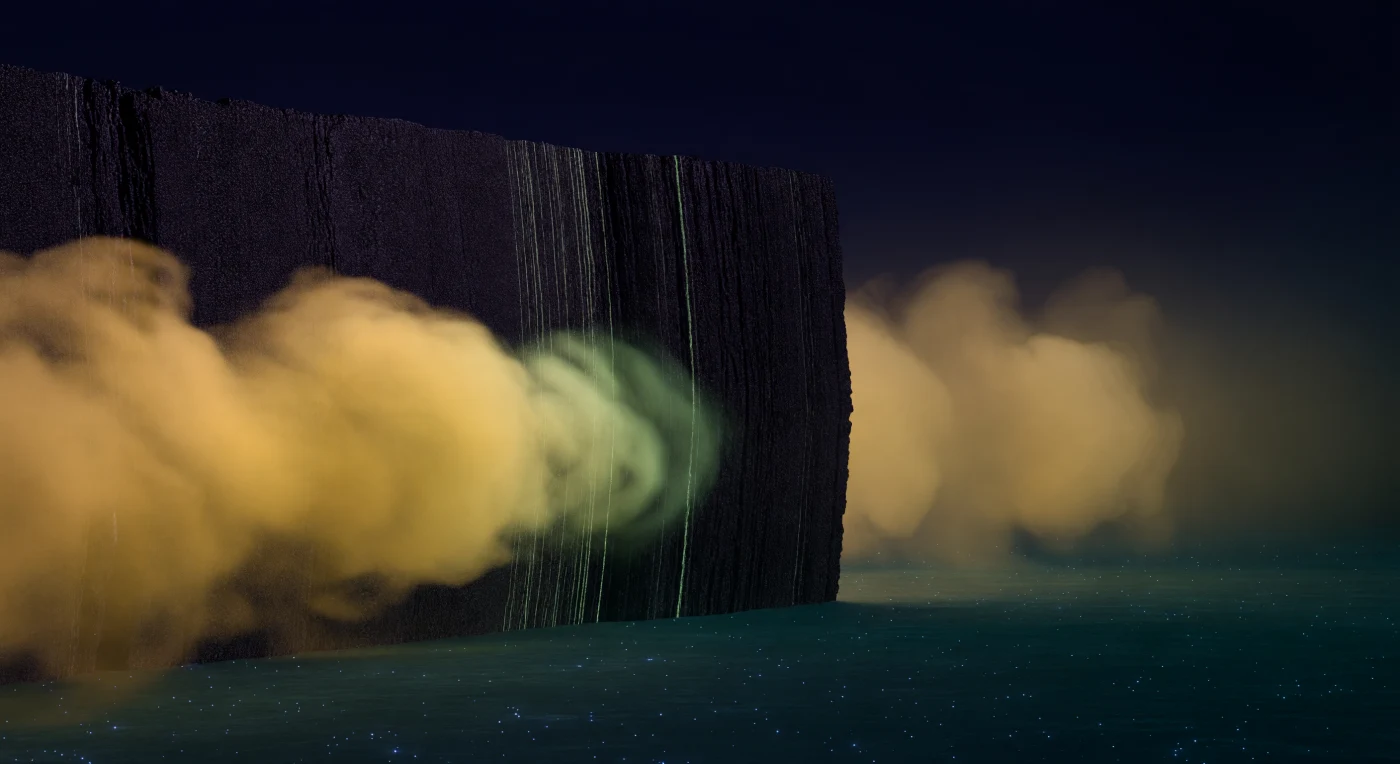
A sheer wall of compressed potential energy fills the left horizon, rising without summit into absolute indigo-black — not a surface in any geological sense, but the materialized form of a classically forbidden barrier, where quantum mechanics dictates that no particle following classical rules has any right to exist. Yet from the left, a warm amber-gold probability fog rolls in slow coherent billows and strikes the face of the barrier, and something extraordinary happens at the threshold: a pale chartreuse evanescent tail pushes fractionally into the obsidian interior, its brightness halving, then halving again with each unit of depth — an exponential extinction not of light being blocked, but of quantum amplitude genuinely collapsing, the wavefunction decaying as it penetrates a region where its kinetic energy has, in classical terms, gone negative. This is quantum tunneling rendered as landscape: the electron does not go over or around the barrier, it dissolves partially into it, maintained only by the non-zero overlap between its probability amplitude and the far side, and on that far side — quieter, cooler, dimmed — a reconstructed amber-ochre mist drifts into open vacuum, unmistakably the same wavefunction, ghosted down by the transmission penalty. The luminance difference between the blazing incoming fog and the hushed transmitted haze is not aesthetic — it encodes the tunneling probability directly, the same mathematics underlying scanning tunneling microscopy, nuclear alpha decay, and the hydrogen fusion that powers stars.
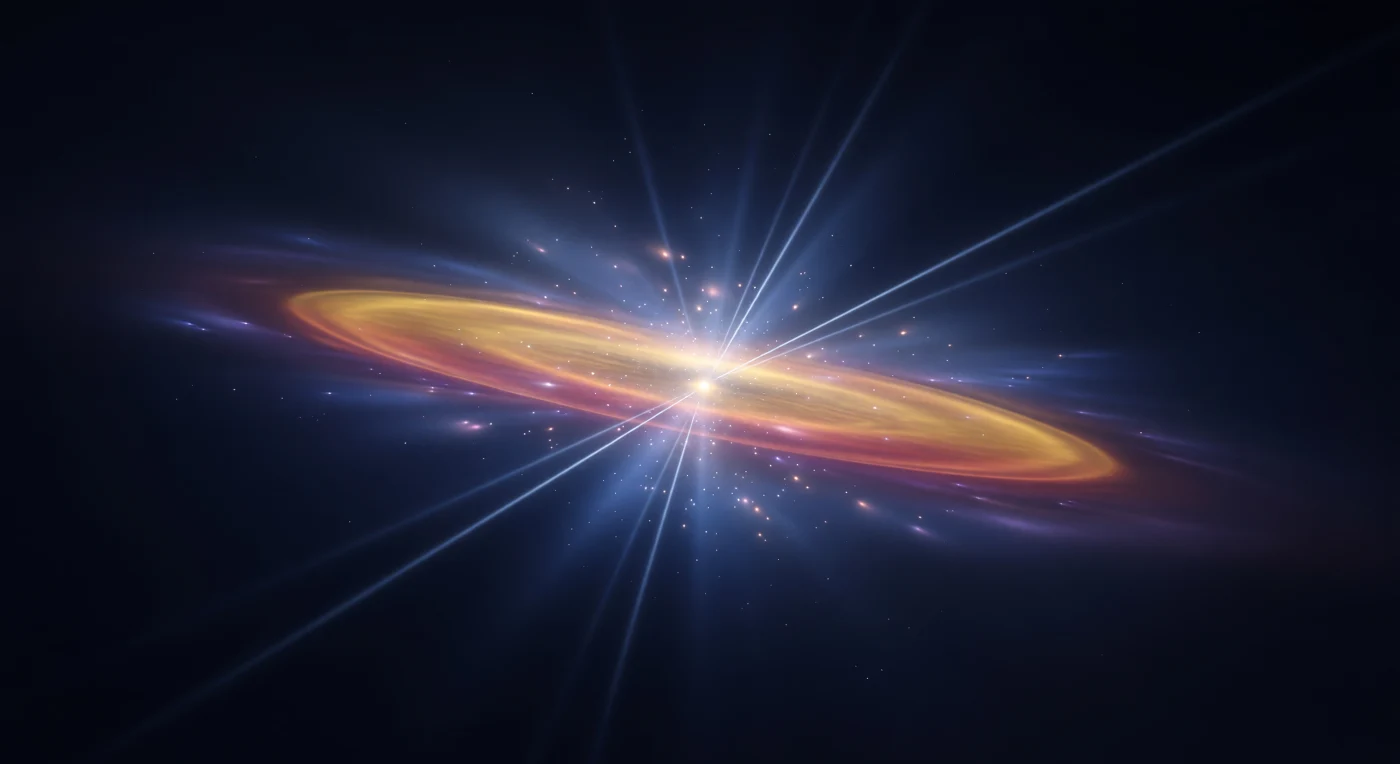
You are suspended at the precise center of a Møller scattering event — the quantum electrodynamic collision of two relativistic electrons — in a domain where distance is measured in femtometers and the relevant timescale collapses below a single attosecond. From opposite directions, two Lorentz-contracted electrons bear down as flattened discs of amber-violet luminosity, their probability densities pancaked by relativistic momentum into membranes of near-zero thickness, their leading faces building an electromagnetic field pressure so extreme that the intervening vacuum briefly ghosts with transient blooms of virtual pair creation — the quantum field's own threshold response, rose and violet specks blinking into nonexistence before they can stabilize. The vertex ignites: a mathematically dimensionless point erupting into a white-gold nucleus of pure incandescence, its halo expanding through copper and crimson as the two electrons scatter wide, their departure marked by thin, crystalline Bremsstrahlung beams lancing outward — photon radiation shed by charges deflected through an intense electromagnetic interaction, each beam a precise column of cool blue-white light cutting the surrounding quantum field darkness at clean scattering angles. What remains is a slowly dimming golden ember at the empty vertex, the vacuum around it still textured with faint blue-violet undulations — field fluctuations not yet settled back to ground state — a reminder that at this scale, the space between events is never truly empty, only momentarily quiet.
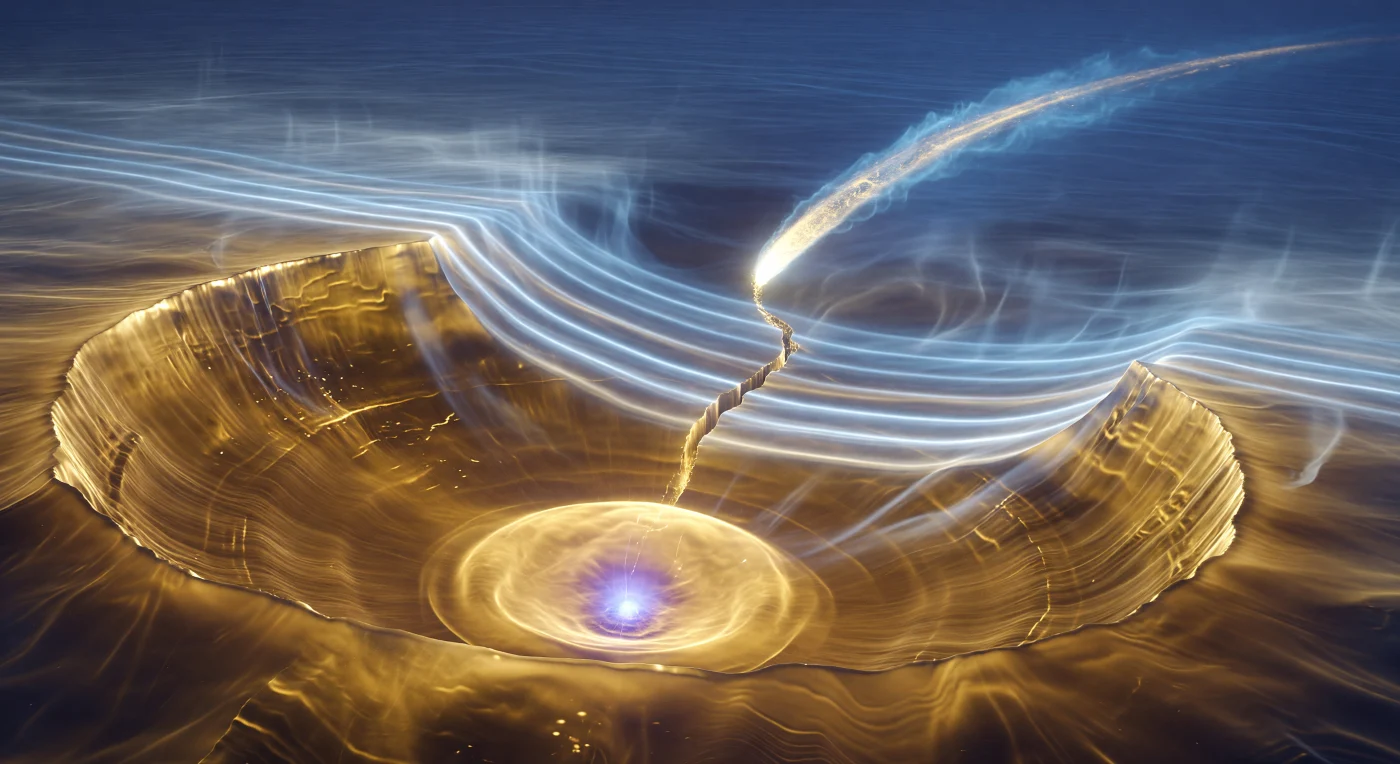
At the bottom of this immense electromagnetic crater, a searing white-blue pinpoint burns at the nadir of a bowl-shaped potential well — this is the nucleus, its Coulomb field sculpted into the amber-gold walls that rise around it like terraced cliffs of frozen probability density. An intense laser field has grotesquely asymmetrized what was once a symmetric confinement: one wall of the well has been dragged downward into a long descending ramp, its surface layered with cold blue-white compression bands that pulse in slow cycles, the visual signature of the laser's oscillating electric force tilting the potential landscape until the barrier height on one side falls below the energy of the bound electron. Through the breach in that rim, the electron's probability cloud — normally a sealed amber hemisphere hugging the nuclear singularity — pours outward as a luminous gold rivulet, accelerating down the ramp and stretching into a comet tail that cools from rich amber through pale champagne into ghostly cyan filaments dissolving into the indigo quantum vacuum beyond. This is tunnel ionization driven to its classical over-the-barrier limit, the physical mechanism underlying attosecond science: when laser intensities exceed roughly 10¹⁴ watts per square centimeter, the suppressed Coulomb barrier allows the electron wavepacket to escape on timescales shorter than a single optical half-cycle, launching a free wavepacket whose subsequent recollision with the parent ion generates the extreme-ultraviolet bursts that now allow physicists to photograph electronic motion in real time. The entire rupture — barrier suppression, escape, and wavepacket stretching — unfolds across distances measured in fractions of a nanometer and timescales of tens to hundreds of attoseconds, a world where quantum probability and classical force momentarily negotiate the boundary between confinement and freedom.