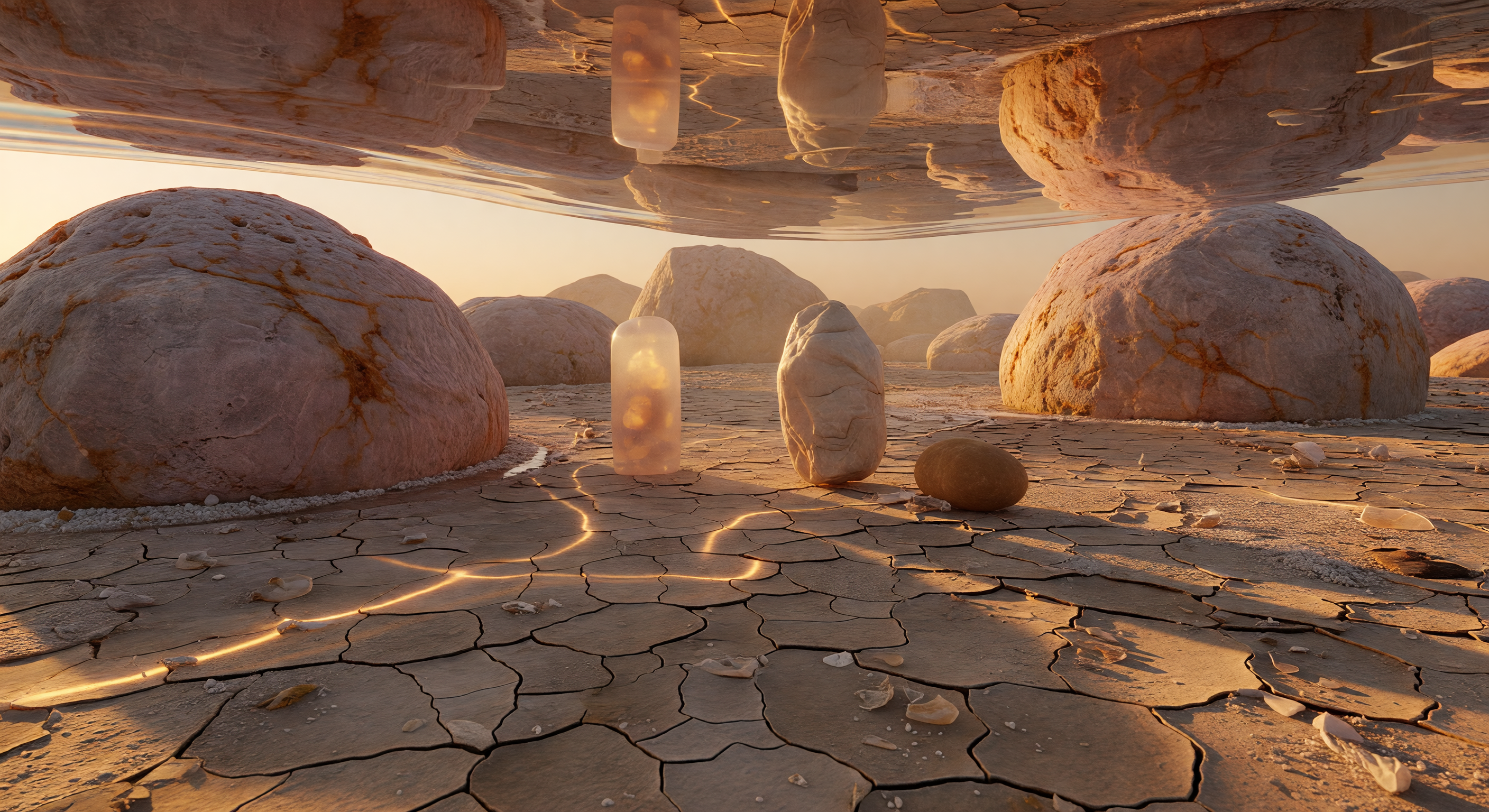
At the edge of the retreating water film, you stand among catastrophe rendered in slow motion — the air-water interface curves overhead like a collapsing vault of flexible glass, bowing downward under its own surface tension while caustic gold lines drift across the mineral plain below where the meniscus has already pulled free and left its salt tide-marks behind. The quartz grains rise around you as rose-gray monoliths streaked with iron oxide, their surfaces pitted and warm in raking amber light that carves hard shadows into ravines between them, a terrain of pure mineral indifference. Three bdelloid rotifers occupy the middle distance in successive stages of anhydrobiotic tun formation: the first still a translucent cylinder with its germovitellarium glowing amber through the body wall, the second already folded into a matte, wrinkled opacity as its syncytium contracts and its body shortens, the third now a compact ellipsoid nested between grains — indistinguishable from mineral detritus, its metabolic machinery idled to near-zero, patient as stone. At this scale, where Reynolds numbers drop toward unity and surface tension governs everything inertia once ruled, desiccation is not death but a controlled retraction of the self into an architecture that can wait out geological time, encased in trehalose and protein glass, while the mirror above continues its slow, absolute descent.
Other languages
- Français: Apocalypse de Dessiccation
- Español: Apocalipsis de Formación Tun
- Português: Apocalipse da Formação Tun
- Deutsch: Apokalypse der Eintrocknung
- العربية: نهاية تشكّل الكيس
- हिन्दी: टन निर्माण प्रलय
- 日本語: 乾眠形成の黙示録
- 한국어: 툰 형성의 묵시록
- Italiano: Apocalisse della Disidratazione
- Nederlands: Apocalyps van Indroging