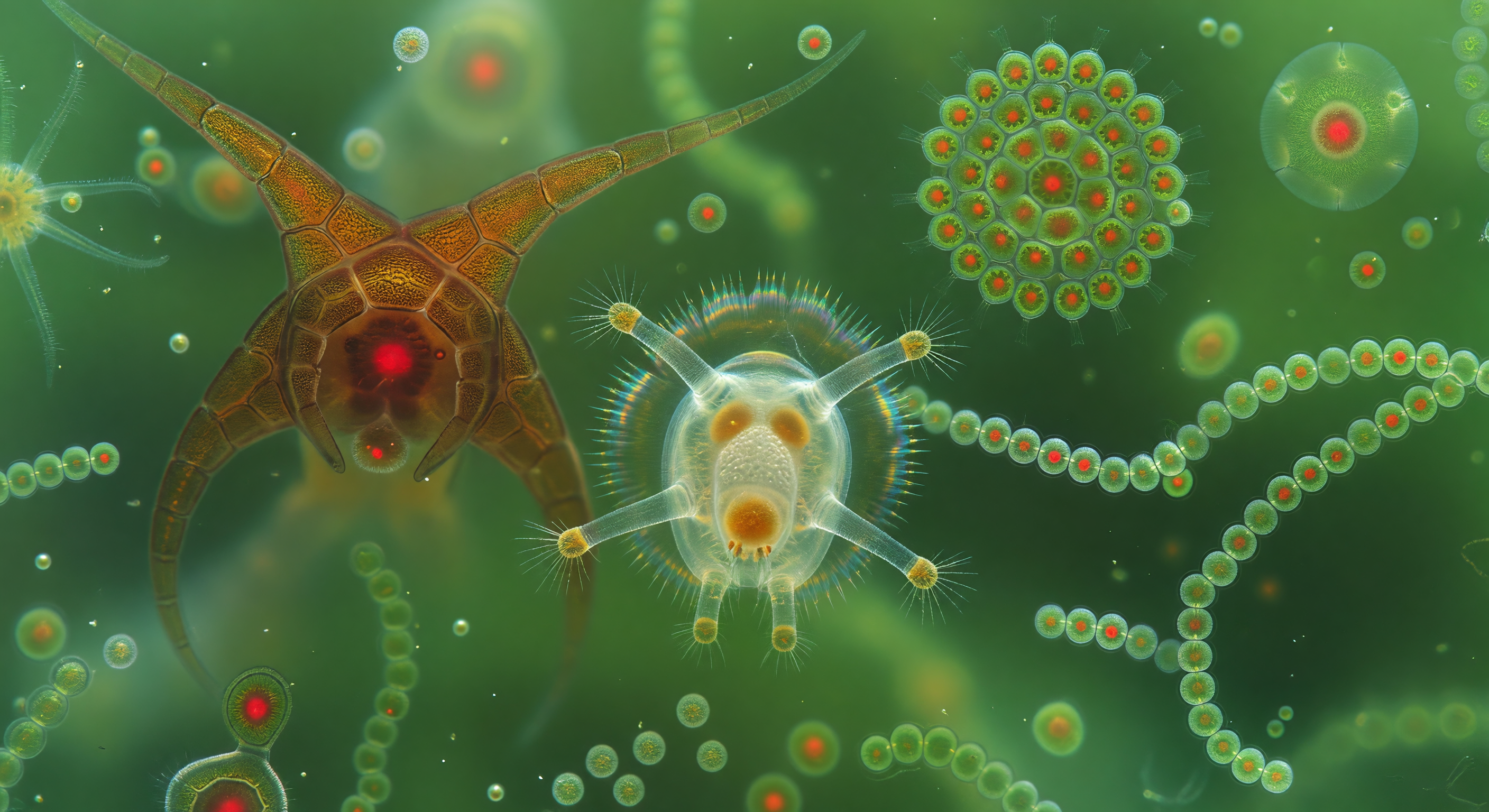
You drift forward through water that has become something other than water — a luminous suspension so saturated with photosynthetic bodies that light no longer travels through it so much as inhabits it, the jade glow arriving from everywhere at once as chlorophyll-dense cells scatter and re-emit every photon that descends from the surface twenty centimeters above. Directly ahead, a *Synchaeta* rotifer perhaps four hundred micrometers long fills the near field, its conical body a lens of living glass through which amber digestive organs and a pale germovitellarium are plainly visible, the mastax at its throat clenching rhythmically as four great auricle extensions reach forward into the medium, each tipped with trembling gold-white ciliary tufts that read the pressure field of this dense world like antennae tuned to frequencies we cannot sense. To the left, a *Ceratium* dinoflagellate presents its baroque triple-horned architecture — interlocking amber cellulose thecal plates etched with reticulate sculpture, its interior burning with a deep crimson autofluorescence where stacked chloroplast membranes conduct their photochemistry — while to the right a *Pediastrum* colony hovers like a hexagonal stained-glass window, each tessellated cell a small green lantern with its own crimson ember, the whole structure backlit by diffuse viridian light. Below it, *Anabaena* filaments drift in slow loops, each bead of jade-translucent cytoplasm carrying that same internal red glow, the chains moving through a medium so viscous at this scale that stopping is instantaneous and every stroke of every cilium must be earned against the resistance of water that feels nothing like water.
Other languages
- Français: Synchaeta dans la Nébuleuse Phytoplancton
- Español: Synchaeta en Nebulosa Fitoplanctónica
- Português: Synchaeta na Nebulosa Fitoplanctônica
- Deutsch: Synchaeta im Phytoplankton-Nebel
- العربية: سينكيتا في سديم العوالق النباتية
- हिन्दी: फाइटोप्लैंकटन नेबुला में सिंकेटा
- 日本語: 植物プランクトン星雲のシンケータ
- 한국어: 식물플랑크톤 성운의 신카에타
- Italiano: Synchaeta nella Nebulosa Fitoplanctonica
- Nederlands: Synchaeta in Fytoplankton Nevel