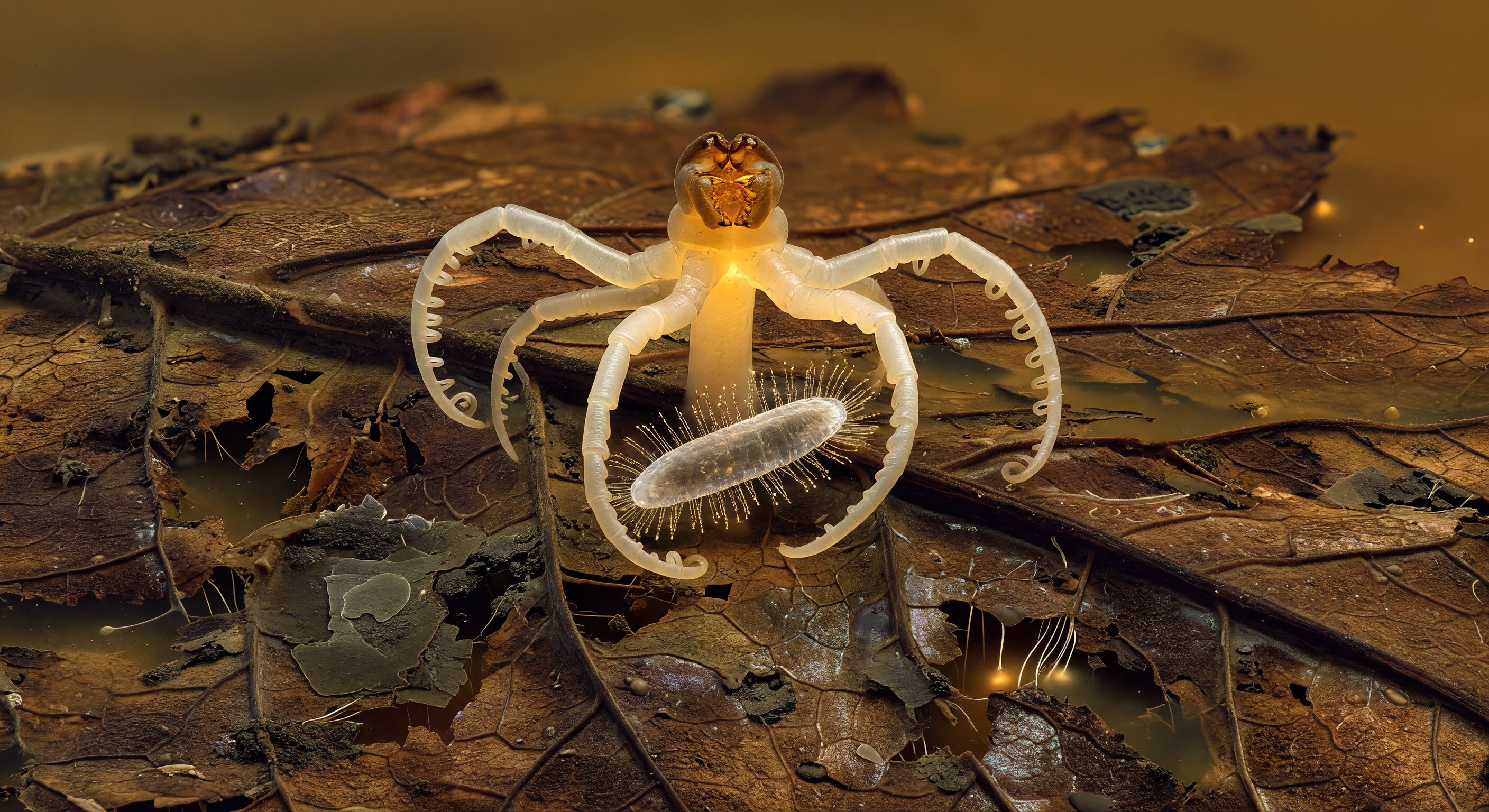
You hover just above the surface of a decomposing alder leaf, your entire field of view filled with a ruined landscape of cellulose — massive interlocking fiber bundles in deep chocolate and burnt umber, their fraying edges dissolving into translucent filaments where bacterial decomposition has softened the once-rigid wall structure, everything bathed in the warm sepia light of tannin-stained water filtering down from above like amber through stained glass. Rising before you from a cracked cellulose ridge is a single *Stephanoceros fimbriatus*, its gelatinous stalk glowing honey-amber with transmitted light, its five spirally-coiled ivory arms spanning roughly the width of a coarse sand grain — yet from within that span the cage they form reads as something architectural, a vaulted predatory cathedral whose curving members are already closing around a struggling ciliate whose surface still fires thousands of silver-bright cilia in frantic, futile motion. Inside the swollen body at the stalk's crown, the mastax — a compact geometric jaw apparatus capable of striking in milliseconds — is visibly tensed, its interlocking elements pressed together in the attitude of imminent action, while the ciliate's flexible pellicle already shows soft divots where two arms have made first contact. This is a world governed entirely by viscosity rather than inertia, where water moves like glycerol, momentum is meaningless, and every structure from the iridescent bacterial biofilms coating the fiber valleys to the amber glow of a predator's stalk exists at a scale where a human hair would loom as a massive cylindrical column overhead.
Other languages
- Français: La Cage de Stephanoceros Se Referme
- Español: Jaula de Stephanoceros Atrapa su Presa
- Português: Gaiola de Stephanoceros Fecha sobre a Presa
- Deutsch: Stephanoceros Käfig Schließt sich
- العربية: قفص ستيفانوسيروس يطبق على الفريسة
- हिन्दी: स्टेफेनोसेरोस का पिंजरा शिकार पकड़ता है
- 日本語: ステファノセロスの檻が獲物を捕らえる
- 한국어: 스테파노세로스 우리가 먹이를 가둔다
- Italiano: La Gabbia di Stephanoceros Cattura la Preda
- Nederlands: Stephanoceros Kooi Sluit om Prooi