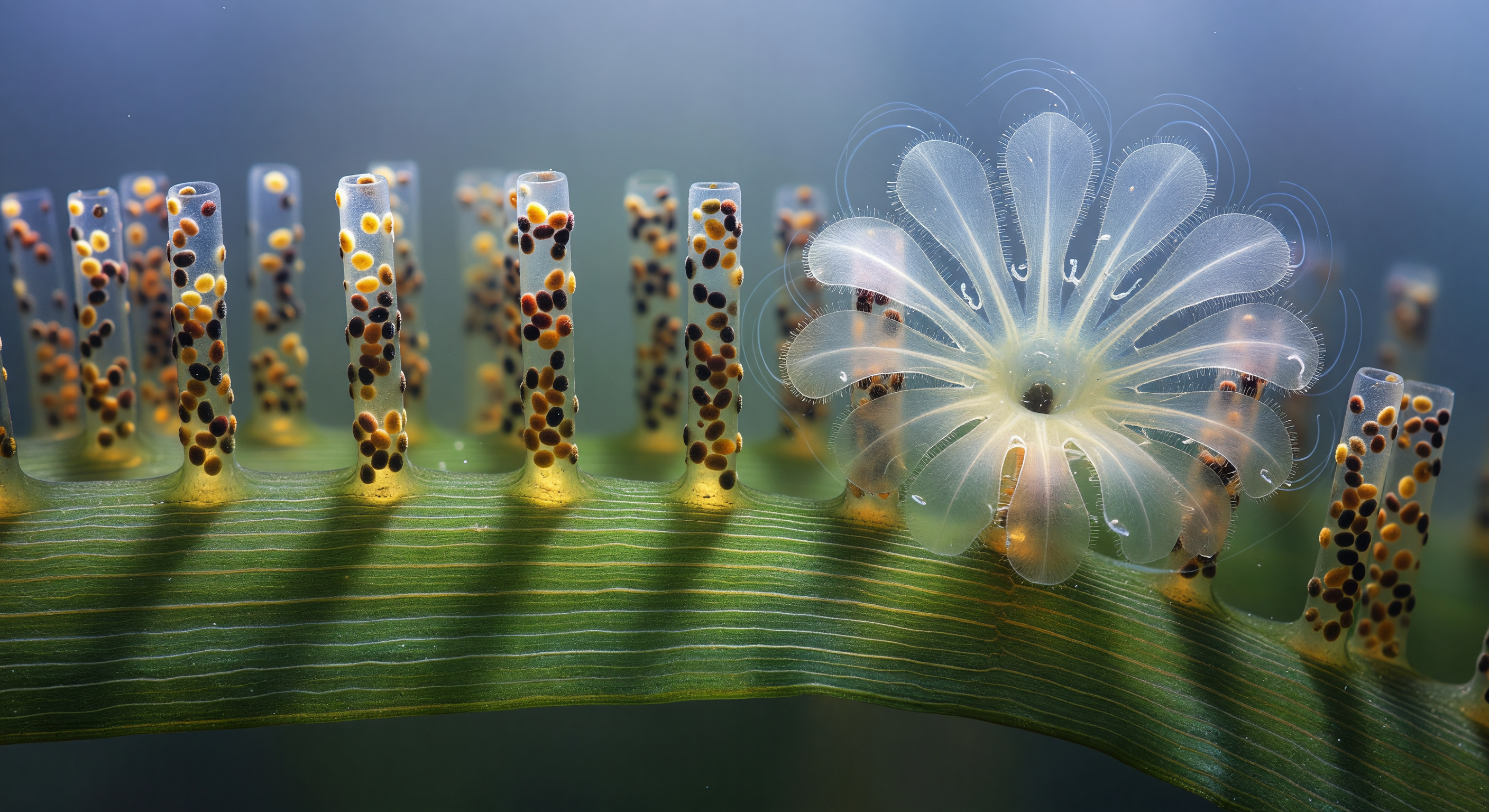
You are suspended before what appears to be an ancient underwater cliff face — the epidermal surface of a *Potamogeton* stem stretching away in all directions, its pale jade cell-wall ridges glowing from within with warm transmitted chlorophyll light, and rising from it a colonnade of gelatinous tubes studded with hand-rolled detritus pellets in amber, ochre, and rust, each tube roughly three times your height and tapering toward an open crown. These are *Floscularia ringens*, sessile rotifers that spend their adult lives anchored within self-constructed tubes, laboriously rolling individual particles of organic matter into uniform pellets and cementing them into place — an architectural behavior unique among the rotifera and one that produces, at this scale, something indistinguishable from fine cobblestone masonry set in clear mucilage. The nearest animal has extended fully into the water column, and its corona floods your entire foreground: twelve broad translucent lobes radiating outward like the tracery of a Gothic rose window, each lobe edged with a shimmering fringe of cilia beating in long metachronal traveling waves at perhaps twenty cycles per second, their collective motion threading slow spiral vortices through the particulate water and drawing flagellates and fine detritus in wide arcs toward the dark buccal field at the corona's center. Light arrives from two temperatures simultaneously — warm green-gold transmitted upward through living plant tissue, and a cooler diffuse blue-white descending from the open water column above — and in the interplay between them the tube-shadows stripe the ridged stem surface in long cool bars that recede in perspective into green-lit aqueous infinity, where the crowns of further colonies glow as small luminous discs, patient and ancient, pulsing without pause.
Other languages
- Français: Rosace Gothique de Flosculaire
- Español: Rosetón Gótico de Floscularia
- Português: Rosácea Gótica da Flosculária
- Deutsch: Gotisches Rosenfenster der Floscularia
- العربية: نافذة وردية قوطية للفلوسكولاريا
- हिन्दी: फ्लॉस्कुलेरिया गॉथिक गुलाब झरोखा
- 日本語: フロスキュラリアのゴシック薔薇窓
- 한국어: 플로스쿨라리아 고딕 장미창
- Italiano: Rosone Gotico della Floscularia
- Nederlands: Floscularia Gotisch Roosvenster