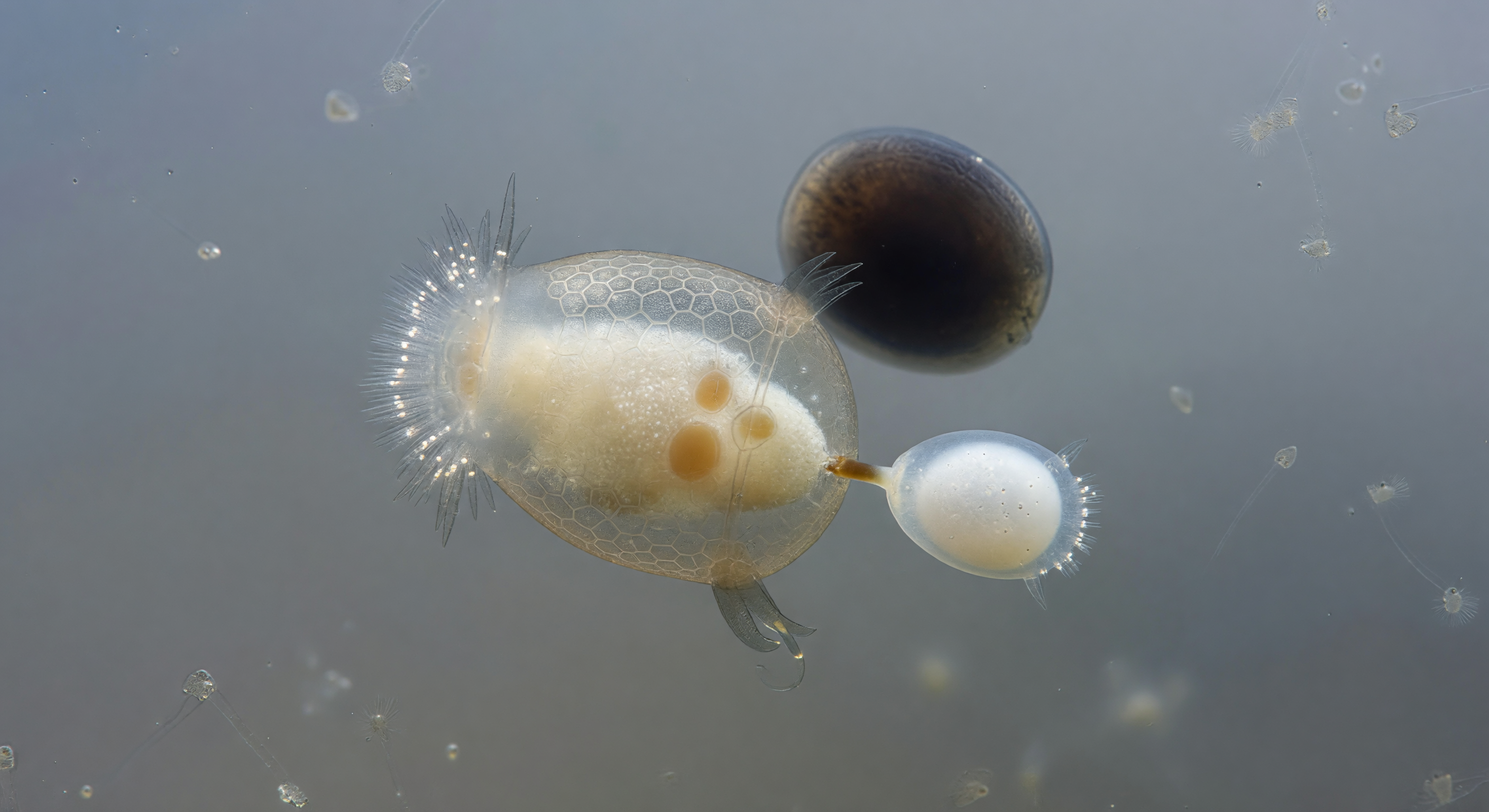
Suspended in the gray-blue haze of a late-summer water column, you drift weightless alongside three bodies that together narrate the full arc of rotifer reproduction compressed into a single instant: a female *Brachionus* nearly four times larger than the dwarf male gripping her posterior lorica, and behind them both, a fertilized resting egg already descending in slow gravitational surrender. The female glows from within like illuminated amber glass, her lorica — a rigid, finely ornamented vase of hardened syncytial protein — transmitting diffuse light through her cream-colored germovitellarium and paired gastric glands, her corona pulsing in a metachronal shimmer that creates the classic optical illusion of a spinning wheel against the turbid void. Clinging to her with purposeful desperation, the dwarf male is little more than a locomotory afterthought built around an enormous milky testis — his copulatory stylet, a needle of sclerotized chitin, already engaged in the precise mechanical act of sperm transfer that represents his entire biological mandate, his vestigial corona barely disturbing the viscous medium around him. Behind both, the resting egg — a dormancy capsule of layered, opaque chitin impenetrable to light and engineered to survive months of anoxic sediment — sinks with the slow patience of a world where gravity barely registers, carrying within its sealed walls a compressed future that will not unfold until conditions permit. The extreme asymmetry of this encounter — female luminous and open, male architecturally reduced, egg closed and inert — makes visible in three floating micrometers of geometry the entire reproductive logic of a lineage that has survived half a billion years by mastering the art of becoming dormant.
Other languages
- Français: Rencontre de Copulation Naine
- Español: Encuentro de Cópula Enana
- Português: Encontro de Cópula Anã
- Deutsch: Zwergmännchen Paarungsbegegnung
- العربية: لقاء تزاوج الذكر القزم
- हिन्दी: बौने नर का संगम
- 日本語: 矮小雄の交尾遭遇
- 한국어: 왜소 수컷 교미 장면
- Italiano: Incontro Copulazione Maschio Nano
- Nederlands: Dwerg Mannetje Paring Ontmoeting