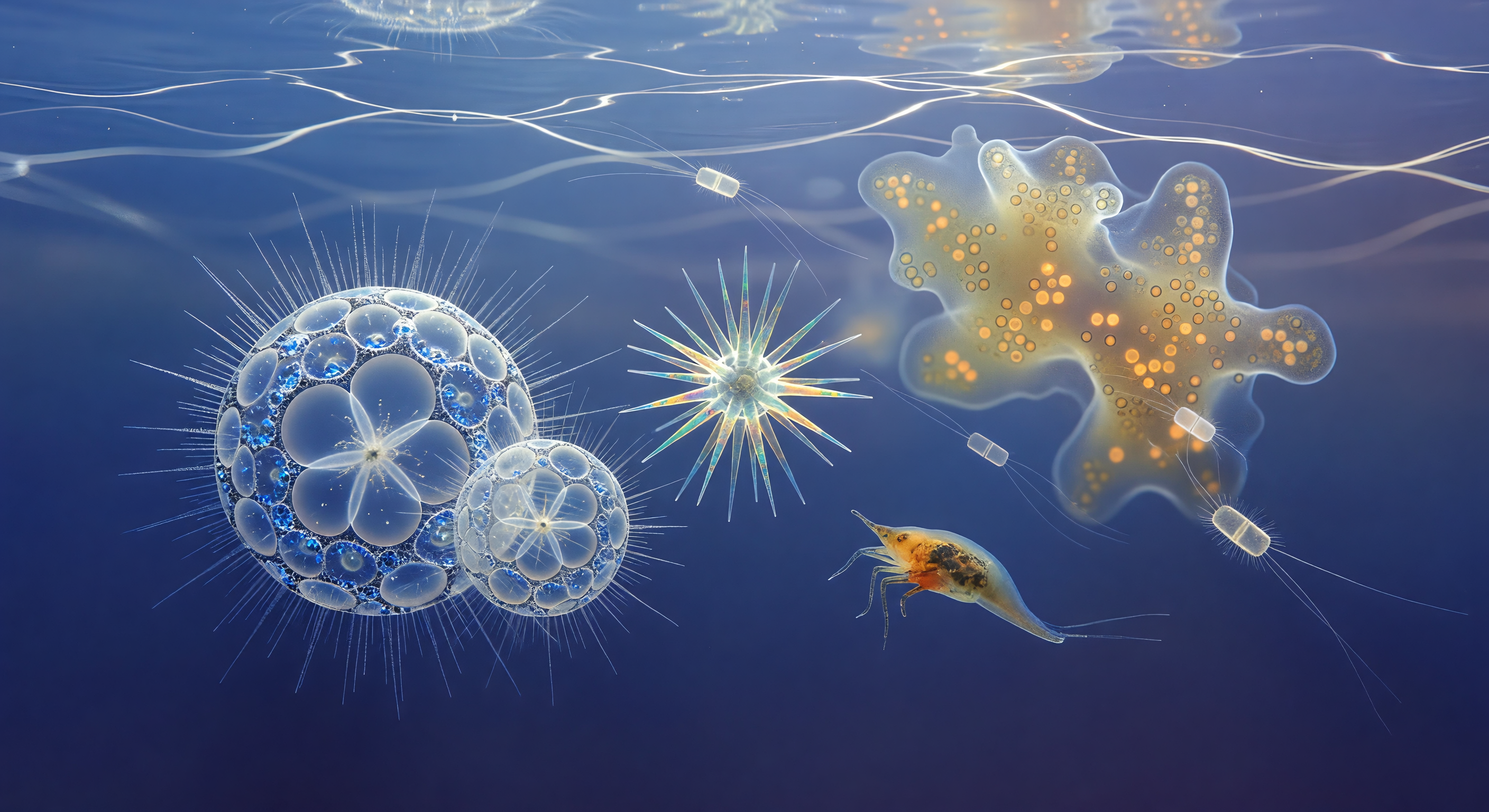
You are suspended thirty meters below the tropical Pacific surface, scaled down to the size of a single radiolarian cell, adrift in a luminous cerulean void where gravity has surrendered its authority to viscosity and diffuse light floods in from every direction above like a slow celestial broadcast. Around you, Sphaerozoum individuals hang in the water like paired cathedrals of opal silica, their nested lattice spheres catching the restless caustic nets drifting down from the surface and fracturing them into cold prismatic sparks at each hexagonal pore, while their axopodial halos — each filament a crystalline microtubule axoneme thinner than a bacterium — ignite briefly into silver wire wherever a shaft of refracted light sweeps through. An Acantharia rotates slowly nearby, its twenty strontium sulfate spines arranged in precise icosahedral geometry and shifting between teal, amber, and rose through birefringence as they turn, the myoneme fibers anchored invisibly at their bases ready to adjust the cell's buoyancy in response to pressure or light. Behind you, the Collodarian colony fills peripheral vision like a warm amber nebula, its gelatinous shared matrix backlit by surface sun filtering through thousands of embedded symbiotic dinoflagellate cells — each a five-to-fifteen-micron sphere burning with chlorophyll warmth — while Chaetoceros diatoms drift past like frosted glass shuttles trailing hair-thin silica setae, and a copepod nauplius the apparent size of a school bus tumbles through mid-water, its translucent body and beating limbs moving in the slow-motion choreography of a world ruled entirely by Stokes drag.
Other languages
- Français: Soupe Vivante Océan Ensoleillé
- Español: Sopa Viva Océano Iluminado
- Português: Sopa Viva Oceano Iluminado
- Deutsch: Sonnendurchflutete Lebende Ozeansuppe
- العربية: حساء المحيط الحي المشمس
- हिन्दी: धूपिल समुद्री जीवन सूप
- 日本語: 陽光差す海の生命スープ
- 한국어: 햇살 가득한 바다 생명 수프
- Italiano: Zuppa Vivente Oceano Soleggiato
- Nederlands: Zonnig Levend Oceaansoep