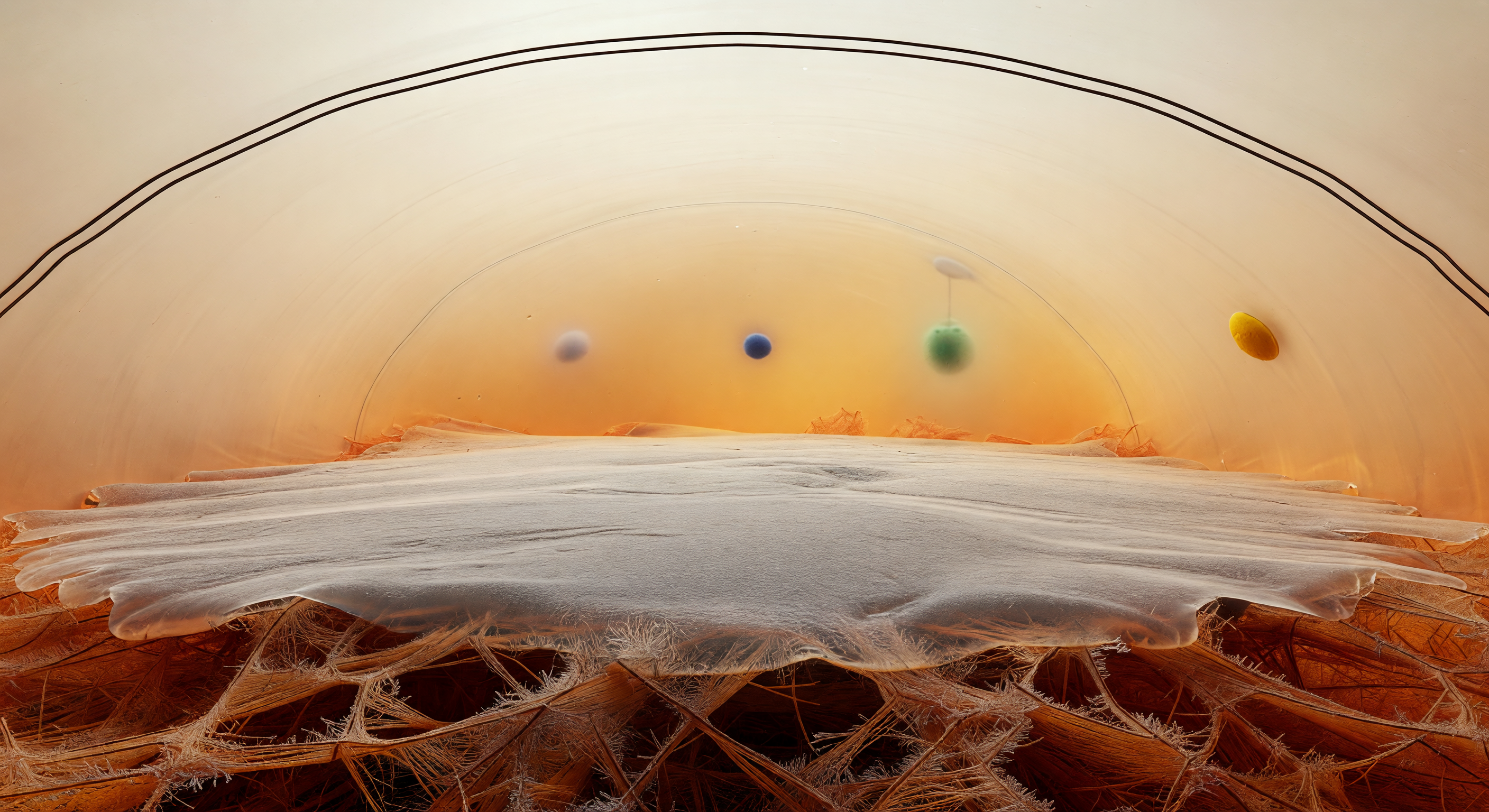
Pressed flat against the interior surface of a silica deposition vesicle, you are witnessing the slow, irreversible act of mineral construction — amorphous silica gel advancing in a pale grey-white mass across a rust-orange lattice of silaffin-like protein fibrils, burying the scaffold strand by strand as silicic acid polymerizes into the hydrated glass that will eventually become a radiolarian's intricate test. The silicalemma membrane curves overhead as a razor-precise double line of darkness, the boundary between this tightly controlled biomineralization chamber and the amber cytoplasm beyond, where cobalt-blue mitochondria and emerald-green granules glow like lamps behind frosted glass. The scaffold beneath you is not passive scaffolding but an active template — the silaffin proteins carry the polyelectrolyte chemistry that catalyzes silica precipitation, drawing dissolved silicic acid out of the vesicle fluid and locking it into solid mineral along their surfaces, the fibres darkening from terracotta to deep sienna as mineral encases them. Where the gel front is thinnest its translucency still permits a glimpse of the compressed protein lattice below, the gradient of encroachment as unhurried and inevitable as a tide darkening sand. The entire space — enclosed, amber-lit, saturated with the diffuse cream luminosity filtering through the membrane above — is a foundry operating at the threshold of chemistry and geometry, building one of Earth's most exquisite mineral architectures one nanometer-thick silica layer at a time.
Other languages
- Français: Polymérisation de Silice au Vésicule
- Español: Polimerización de Sílice en Vesícula
- Português: Polimerização de Sílica na Vesícula
- Deutsch: Silika-Polymerisation an SDV-Wand
- العربية: بلمرة السيليكا في الحويصلة
- हिन्दी: सिलिका बहुलकीकरण SDV भित्ति
- 日本語: 珪酸重合の沈着小胞壁
- 한국어: 규소 중합 침착 소포벽
- Italiano: Polimerizzazione della Silice al Vesiculo
- Nederlands: Silicapolymerisatie aan SDV-Wand