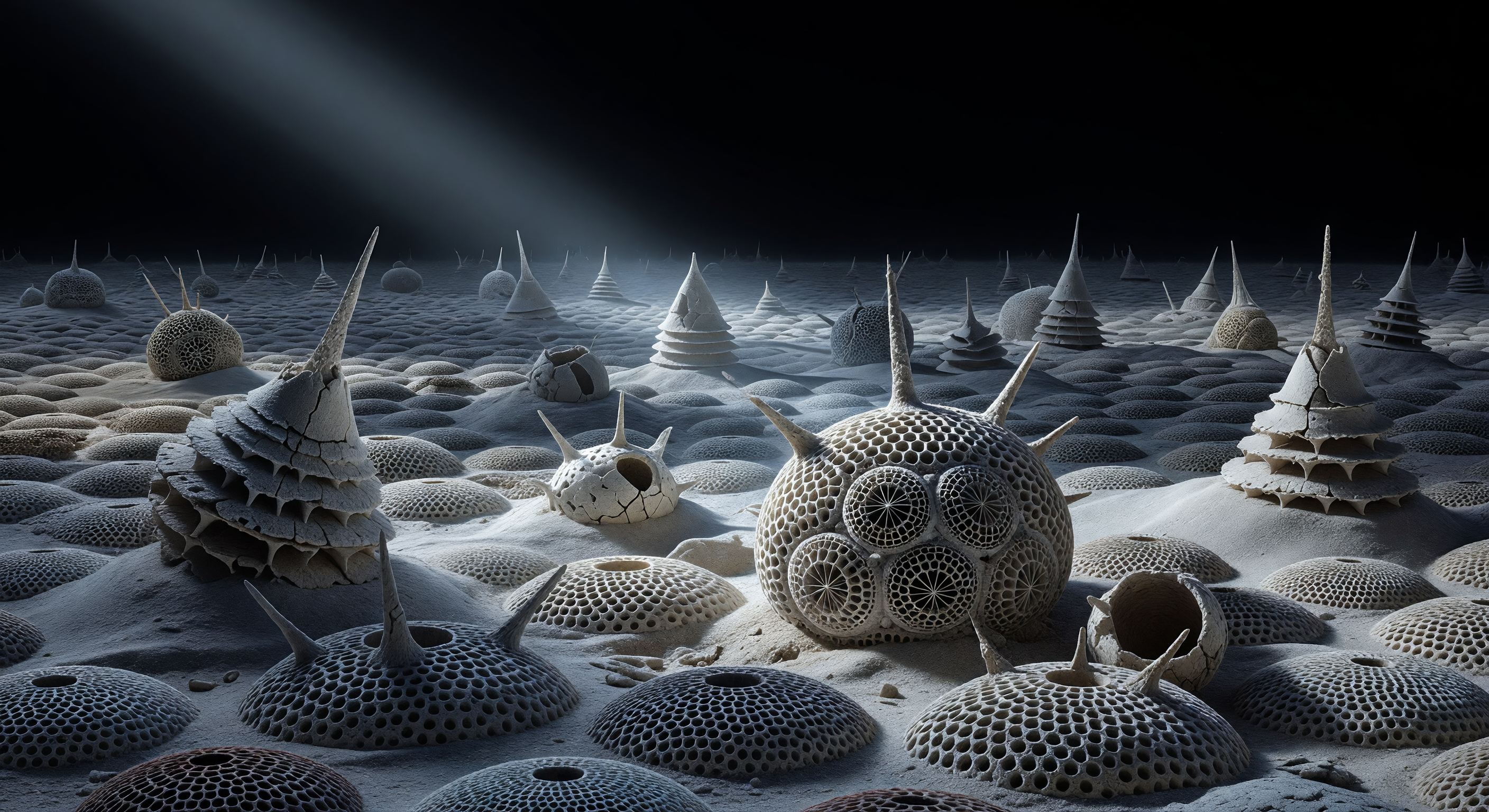
You are suspended above a vast grey plain that extends in every direction without relief, its surface packed so densely with the silica remains of radiolarians that it reads less as sediment than as a ruined city compressed flat by geological time. Under the oblique electron beam, intact Spumellarian tests loom like geodesic dome complexes, their nested concentric lattices casting intricate grids of shadow-pits into their own interiors, each hexagonal pore framing a doorway-sized rectangle of absolute black, while broken Nassellarian cones lie overturned among them like collapsed cooling towers, their apical spines still lancing upward through the mineral fill at odd angles. Amorphous clay drifts in smooth accumulations around the bases of intact tests, half-burying some and leaving others elevated on compacted pedestals, the whole surface recording in monochrome physics — electron contrast alone, no colour, no atmosphere — the compression of millions of years of pelagic snowfall into a few centimeters of ooze. The silica of each test is opaline and biogenic, secreted by living cells from dissolved silicic acid over hours of slow mineral accretion, and what survives here is only the most durable fraction: forms whose lattice geometry was strong enough to resist dissolution in the undersaturated deep water during the centuries of sinking and burial. Behind the nearest landmarks, the raking beam loses its power to lift geometry from shadow, and the far field dissolves into undifferentiated grey, a necropolis extending beyond resolution in every direction.
Other languages
- Français: Cimetière de Boue Radiolaire
- Español: Cementerio de Ooze Radiolario
- Português: Cemitério de Lodo Radiolário
- Deutsch: Radiolarian Schlamm Friedhof REM
- العربية: مقبرة طين الرادیولاریا
- हिन्दी: रेडियोलेरियन कीचड़ कब्रिस्तान
- 日本語: 放散虫軟泥の墓場SEM
- 한국어: 방산충 연니 묘지 SEM
- Italiano: Cimitero di Fango Radiolario
- Nederlands: Radiolariën Slijk Begraafplaats