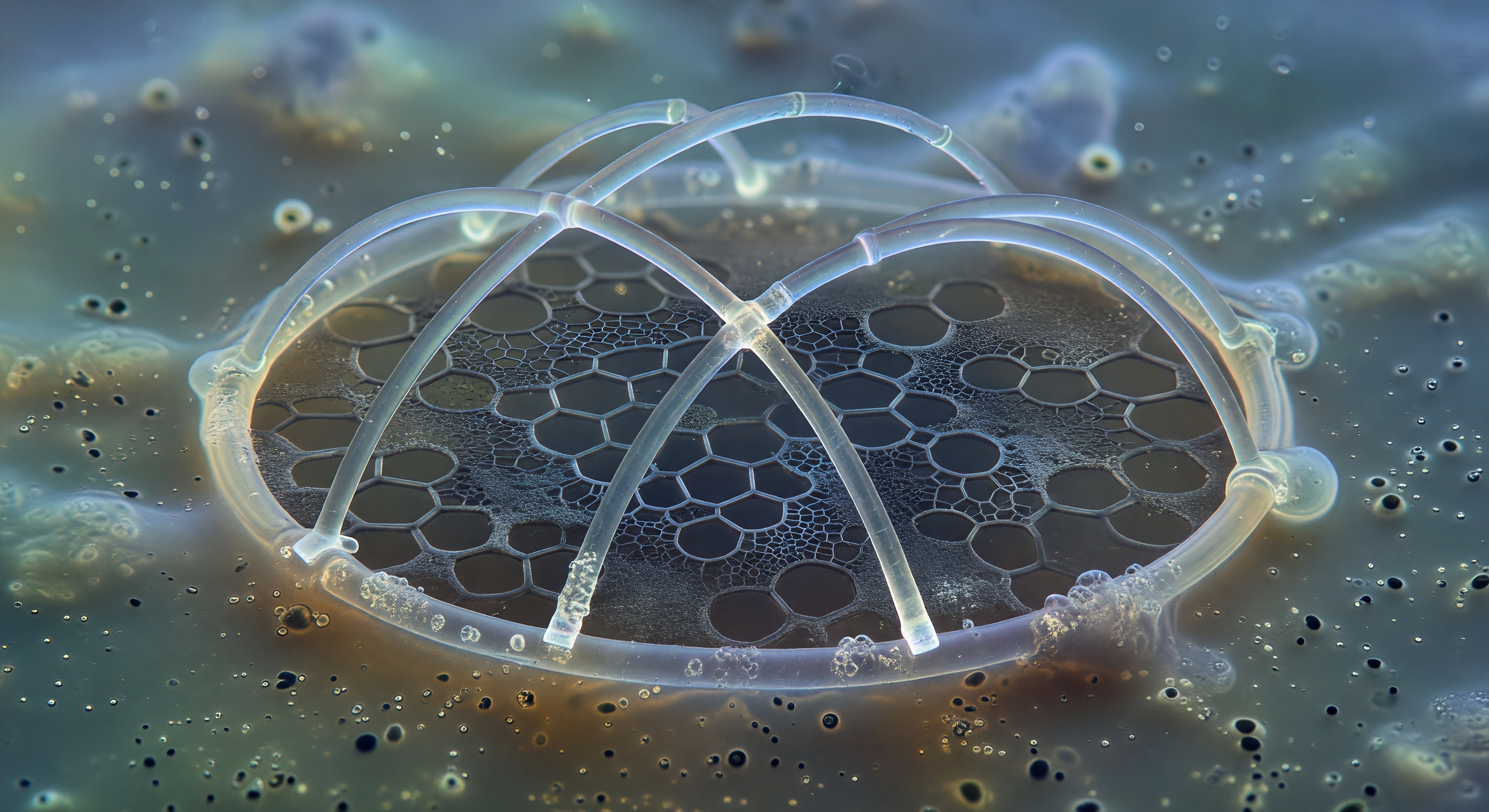
You drift within a medium so thick with biological density that motion itself seems suspended, watching the earliest moments of a skeleton being born. Before you, the nascent sagittal ring of a *Pterocorys* rises in luminous glass arcs — silica no thicker than a few microns already hard and transparent, edged with cold iridescent halos where phase contrast plays along its curves, two primary bars crossing its interior like the first ribs of a cathedral only just begun. Beneath the mineral, barely perceptible against the granular amber-brown cytoplasm, a matte gray meshwork of glycoprotein fibers spreads in uncanny geometric patience — the organic template that precedes and directs silicification, its hexagonal pore outlines already inscribed in soft matter, empty and waiting for the mineral that will follow. This pre-skeletal scaffolding is secreted within silica deposition vesicles, intracellular membrane-bound compartments where seawater-derived silicic acid polymerizes into amorphous opal under precise biochemical control, the growing test never touching open cytoplasm directly. The ring reads as an immense architectural member from this vantage — its curvature implying vast enclosed space — and the silica gleaming with the patient permanence of a structure that, once complete, will outlast the cell that built it by half a billion years.
Other languages
- Français: Échafaudage Nassellaire en Formation
- Español: Armazón Naselario en Construcción
- Português: Estrutura Naselária em Formação
- Deutsch: Nassellarisches Gerüst im Aufbau
- العربية: هيكل ناسيلاري قيد البناء
- हिन्दी: नैसेलारी ढाँचा निर्माणाधीन
- 日本語: ナッセラリアの骨格形成中
- 한국어: 나셀라리아 골격 형성 중
- Italiano: Impalcatura Nassellaria in Costruzione
- Nederlands: Nassellariaans Skelet in Opbouw