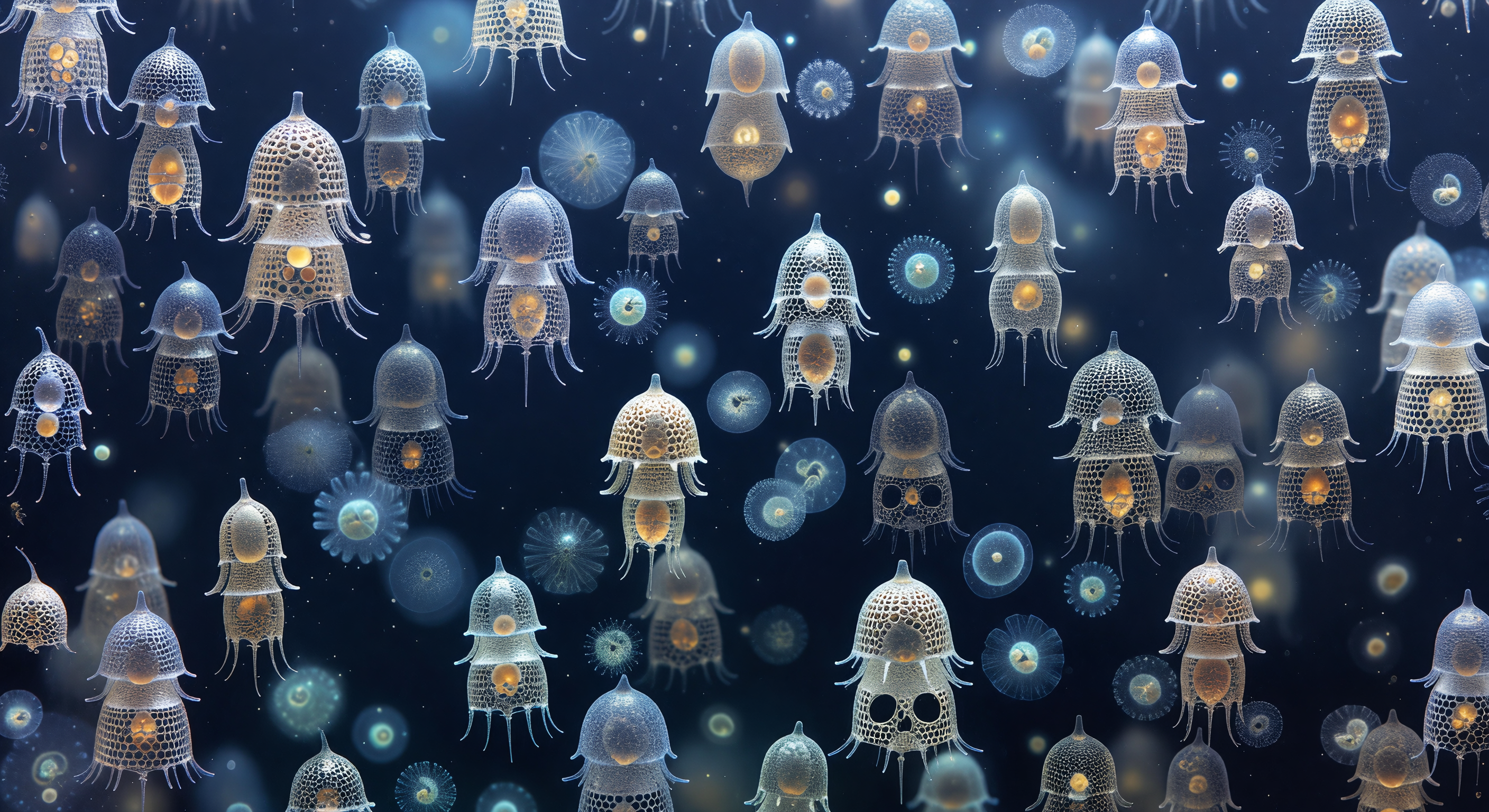
You are suspended in a column of water so cold it registers in the body as pressure rather than temperature, and around you, in every direction, the mesopelagic zone is conducting its quiet architecture. Nassellarian tests descend on all sides — conical helmets, stacked pagoda-chambers, elongated multi-segmented forms between one hundred and four hundred micrometers across — their amorphous opal silica lattices catching the last attenuated photons from the surface world and breaking them into cold blue-grey glints along every pore-edge and radial bar, each skeleton a cathedral of spun mineral that took its occupant days to deposit one silica vesicle at a time. Where cells still live, amber and tawny cytoplasm presses warm against the inner lattice walls, leaking through hexagonal pore-arrays as faint biological light — stained-glass lanterns adrift in near-total darkness — while the many empty tests beside them read as pale silver-grey, their hollow chambers open to seawater, cold and eyeless. Between these sinking forms, marine snow flocs — transparent aggregates of shed mucus, dead organic matter, and released radiolarian cytoplasm — drift in slow spiral paths through the deep indigo water column, occasionally snagging on a protruding silica spine before releasing, their semi-luminous surfaces catching ambient bioluminescence from somewhere unseen and passing it along as a diffuse pearlescent shimmer. This is the biological pump made visible: each test that sinks carries sequestered silica and organic carbon toward the abyssal floor, a millimeter-scale freight contributing to the planetary-scale transfer of matter from the sunlit ocean surface to the sediment record below, where after tens of millions of years it will compress into radiolarite and re-enter the geochemical cycle of the Earth.
Other languages
- Français: Neige Nassellaire Mésoéplagique
- Español: Nevada Naselaria Mesopelágica
- Português: Neve Naselária Mesopelágica
- Deutsch: Nassellarer Schneefall Tiefsee
- العربية: تساقط ثلج النسيليات العميق
- हिन्दी: मेसोपेलाजिक नासेलेरियन हिमपात
- 日本語: 中深層放散虫の雪
- 한국어: 심해 나셀라리아 눈송이
- Italiano: Nevicata Nassellariana Mesopelagica
- Nederlands: Mesopelagische Nassellaire Sneeuwval