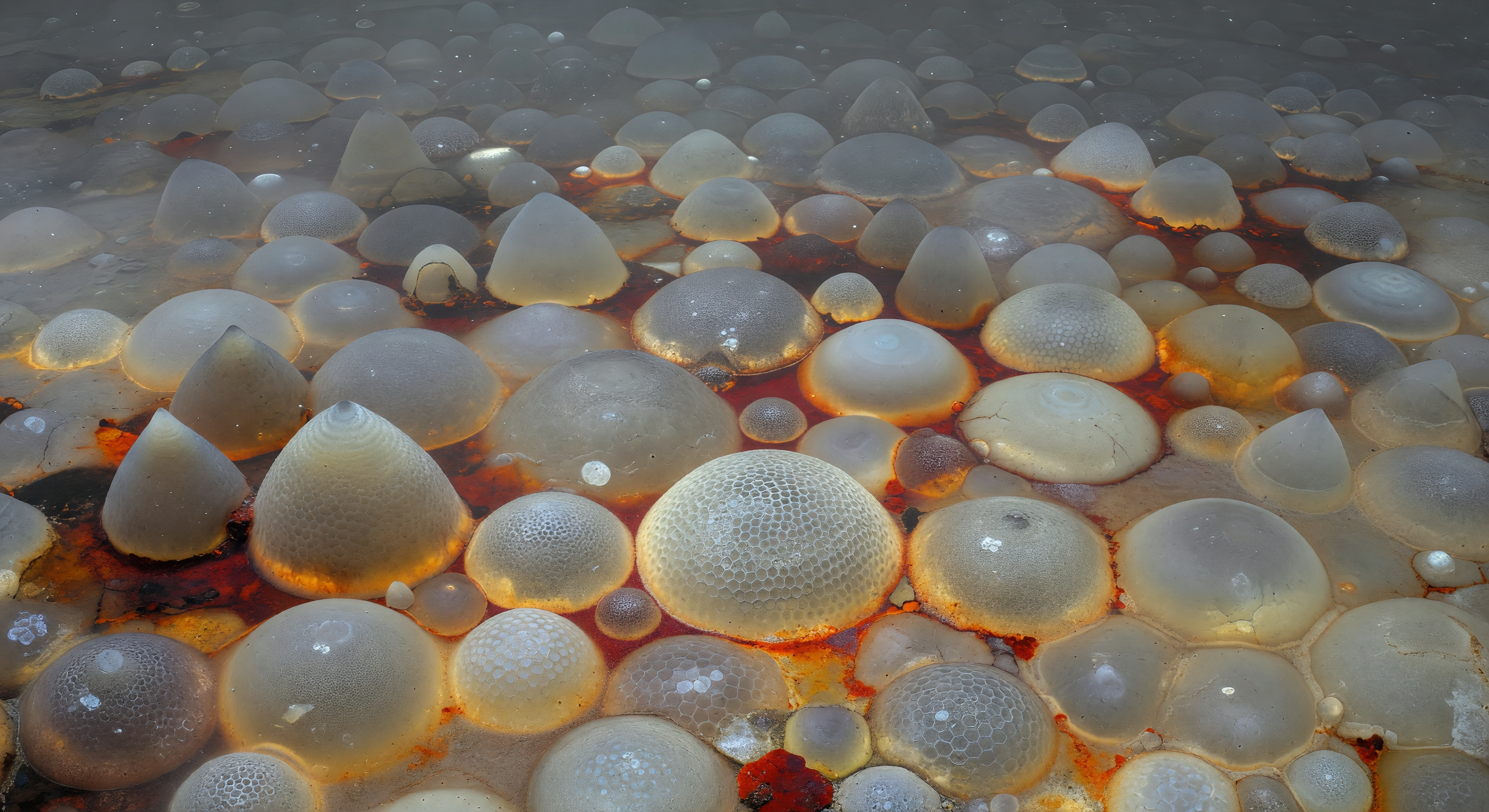
The field before you is an ancient seafloor rendered in stone — a dense, interlocking mosaic of recrystallized silica tests pressing against one another in every direction, their original spherical and conical geometries still legible as ghost-forms beneath 150 million years of burial and mineral replacement. These are the compressed remains of radiolarians, single-celled planktonic organisms whose intricate silica skeletons once drifted through a Jurassic ocean that has long since vanished, accumulating on the seafloor over millions of years before being entombed, pressurized, and transformed into radiolarite chert. Transmitted light floods upward through the section in a cold, diffuse wash, suffusing the pale chalcedony and microcrystalline quartz of each recrystallized test with a faint phosphorescent glow — ash-white and bone-cream forms welded seamlessly to their neighbors, the delicate pore lattices of living architecture now flattened into subtle surface relief by lithostatic pressure. Between the tests, hematite-stained cements bleed rust-orange and dried-blood crimson through the interstices, tracing the ghost geometry of pore spaces once filled with seawater, now mineralized into iron-veined amber gradients that pool and trail like rust-water through cracked stone. The world extends in all directions as an infinite compressed archive — denser and more opaque at center, dissolving toward the periphery into granular translucence — the entire visible field a planetary surface made of fossilized plankton, an ocean's biological productivity frozen into mineral silence.
Other languages
- Français: Lueur du Silex Jurassique
- Español: Brillo de Chert Jurásico
- Português: Brilho do Cherte Jurássico
- Deutsch: Jurassischer Hornstein Schimmer
- العربية: توهج الصوان الجوراسي
- हिन्दी: जुरासिक चर्ट की चमक
- 日本語: ジュラ紀チャートの輝き
- 한국어: 쥐라기 처트 박편의 빛
- Italiano: Bagliore del Selce Giurassico
- Nederlands: Jurassisch Vuursteen Glinstering