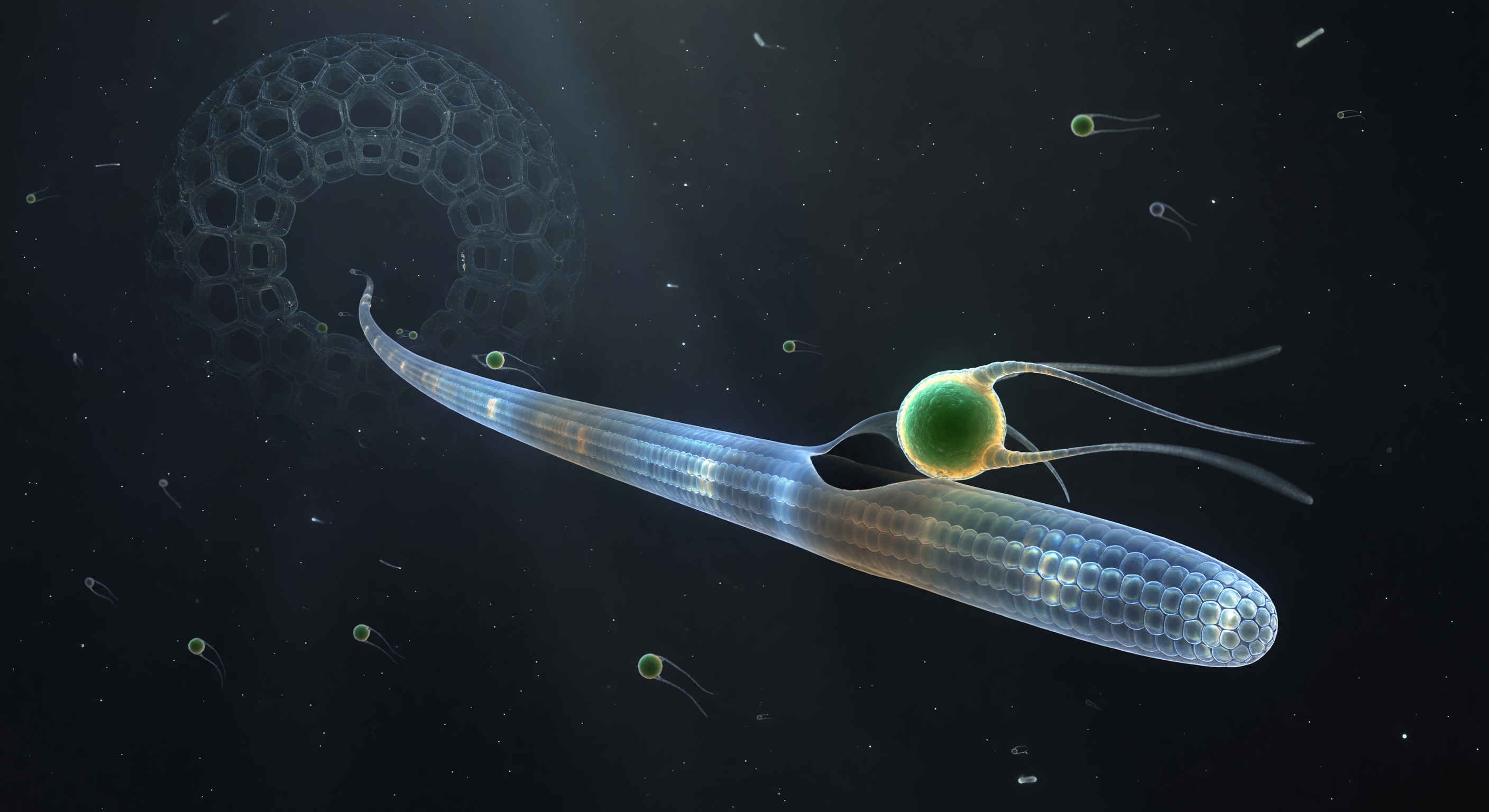
You are suspended at the threshold of a predatory act frozen in time — a crystalline axopodium extends across your entire field of view like a translucent architectural beam, its interior honeycomb of parallel microtubule bundles catching diffracted light and casting cold prismatic halos along its length, while at the point of contact a vivid emerald sphere barely three microns across blazes against the charcoal deep like a small incandescent planet, its two flagella halted mid-beat in arcs of pure filament-light. This is a radiolarian axopodium in the first instant of prey capture: the stiff pseudopodium is braced internally by a crystalline axoneme of bundled microtubules running in precise geometric arrays, and where the flagellate — a Micromonas, one of the ocean's smallest photosynthesizers — has made contact, the glassy axopodial membrane has dimpled inward and begun extruding a dark crescent of new membrane that curls around the green sphere like the opening degree of a slow eclipse. The cytoplasm at the contact zone has shifted from cool glass-blue to a warm turbid amber, betraying the biochemical cascade already triggered: adhesive surface molecules have fired, the engulfment machinery is committed, and the flagellate's fate is decided even as its chloroplast burns at full autofluorescent intensity. Deeper along the axopodium, toward the vaulted silica cathedral of the central capsule barely resolved in the background darkness, earlier vacuolated prey drift inward like dimming lanterns, their pigments faded to rust — evidence that this moment of luminous contact is merely the latest event in a continuous, patient harvest conducted entirely below the threshold of unaided vision, in the sunlit upper ocean.
Other languages
- Français: Flagellé Capturé en Pleine Eau
- Español: Flagelado Atrapado en el Agua
- Português: Flagelado Capturado na Água
- Deutsch: Geißeltier Im Wasser Gefangen
- العربية: سوطية مُقتنصة في الماء
- हिन्दी: जल में कशाभी पकड़ा गया
- 日本語: 水中で捕らえられた鞭毛虫
- 한국어: 물속에서 포획된 편모충
- Italiano: Flagellato Catturato in Acqua
- Nederlands: Zweepdiertje Midden Water Gevangen