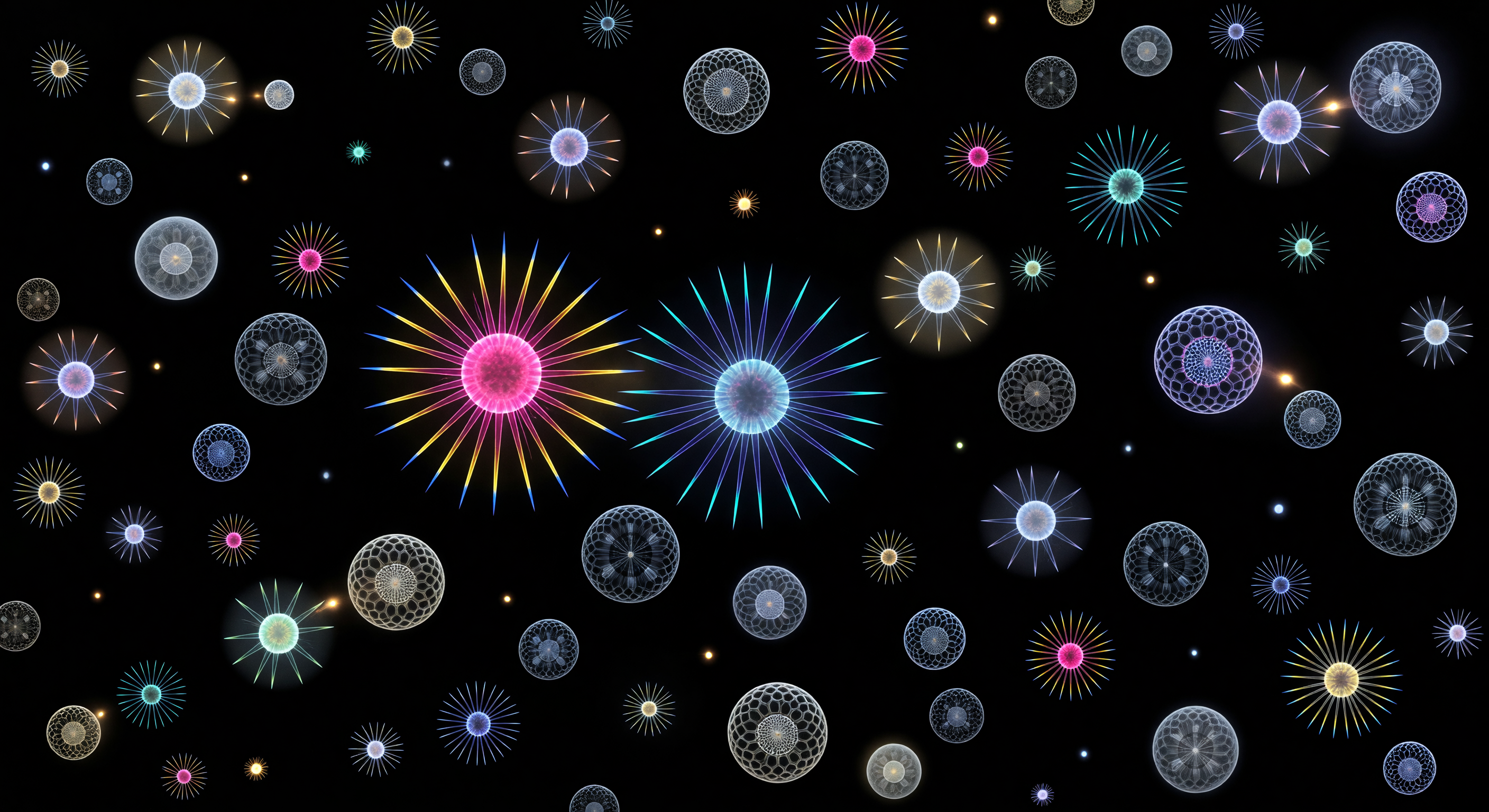
You float within an absolute blackness that reads more like deep space than ocean water — the crossed polarizing filters have erased all ambient light, leaving only what the mineral architecture itself chooses to radiate. Scattered across this darkness in every direction, Acantharia cells detonate like suspended fireworks: each of the twenty strontium sulfate spines fanning outward from a single organism functions as a birefringent rod, converting polarized illumination into blazing interference color, so that one cell burns in magenta and gold while its neighbor erupts entirely in electric teal and cobalt, the icosahedral symmetry of their spine arrangements mapping each cell's chromatic identity as precisely as a fingerprint. Between these chromatic explosions, the amorphous opaline silica of Spumellaria tests surrenders nothing to the polarized field, instead appearing as cold pewter lattice-spheres — nested concentric cages of hexagonal pores connected by radial struts, readable in exquisite structural detail yet chromatically inert, haunting the dark between the Acantharia like Gothic cathedral ruins preserved in silver fog. The strontium sulfate composing the Acantharia spines is itself a rarity: unlike the silica skeletons built by virtually all other radiolarian lineages, it is unstable in seawater and dissolves almost completely within days of the cell's death, meaning these incandescent forms leave almost no fossil record — what burns so brilliantly here vanishes without geological trace.
Other languages
- Français: Feux d'artifice polarisés croisés
- Español: Fuegos artificiales de polarización cruzada
- Português: Fogos de artifício polarizados cruzados
- Deutsch: Kreuzpolarisiertes Feuerwerk Ensemble
- العربية: ألعاب نارية بضوء مستقطب متقاطع
- हिन्दी: क्रॉस्ड पोलर आतिशबाजी समूह
- 日本語: 偏光交差花火の集合体
- 한국어: 편광 교차 불꽃놀이 집합
- Italiano: Fuochi d'artificio a polarizzatori incrociati
- Nederlands: Gekruiste Polarisatie Vuurwerk Ensemble