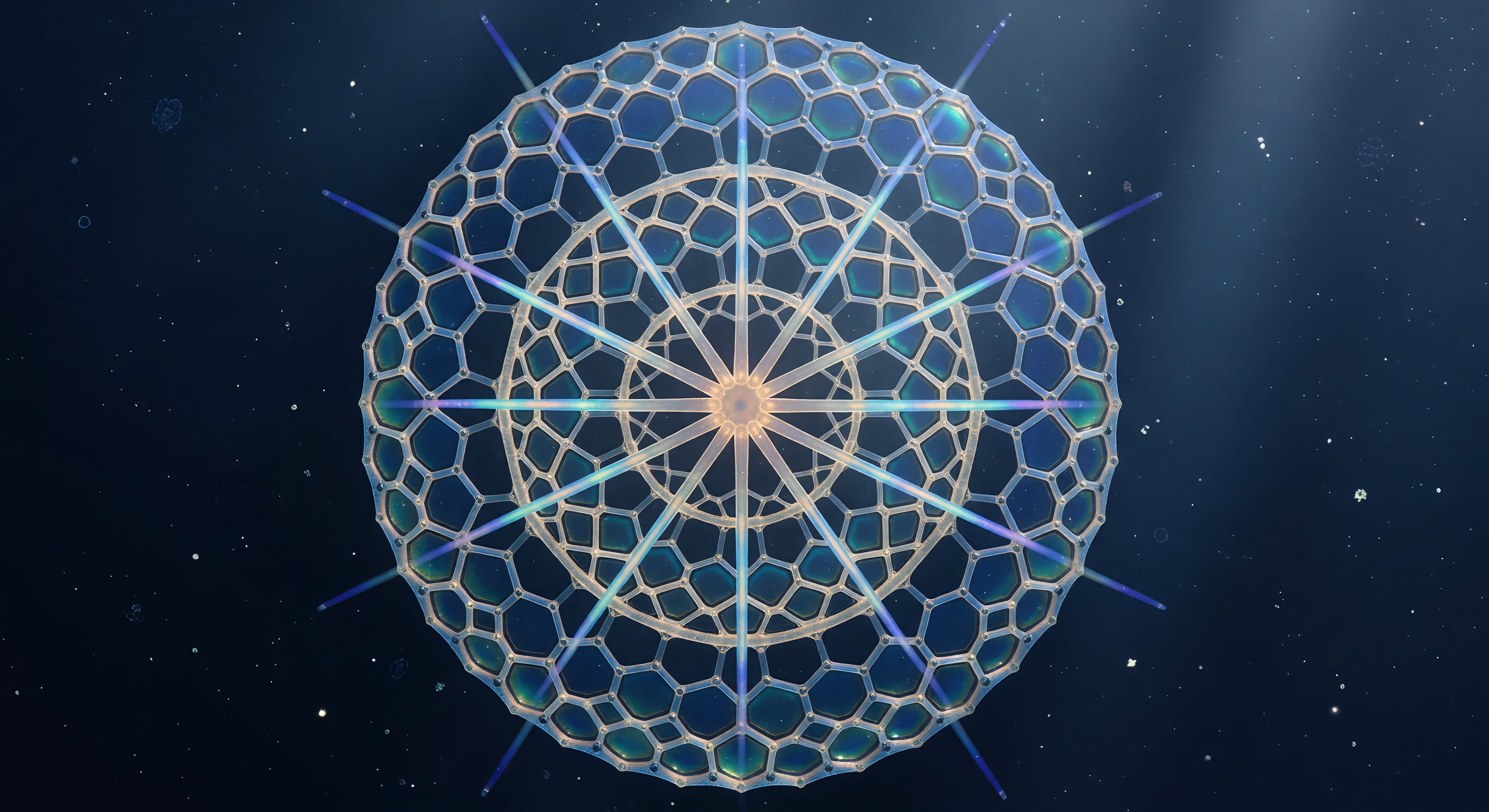
You are suspended at the geometric center of a living mineral cathedral, looking outward through three concentric shells of amorphous opaline silica — the skeleton of *Actinomma asteracanthion*, a spherical radiolarian no wider than a fine human hair. Each shell is a precision lattice of hexagonal pores, each pore a fraction of a bacterium across, and together they nest like Russian dolls of frozen light, their silica struts refracting the cold deep-ocean blue into prismatic halos — pale violet at the margins, warm aquamarine at the center — so that the entire structure reads as a luminous stained-glass vault built at cellular scale. Behind you, the endoplasm glows with a subdued amber warmth, the nucleus and lipid-rich cytoplasm of a living protist radiating honey-colored light that softens the geometry, while twelve triradiate spines — each a crystalline fiber of biogenic silica secreted atom by atom inside membrane-bound vesicles — drive outward through all three lattices and vanish into the indigo haze of the deep ocean beyond. Through every hexagonal pore, the abyss outside resolves into a slightly different refracted window, multiplied across hundreds of tiny lenses, so that depth is felt not as distance but as layering — three superimposed geometric shadows drifting in moiré offset, the progressive darkening of blue between each shell, and the long receding perspective of spines that seem to reach toward a horizon the eye can never quite reach. This is the Stokes regime, where viscosity rules over gravity and inertia, where Brownian jostling is the dominant motion and a drifting bacterium is both landscape feature and prey, and where one of Earth's oldest continuous lineages — half a billion years of siliceous architecture in the fossil record — has solved the problem of life in open water with geometry alone.
Other languages
- Français: Cathédrale de Sphères de Verre
- Español: Catedral de Esferas de Cristal
- Português: Catedral de Esferas de Vidro
- Deutsch: Kathedrale aus Gläsernen Sphären
- العربية: كاتدرائية الكرات الزجاجية المتداخلة
- हिन्दी: काँच के गोलों का गिरजाघर
- 日本語: ガラス球の大聖堂
- 한국어: 중첩 유리구의 대성당
- Italiano: Cattedrale di Sfere di Vetro
- Nederlands: Kathedraal van Glazen Sferen