Scientific confidence: Speculative
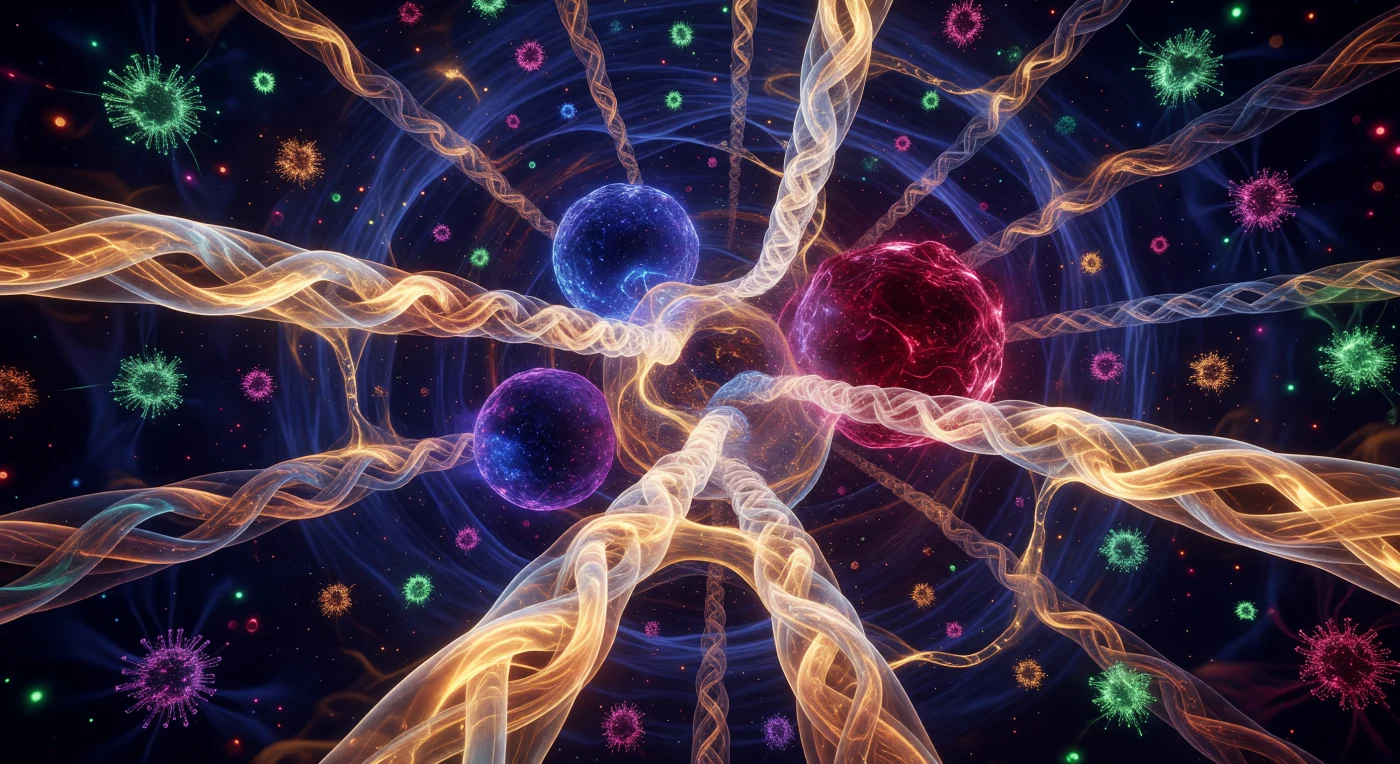
Inside the proton’s core, three luminous quark nodes hover in a storm of confined color charge: two cobalt-blue and one deep crimson, each with softened edges that blur into probability rather than hard matter. They are tied together by writhing amber-gold flux tubes, the strong force made visible as tensioning strands of gluon field that continually shudder, thicken, and rebraid as energy is redistributed through the confinement network. Around them, the indigo gluon sea never settles into darkness; instead it flickers with fleeting emerald-magenta virtual quark pairs that nucleate and vanish almost instantly, leaving only layered gradients and no shadows. The immersion is total and intimate, as if the viewer is suspended within the proton’s living interior, where scale is measured not in distance but in pulses of imprisoned energy and the restless geometry of fields.
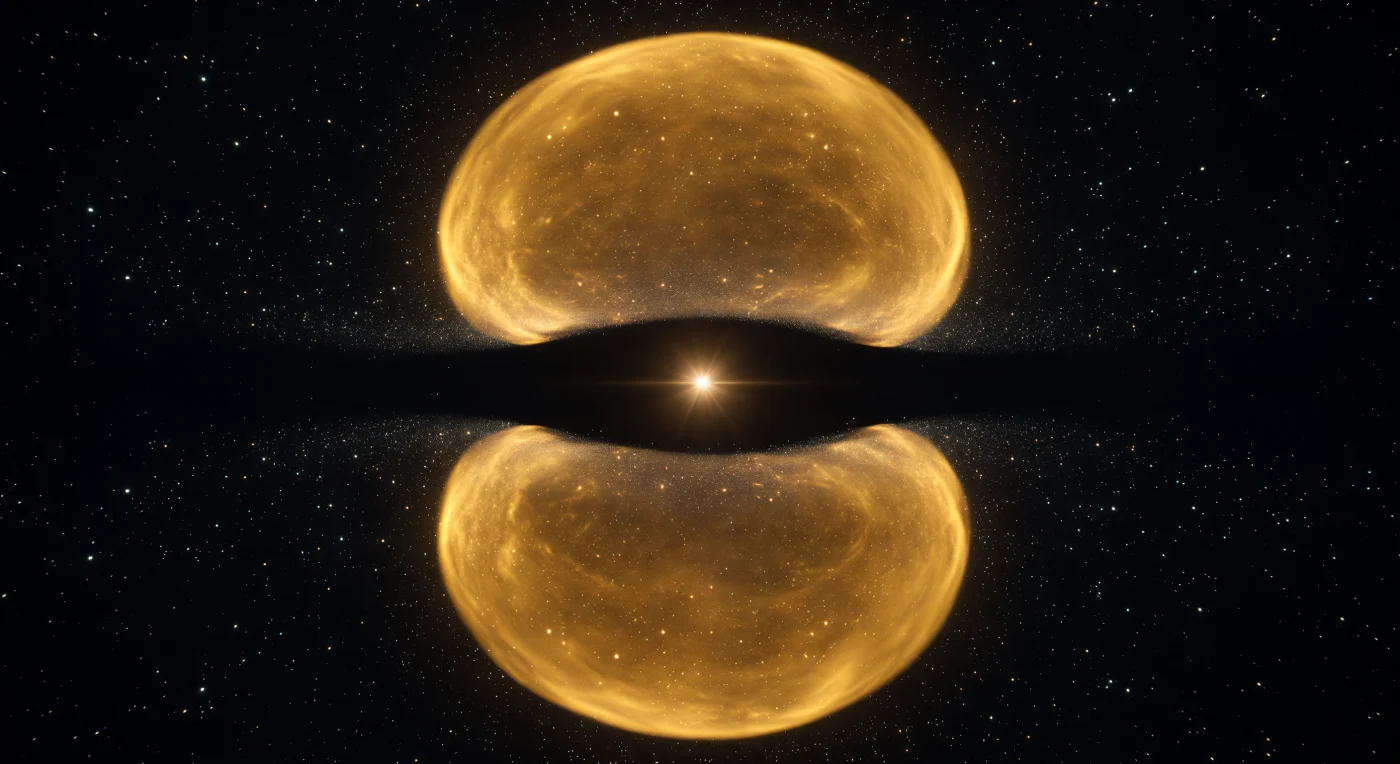
Two immense amber lobes of electron probability rise above and below a perfectly flat, black nodal plane, their warm volumetric glow dissolving at the edges into a glittering haze of tiny statistical flashes. At the exact center, the nucleus burns white-gold like a point of unbearable intensity, anchoring the two lobes while the plane between them remains a mathematically exact zero of amplitude, darker than shadow and stripped of all presence. The scene feels less like looking at matter than standing inside a living equation, where every luminous contour is a map of likelihood rather than a solid boundary. Around the whole structure, the vacuum carries a faint, restless shimmer, making the immense quiet of the orbital feel vast, precise, and strangely alive.
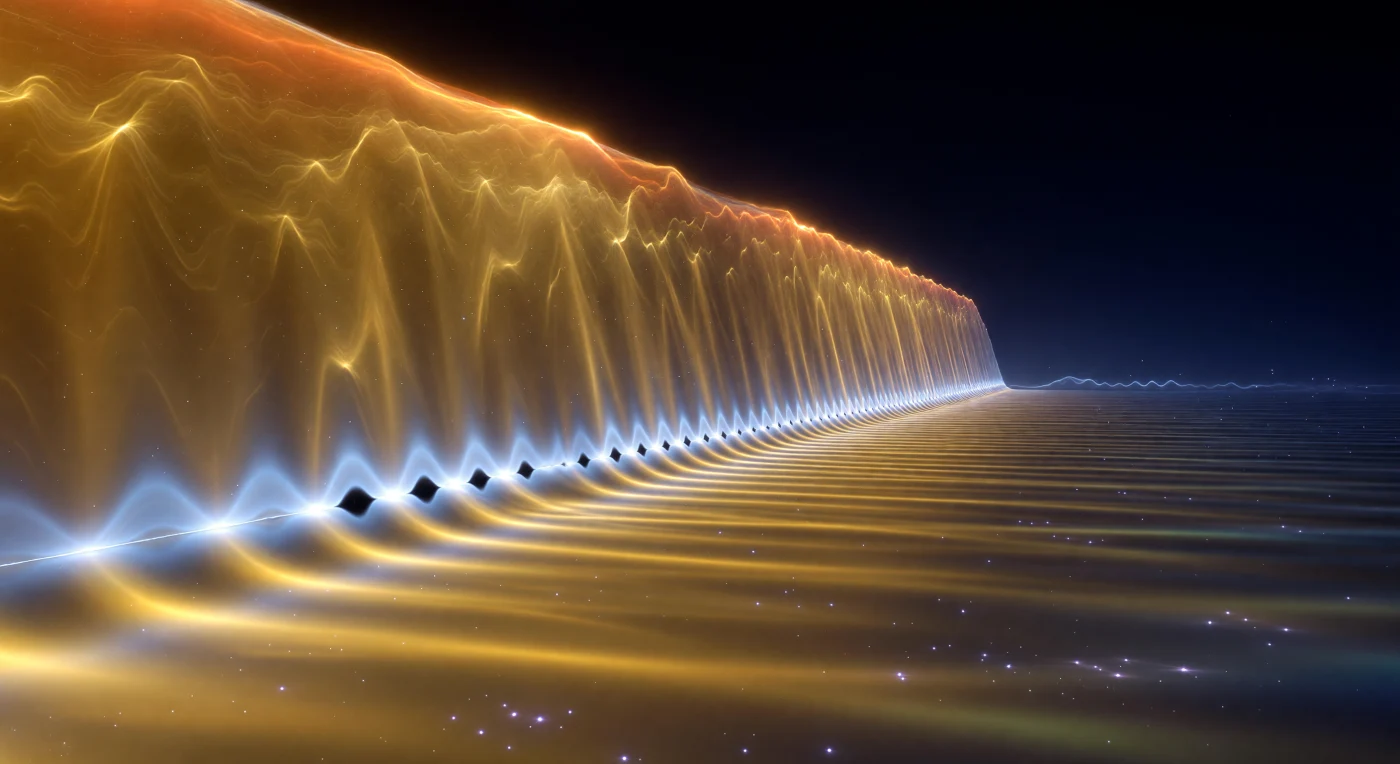
An immense orange-gold wall of Coulomb potential rises ahead, not as rock but as a living gradient of repulsive field energy, translucent and glowing from within like heated amber. Its interior is threaded with slow pulses of brighter gold, while the ground around it falls away into a dark, glassy vacuum plain that catches stray flashes from zero-point fluctuations. Behind you, a coherent alpha-particle wave arrives as a blue-white ripple and splits: part of it reflects into crisp standing-wave bands, and part becomes a faint exponentially decaying ghost that slips into the barrier’s thickness. Far beyond the far face, that attenuated shimmer reappears as a pale propagating wave, an eerie proof that the barrier was not crossed by force so much as by probability.
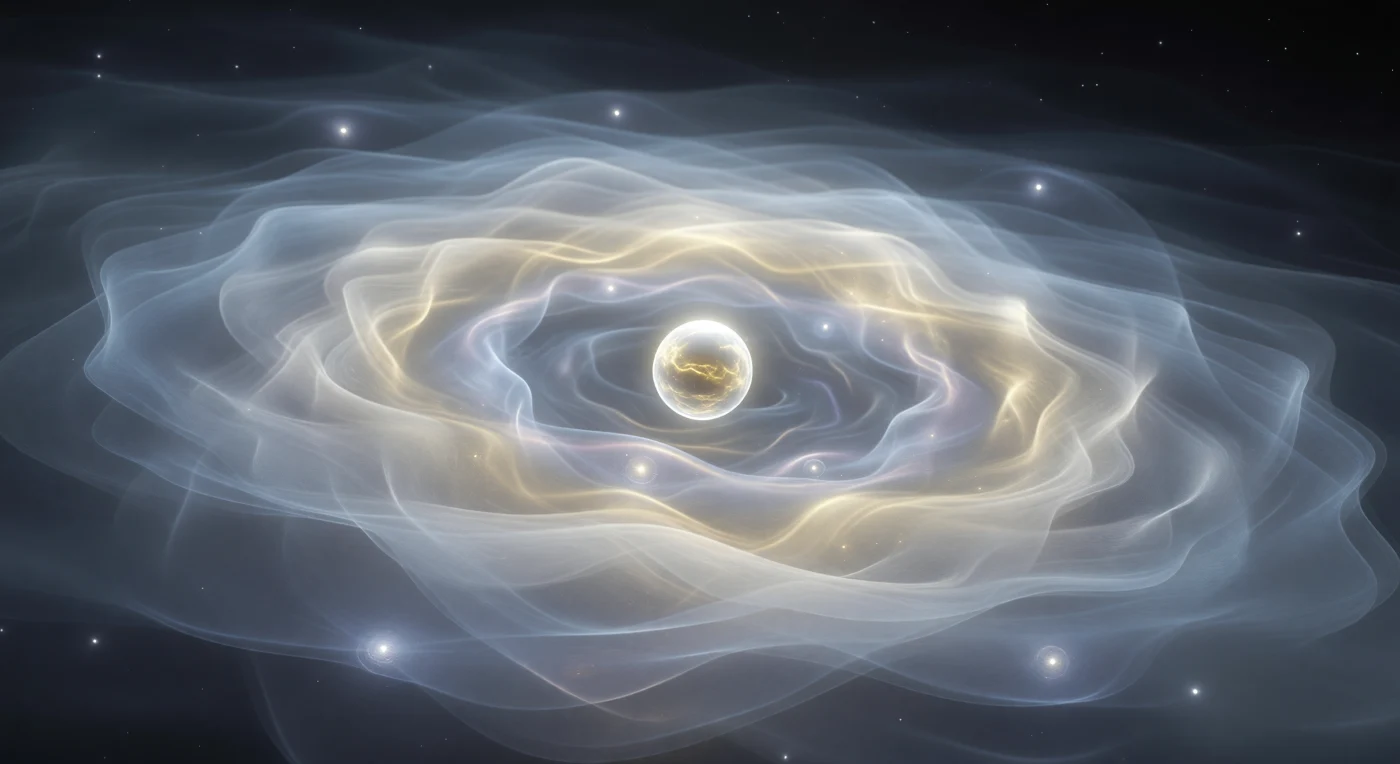
You float inside the hydrogen atom’s ground-state cloud, surrounded by a vast, softly glowing blue-white fog whose density swells inward toward a brilliant white-gold nucleus and then falls away into near-black at the farthest perceived distances. The mist is not empty vapor but the electron’s probability amplitude made spatial, a spherical field with no true horizon, its texture formed by subtle volumetric grains and layered translucence that suggest motion without any visible flow. At irregular moments, tiny crystalline flashes puncture the haze and vanish almost instantly, like brief localizations of charge before the wavefunction relaxes back into spread-out uncertainty. The nucleus burns at the center as an impossibly intense compact source, bleaching nearby space to pale cream and gold while faint halos and interference-like bands ripple through the surrounding cloud, making the entire scene feel both intimate and immeasurably vast.
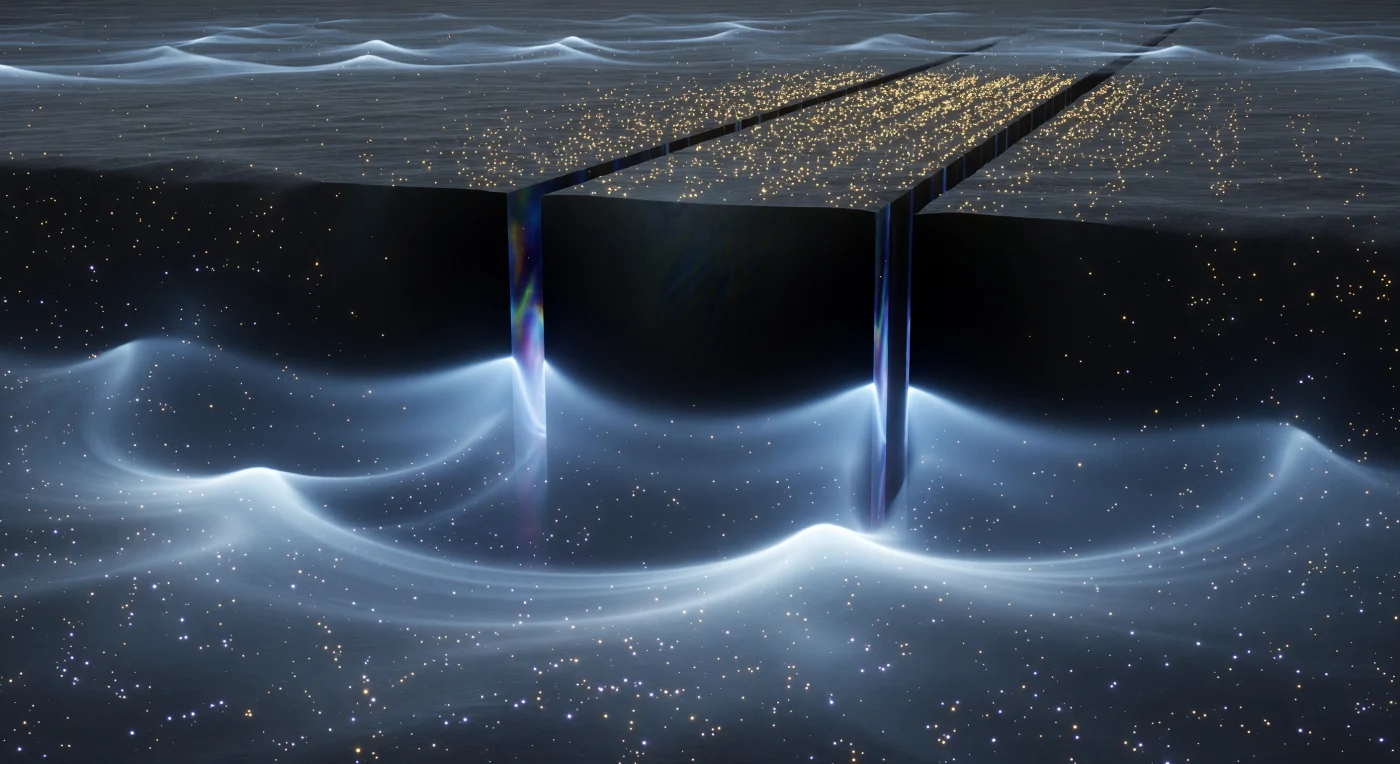
Before you stretches a colossal obsidian-black wall pierced by two narrow slits, their edges burning with electric blue-white light as probability amplitude pours through them like luminous fog. From each opening, semicircular wavefronts spread outward and overlap into a vast interference landscape, where brilliant cyan ridges mark constructive probability and deep bands of absolute darkness mark perfect cancellation. Far ahead, on a warm-gray detection plane, tiny gold sparks accumulate one by one into vertical fringes, the record of a single electron arriving as discrete events while its wave-like pattern is built across the whole field. The scene feels physically inhabitable and immense, yet every feature is a translation of quantum behavior into spatial form: amplitudes, phase differences, and collapse made visible in a frozen instant.
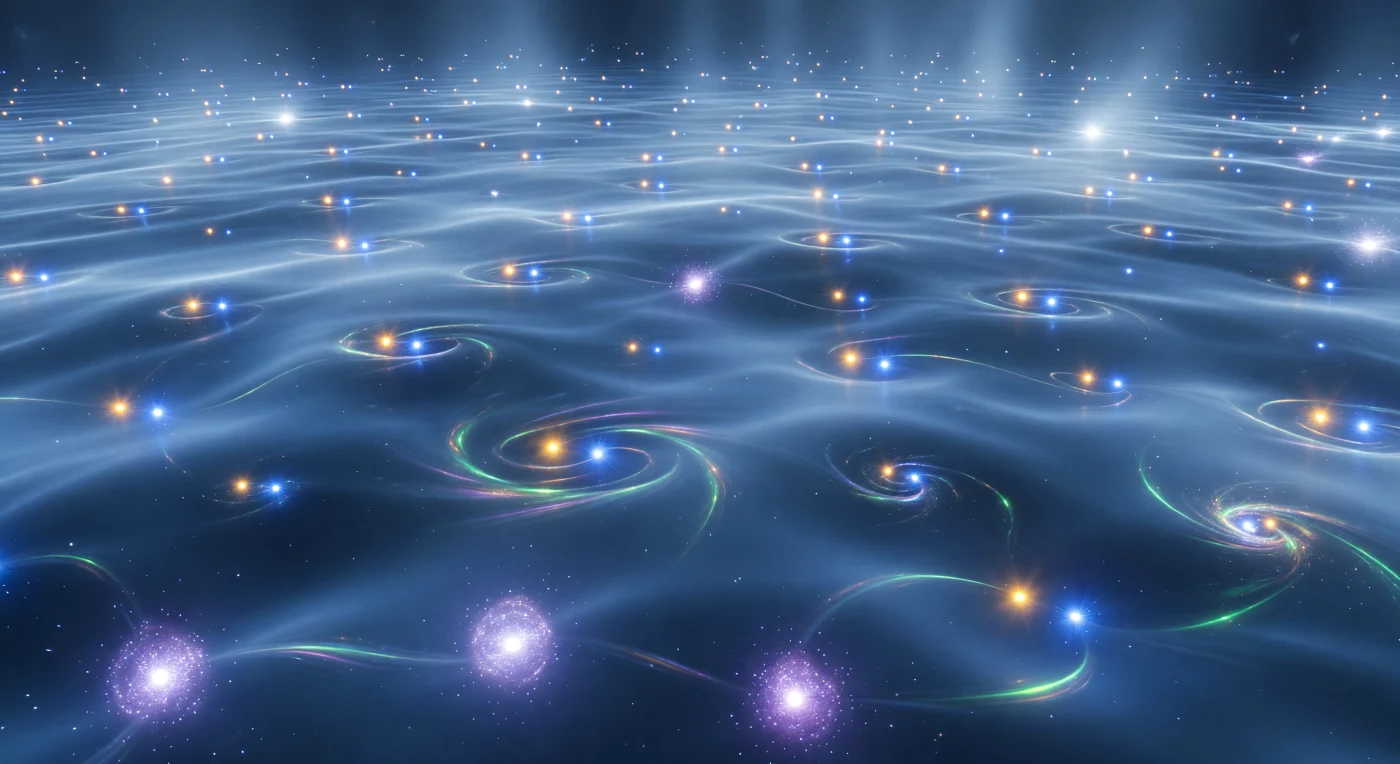
Every direction is filled with a cold blue-white haze that is not emptiness but the restless activity of the vacuum itself, a volumetric field shimmering with zero-point energy. Within it, paired flashes of amber-gold and cobalt-blue appear, spiral briefly around one another in tight luminous curls, and vanish in sharp violet-white gamma bursts that leave no trace behind. The scene feels immense despite its tiny physical domain, as if you are standing inside a three-dimensional aurora made of electromagnetic fluctuations, where the background is always breathing and every bright event is a fleeting rearrangement of the fields of space.
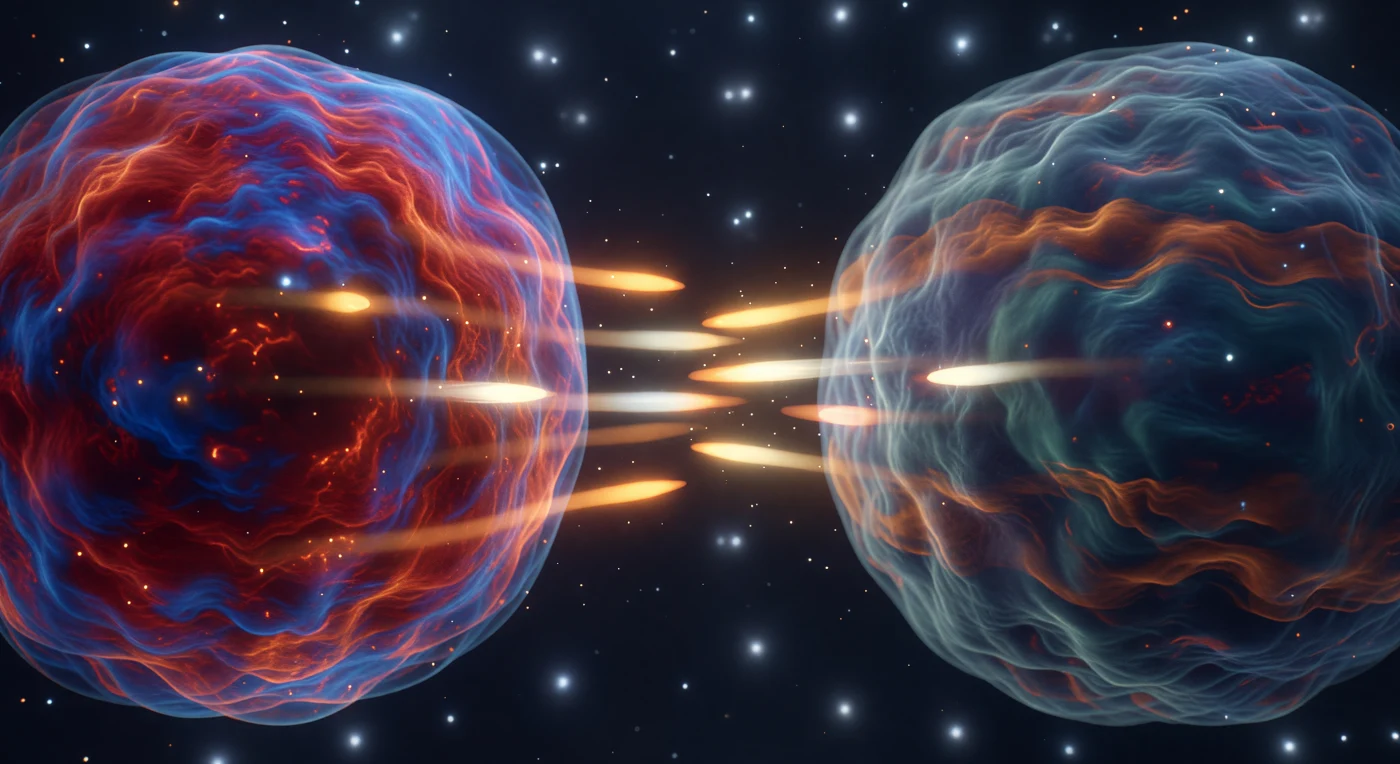
Two colossal nucleon bodies fill the view on either side, the proton and neutron of a deuteron, each wrapped in a semi-translucent skin through which red, blue, teal, and indigo QCD activity glows like a buried storm. Between them, the narrow gap is alive with warm amber-white pulses that slide from surface to surface as virtual pion exchange, the residual strong-force carrier that continually binds the pair and keeps them from drifting apart. Their outer probability clouds taper away exponentially into the separation, while the surrounding quantum vacuum remains a dark, restless medium speckled with faint blue-white fluctuations that appear and vanish without pattern. The whole scene feels less like empty space than a tightly held field of forces, where structure is defined by confinement, exchange, and the ceaseless trembling of subnuclear matter.
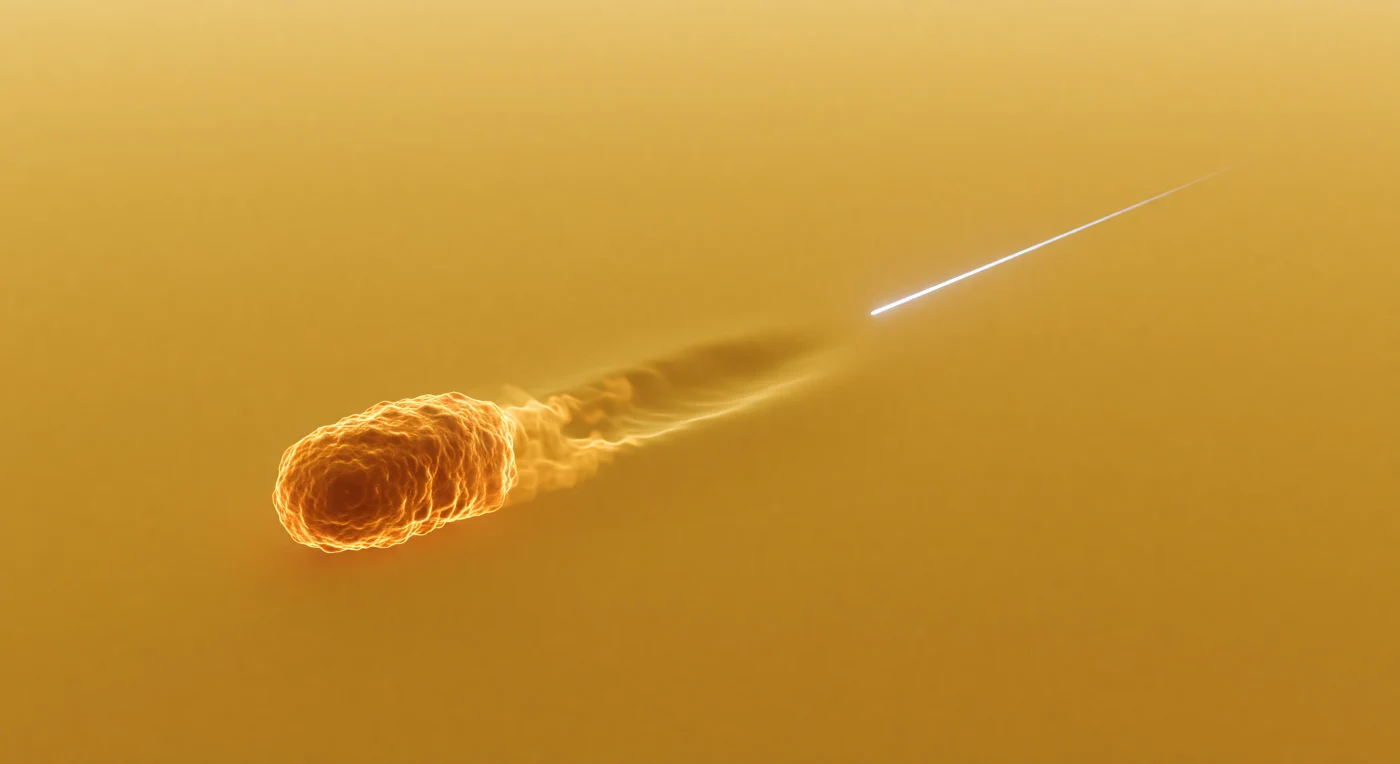
You are immersed in a vast, uniform gold luminance that is not lighting the scene but constituting the very medium itself, with no horizon, edge, or shadow to orient you. Through this Higgs-like field, a top quark appears as a dense orange wave packet pushing forward with deliberate effort, its passage carving a subtle dimple-wake in the surrounding gold as if the vacuum were a viscous, responsive substance. Crossing in the opposite direction, a photon becomes a razor-thin white-silver streak that leaves the medium perfectly undisturbed, emphasizing its effortless passage through the same background that resists the massive quark. The contrast between the dragged, compressed wake of the quark and the untouched continuity around the photon turns the whole field into a visual demonstration of mass arising from interaction with an all-pervading quantum background.
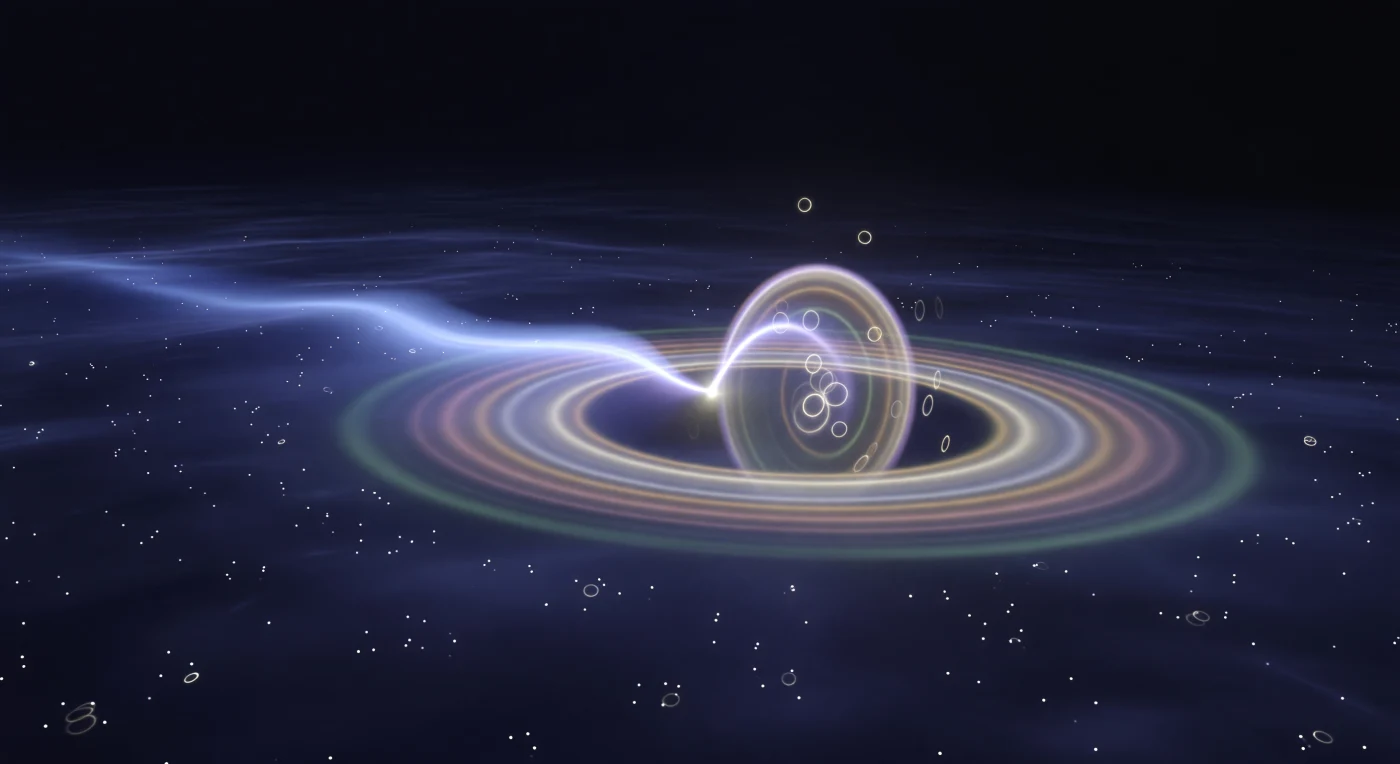
You stand inside a cold, indigo-black vacuum that feels less like empty space than a living medium, faintly flickering with the birth and collapse of virtual pairs. Across the scene, a blue-white electron probability packet streaks like a comet’s edge, then kinks at a sudden white-gold emission vertex where its momentum changes and a photon is released. From that point, concentric electromagnetic rings expand outward in pale warm whites, amber, and rose, each band a visible translation of field oscillations spreading through nothingness. Near the vertex, ghostly translucent loops hint at higher-order quantum corrections, barely perturbing the clean geometry of the main event and making the whole scene feel immense, immediate, and impossibly close.
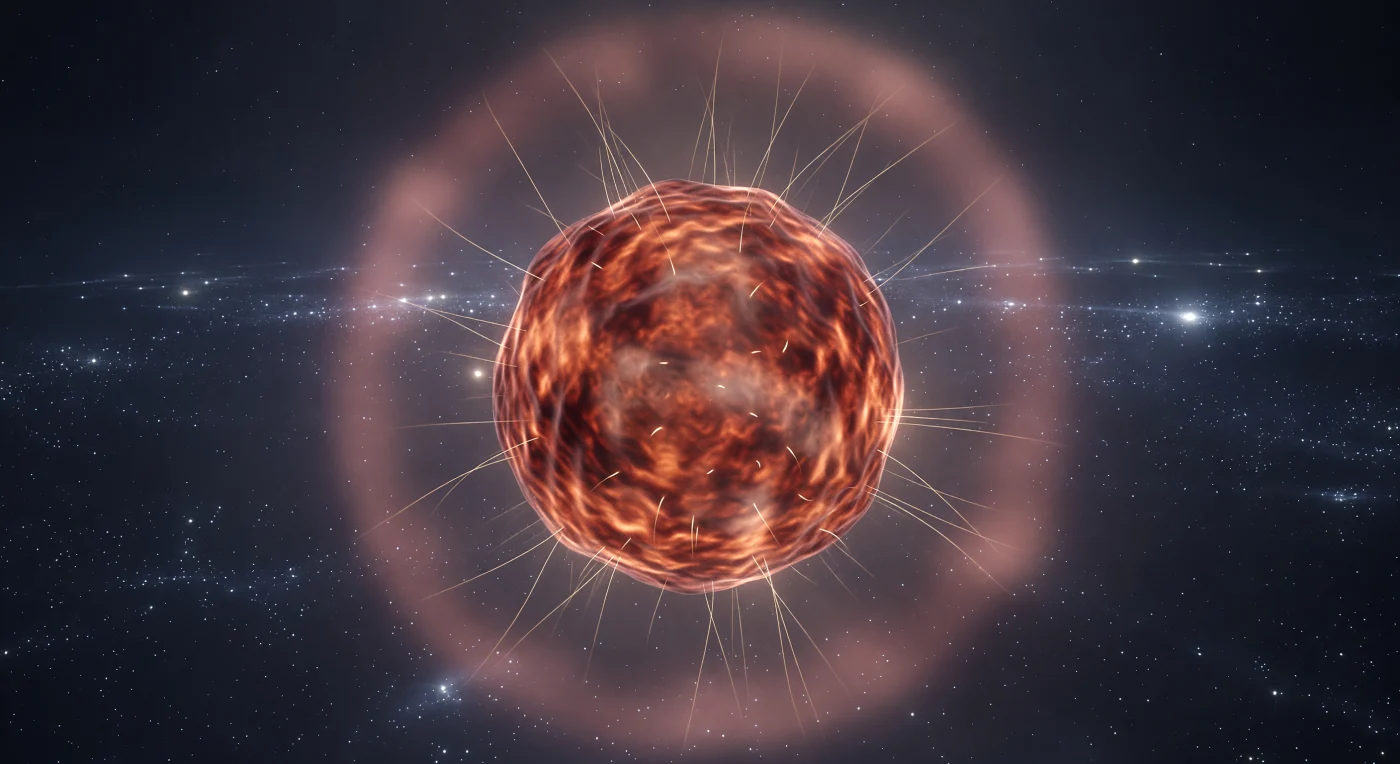
Before you hangs an iron nucleus rendered like a dark, spherical planetoid, its blurred surface mottled with crimson, sienna, and ember-orange textures that never quite settle into hard edges. The glow seems to rise from within, a consequence of nucleon probability densities, nuclear binding, and the outward pressure of the strong force, while faint pale-gold Coulomb filaments radiate away like a delicate corona. Around it, a soft amber halo marks the reach of pion exchange, fading into a vast surrounding void where the quantum vacuum itself shimmers with barely perceptible cold light. The scene feels immense and intimate at once: a dense object of nearly incomprehensible matter suspended in an empty field of fluctuating fields, charge, and confinement.
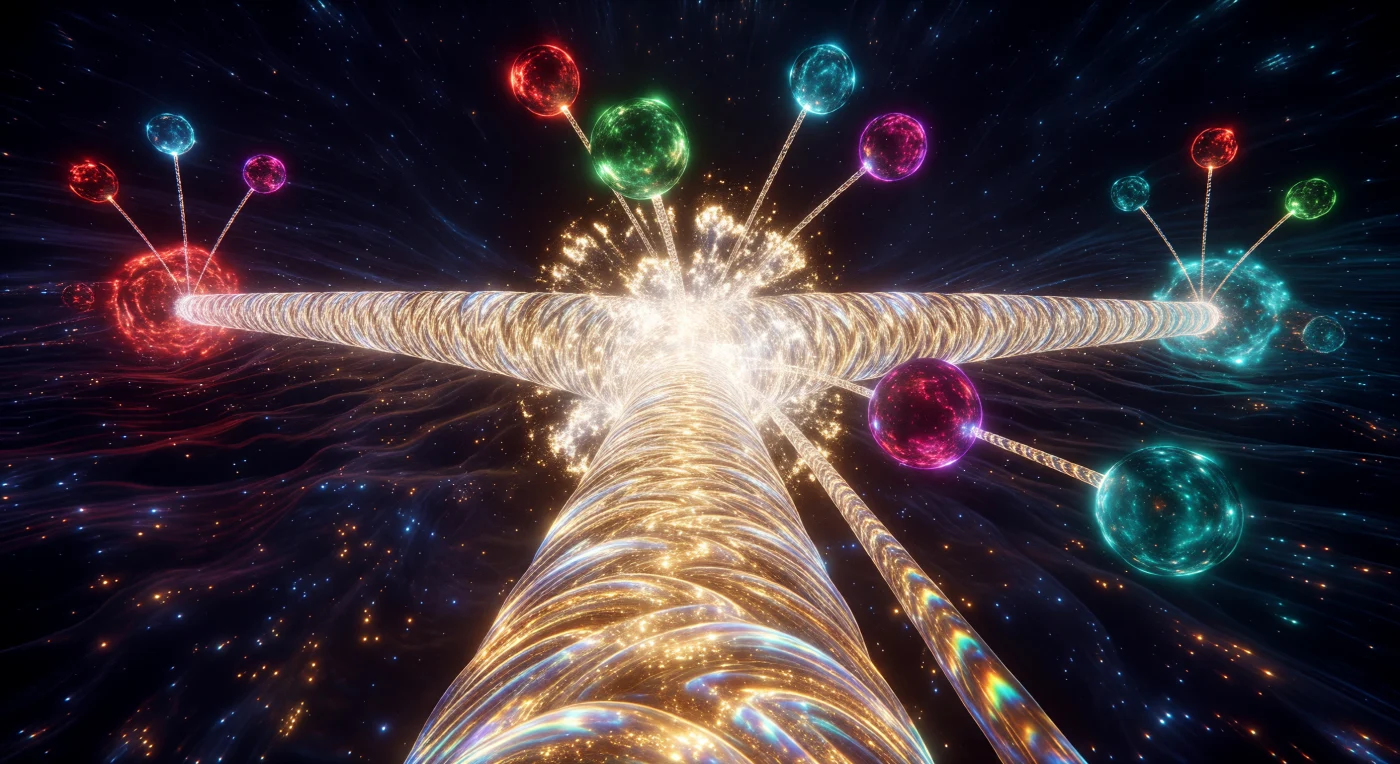
You are suspended inside a blazing corridor of white-gold field energy, with a red quark node receding at one end and a cyan node anchoring the other, both bound by a taut gluon flux tube that keeps its width while stretching under relentless confinement. At the center, the tube snaps in a blinding burst, and from that rupture emerge a green and a magenta quark-antiquark pair, each already pulling fresh strands of field behind them as the original string re-forms into new links. The scene reads like a luminous branching tree made of pure strong force: every stub elongates, strains, and tears again, turning a single break into a cascading hadron spray of meson and baryon fragments. Around the structure, the vacuum is not empty but alive with faint, flickering pair creation, giving the whole event the feel of standing at the heart of an unimaginable, femtometer-sized storm where color charge becomes visible as light.
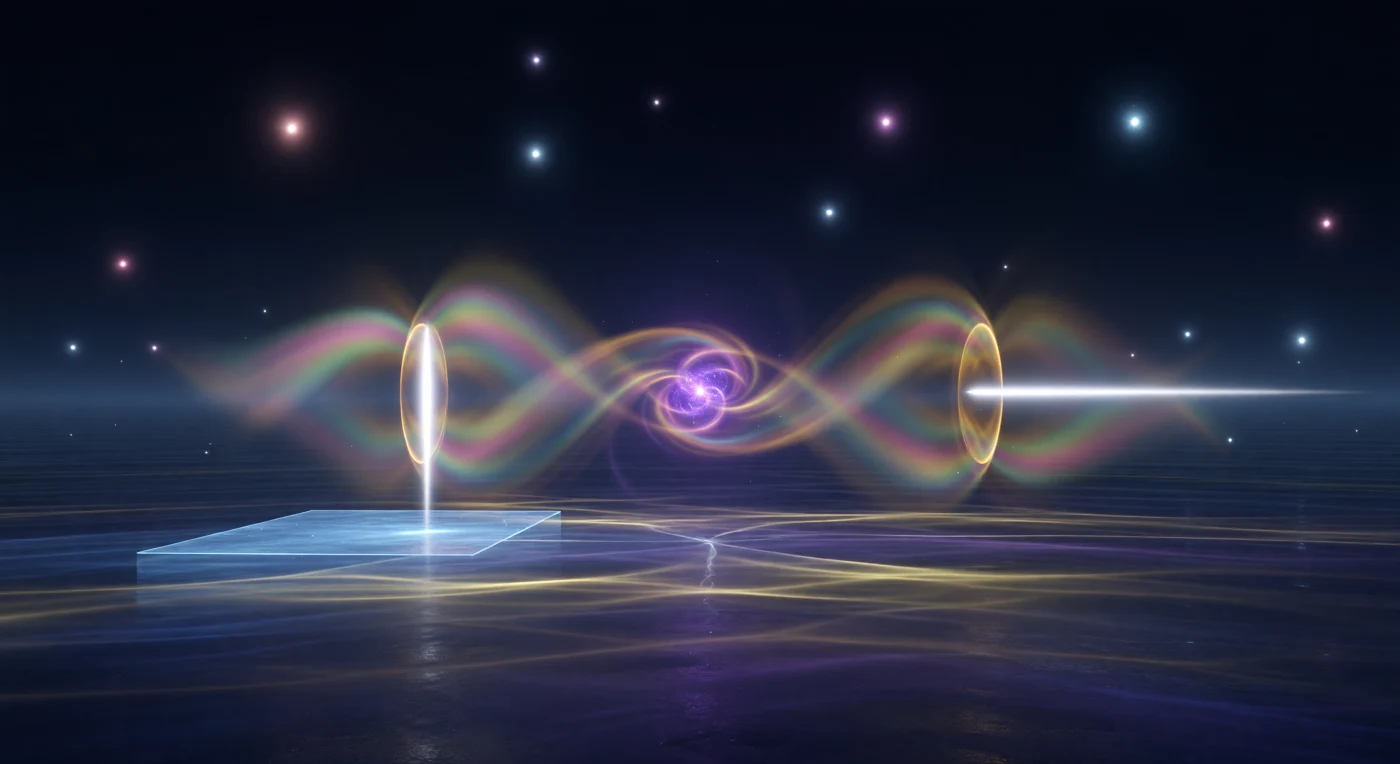
At the center of the scene, a deep-violet conversion burst smolders in the cold quantum vacuum, sending two golden photon wave packets racing in opposite directions through a dark indigo expanse that glows with faint zero-point ripples. Each packet is wrapped in a slowly rotating rainbow haze, the visual metaphor for polarization that has no fixed direction until measurement, while the vacuum itself feels like a living dielectric rather than empty space. On the left, a cool blue analyzer plane slices through one packet, and in the same instant both packets snap into crisp, perpendicular polarization states, their hazes collapsing into sharp white arrows. A faint silvery thread lingers between the two collapse events, not as a physical wire but as a visual echo of entanglement, making the whole space feel immense, quiet, and charged with nonlocal connection.
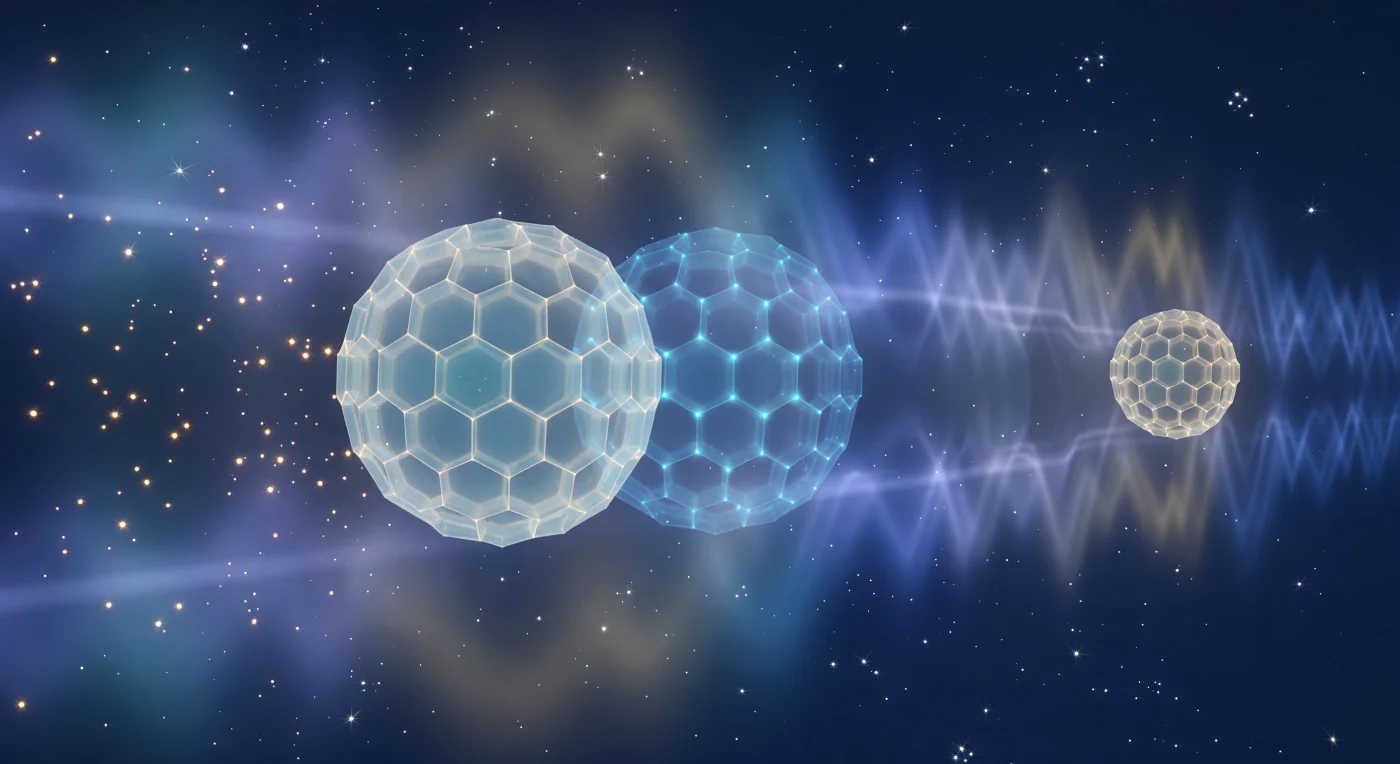
You see a fullerene molecule stretched across your view like a drifting geodesic world, its sixty carbon atoms forming a cage of pale blue-white facets that appear twice at once, two translucent ghost images occupying the same space and sliding through separate paths in the interferometer. Ahead of them, vivid violet and cobalt interference fringes hang in the void as standing waves of probability, their sharp periodic structure gradually disturbed by warm gold sparks that mark stray photons and air molecules touching one path and not the other. With each contact, one ghost brightens and firms into a more opaque, amber-tinged body while the other thins and fades, and the fringes blur from crisp bands into soft haze as coherence is lost. What began as a delicate overlap of possibilities resolves into a single definite molecule moving alone, the scene shifting from cool quantum translucence to the warm solidity of classical reality.
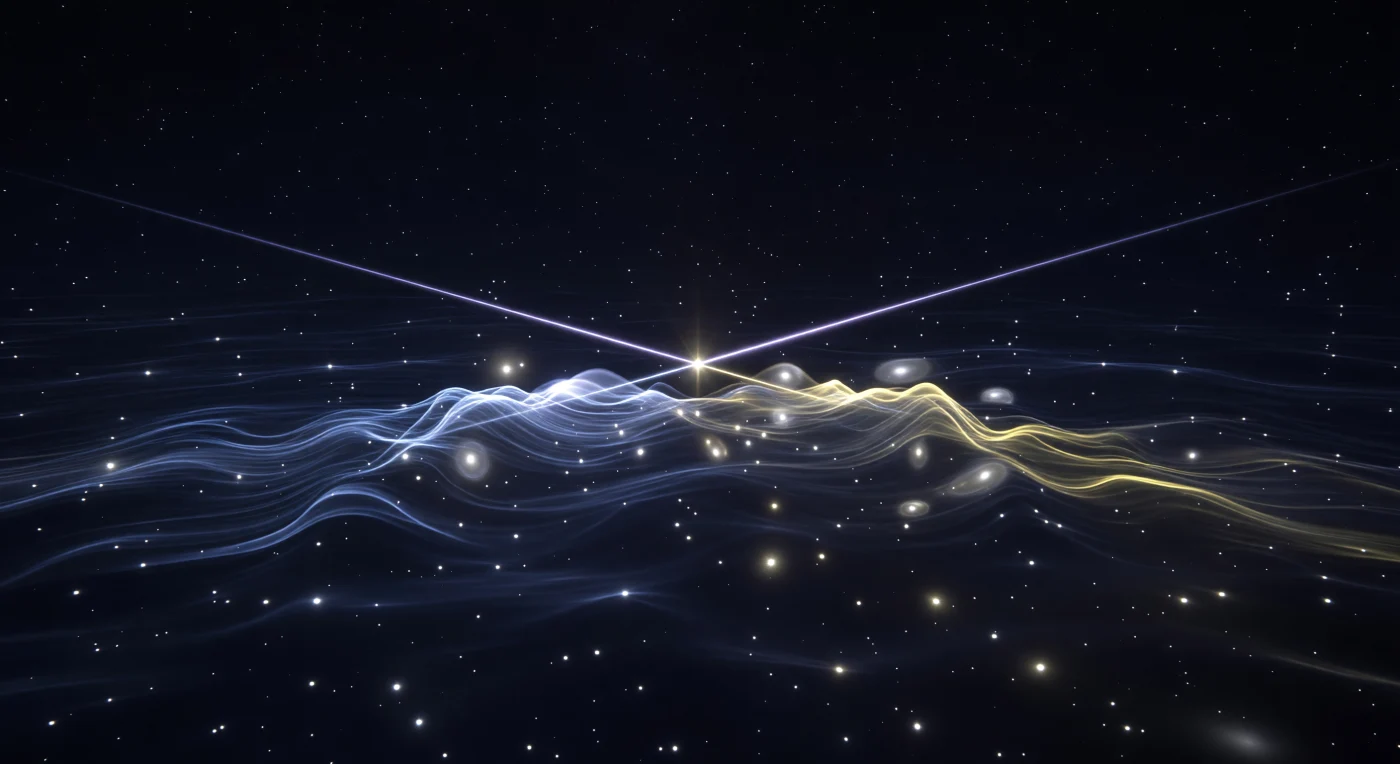
A vast indigo vacuum fills the frame, its darkness not empty but faintly alive with a subtle phosphorescent shimmer, as if the field itself were breathing. From opposite sides, a blue-white electron probability front and a gold-white positron front surge inward as layered, wave-like terrains, their interference fringes tightening in the narrowing gap while rapid translucent pulses mark the exchange of virtual photons. At the center, the overlap collapses into a blinding white-gold vertex, and two razor-clean violet-white gamma beams burst away in exactly opposite directions, carrying the interaction’s energy off at light speed. In their wake, nothing solid remains—only the fading afterglow of quantum fluctuations, and the unsettling sense of witnessing a conversion so complete that space itself seems briefly rearranged.
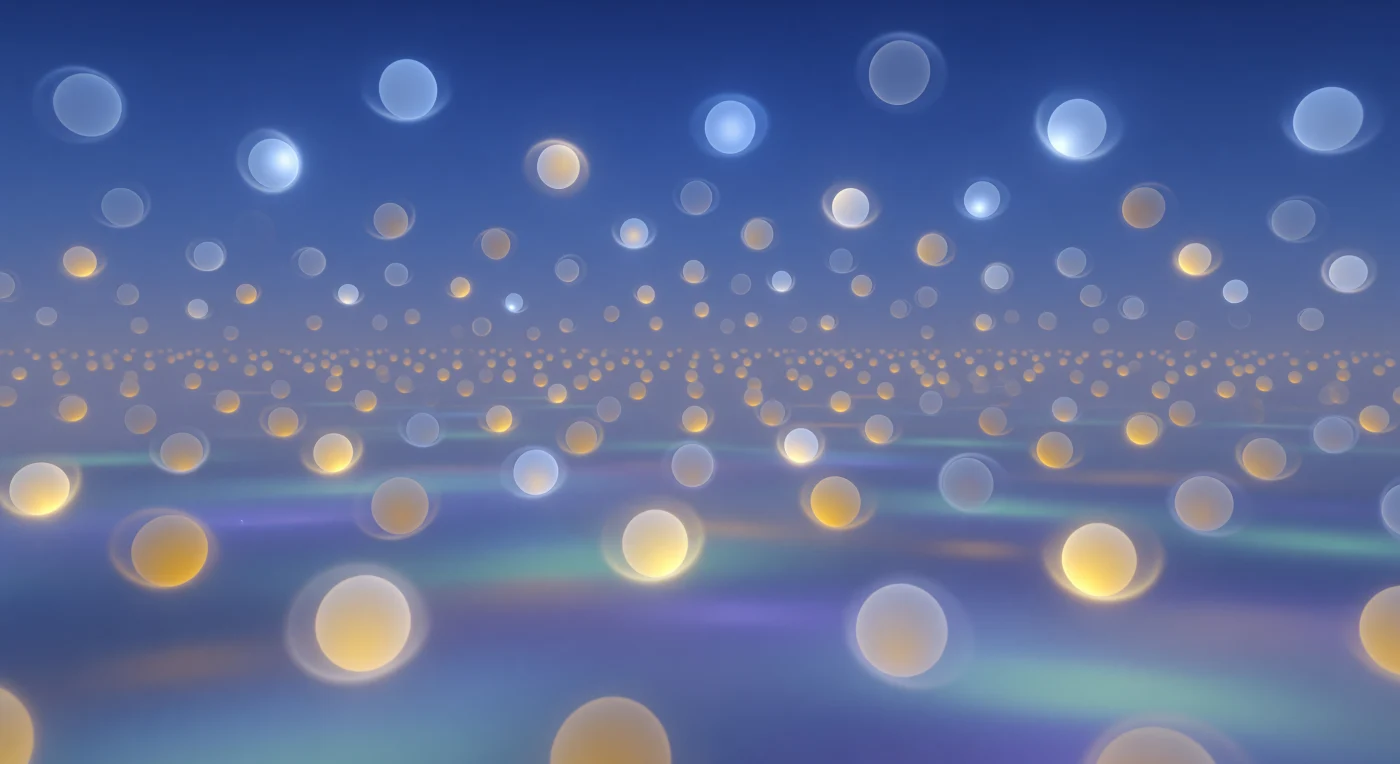
A vast field of translucent electron probability spheres fills the view, each hovering like a softly lit bubble in an indigo magnetic haze that presses in from every direction. Some glow cool blue-white and sit slightly higher, while others burn amber and hang lower, expressing the two spin populations that can occupy different energies in a magnetic field; around each one, a faint rotating asymmetry marks the slow precession of its magnetic moment. Now and then, a white-gold flash cuts through a sphere as a microwave photon flips a spin, briefly inverting its color before the glow settles again, like a living signal pulse in a coordinated quantum array. The scene feels boundless and breathable, with countless more spheres fading into the luminous distance, so dense with order and motion that the whole forest seems to hum with invisible field lines and resonant timing.