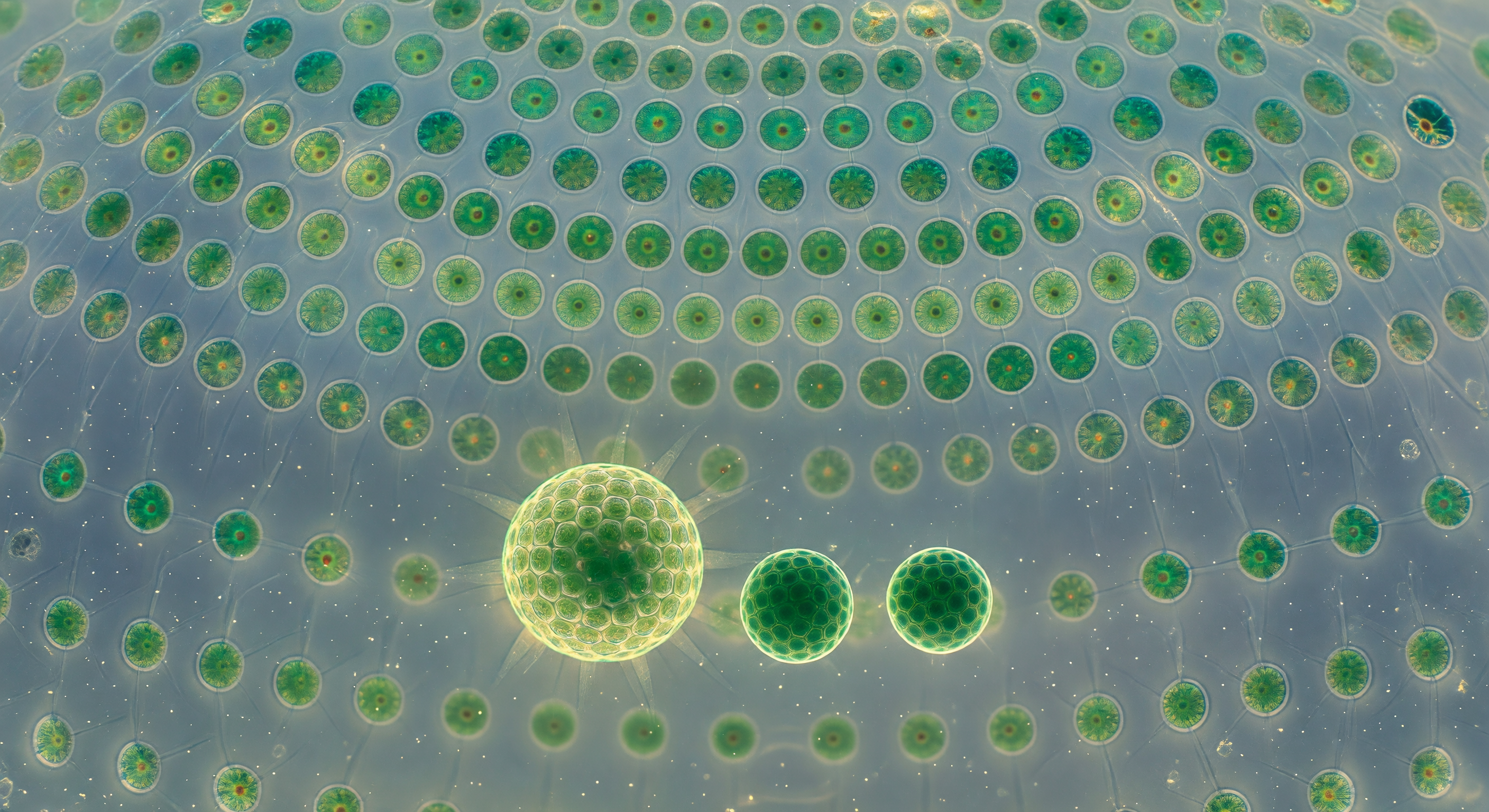
You stand at the hollow center of a living sphere barely half a millimeter wide, yet the scale it commands is monumental — the curving dome overhead resolved into a geodesic mosaic of thousands of somatic cells, each a ten-micron biflagellate organism locked into the transparent glycoprotein matrix like an emerald pressed into pale resin, connected to its neighbors by hair-fine cytoplasmic strands that catch the diffuse aquatic light as faint silver threads, stitching the entire colonial organism into a single coordinated architecture. This is *Volvox globator*, a green alga that occupies the threshold between unicellularity and true multicellularity: its roughly two thousand somatic cells are terminally differentiated — they can never divide — and exist solely to row the colony through the water column using paired flagella whose metachronal beat ripples continuously across the dome's inner face like wind crossing luminous moss, the collective motion rotating the whole sphere as it climbs toward light. Suspended in the clear fluid of the interior, three daughter colonies drift like planets in a glass reliquary — each one an inversion embryo that formed inside the parent through a developmental process called palintomy, dividing rapidly without growth and then turning itself inside out through a choreographed rupture, so that the flagella emerge facing outward — the largest daughter already shimmering with its own coordinated cilia-light, the smallest still a dense jade ball of cells waiting for its flagella to wake. The fluid between them trembles with Brownian motion, carries dissolved oxygen gradients shaped by photosynthesis, and holds the chemical signals that coordinate reproduction across the colony; the entire structure, from dome to daughters to the aqueous medium binding them, is a single organism in negotiation with itself.
Other languages
- Français: Dôme Cathédrale Volvox Intérieur
- Español: Cúpula Catedral Interior Volvox
- Português: Cúpula Catedral Interior Volvox
- Deutsch: Volvox Inneres Kathedralenkuppel
- العربية: قبة كاتدرائية فولفوكس الداخلية
- हिन्दी: वॉल्वॉक्स आंतरिक गुंबद कैथेड्रल
- 日本語: ボルボックス内部大聖堂ドーム
- 한국어: 볼복스 내부 대성당 돔
- Italiano: Cupola Cattedrale Interna Volvox
- Nederlands: Volvox Binnenste Kathedraalkoepel