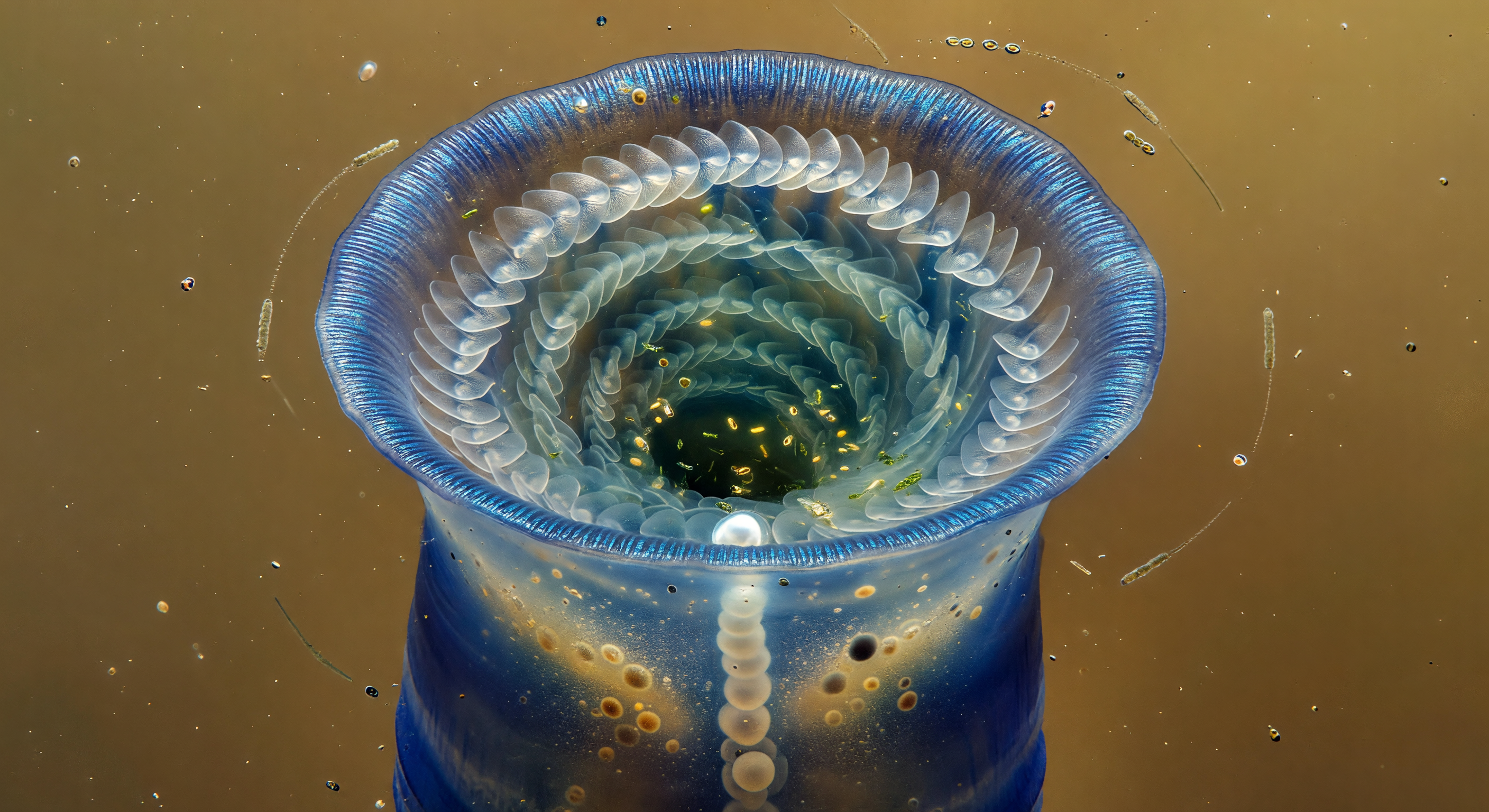
You hover directly above the living drain of a single-celled giant, staring down into the spiraling oral disc of a *Stentor coeruleus* — a blue-green whirlpool roughly half a millimeter tall, yet structurally as intricate as any coral reef or rain forest canopy. The rim of the disc is ringed with compound membranelles, each a fused paddle of hundreds of cilia sweeping in tight coordination at twenty to forty beats per second, generating the slow clockwise gyre that continuously funnels bacterial rods and algal cells down into the cytostomal pit below, a dark gravitational center from which nothing returns. Through the semi-transparent pellicle the macronucleus descends like a string of river pearls — its beaded lobes the control architecture for the thousands of genes the organism must run simultaneously, a single nucleus shattered into redundant nodes threading through cobalt endoplasm dense with food vacuoles at every stage of digestion. The parallel striations of stentorin pigment granules run longitudinally across the cortex in alternating Prussian blue and pale aquamarine bands, a biological textile so precisely repeated it reads as woven fabric rather than chemistry. Around the outer disc, diatom frustules and smaller protists orbit just beyond the pull of the current like debris at the edge of a gravity well, tracing arcs through amber-hazed water that is not empty but thick with dissolved organics, Brownian noise, and the slow chemical conversations of a living freshwater world.
Protists & protozoa