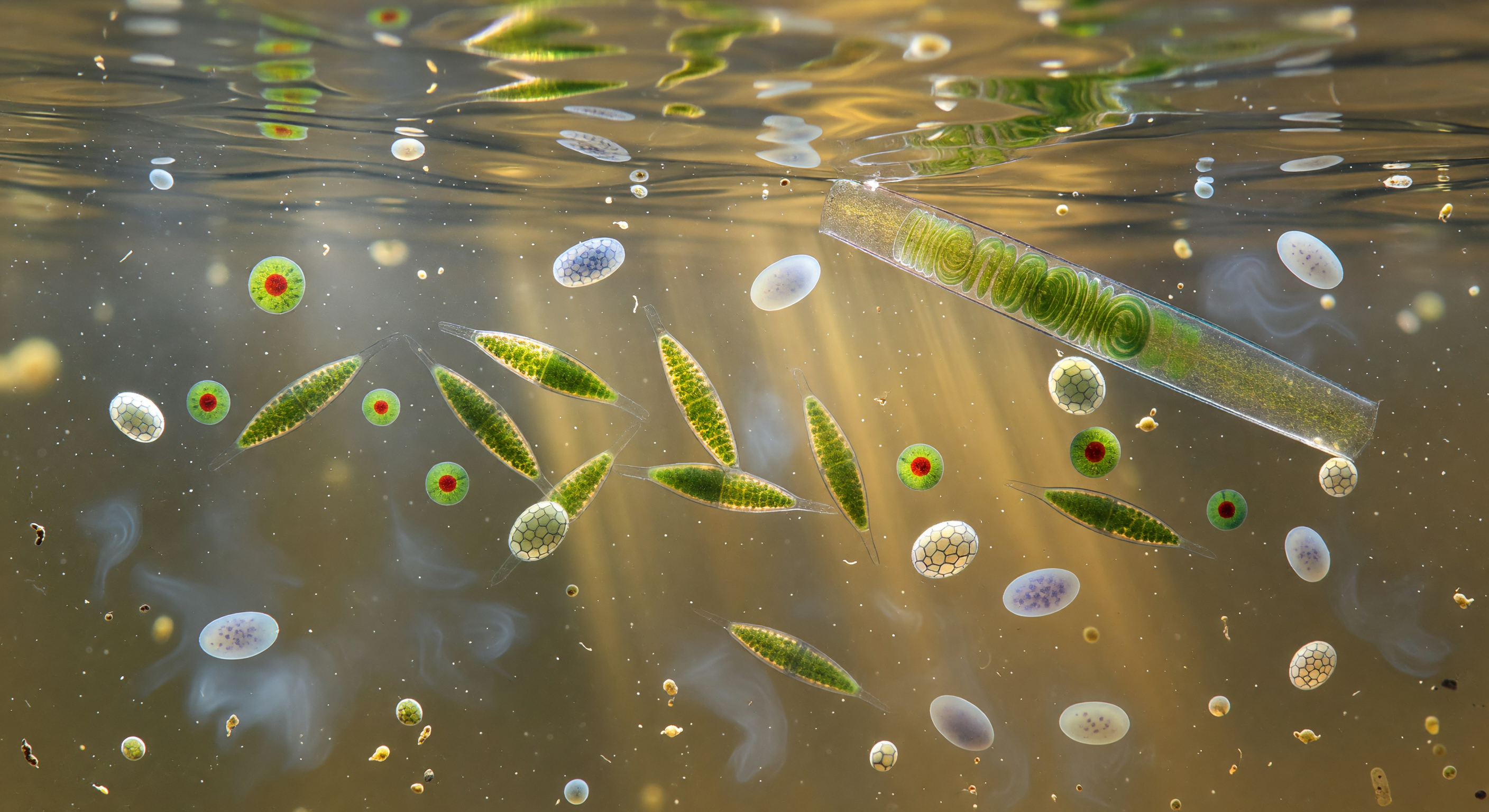
You hover two hundred micrometres below a ceiling that looks like liquid mercury — the underside of the pond's surface film — which shimmers and ripples with the micro-wakes of dozens of organisms pressing against it from below, returning afternoon light as a broken, amber-tinged mirror. The community suspended around you represents the neuston, a thin biological stratum exploiting the physics of the air-water interface: here, dissolved organic matter concentrates, dissolved oxygen peaks, and light intensity is highest, drawing photosynthetic protists upward until they pack the surface film at densities rare anywhere else in the water column. Euglena, each a tapered emerald spindle between fifteen and eighty micrometres long, jostle with bead-like Chlamydomonas cells whose brick-red eyespots — dense carotenoid granule arrays tuned to detect photon direction — burn like heated coals against the green, while barrel-shaped Coleps tumble slowly among them, their armour of interlocking calcium carbonate platelets fracturing the caustic light into hard facets. Threading through the bacterial haze that softens every distant form into a blueish-silver fog, a Spirogyra filament angles across the background like an industrial girder, its cellulose wall bending the ambient light into a bright specular edge and revealing the spiralling jade-green chloroplast ribbon within. This is a world governed entirely by viscosity and chemistry rather than by inertia: at Reynolds numbers far below one, every organism swimming through this crowded amber medium feels not open water but something closer to warm syrup, every flagellar stroke and pellicle contraction a deliberate negotiation with fluid that forgets no movement instantly.
Other languages
- Français: Tumulte de formes lacustres
- Español: Caos de formas en estanque
- Português: Tumulto de formas no lago
- Deutsch: Wildnis der Teichformen
- العربية: فوضى أشكال البركة
- हिन्दी: तालाब रूपों का उत्सव
- 日本語: 池の微生物の乱舞
- 한국어: 연못 생명체 형태의 향연
- Italiano: Caos di forme nello stagno
- Nederlands: Werveling van vijvervormen