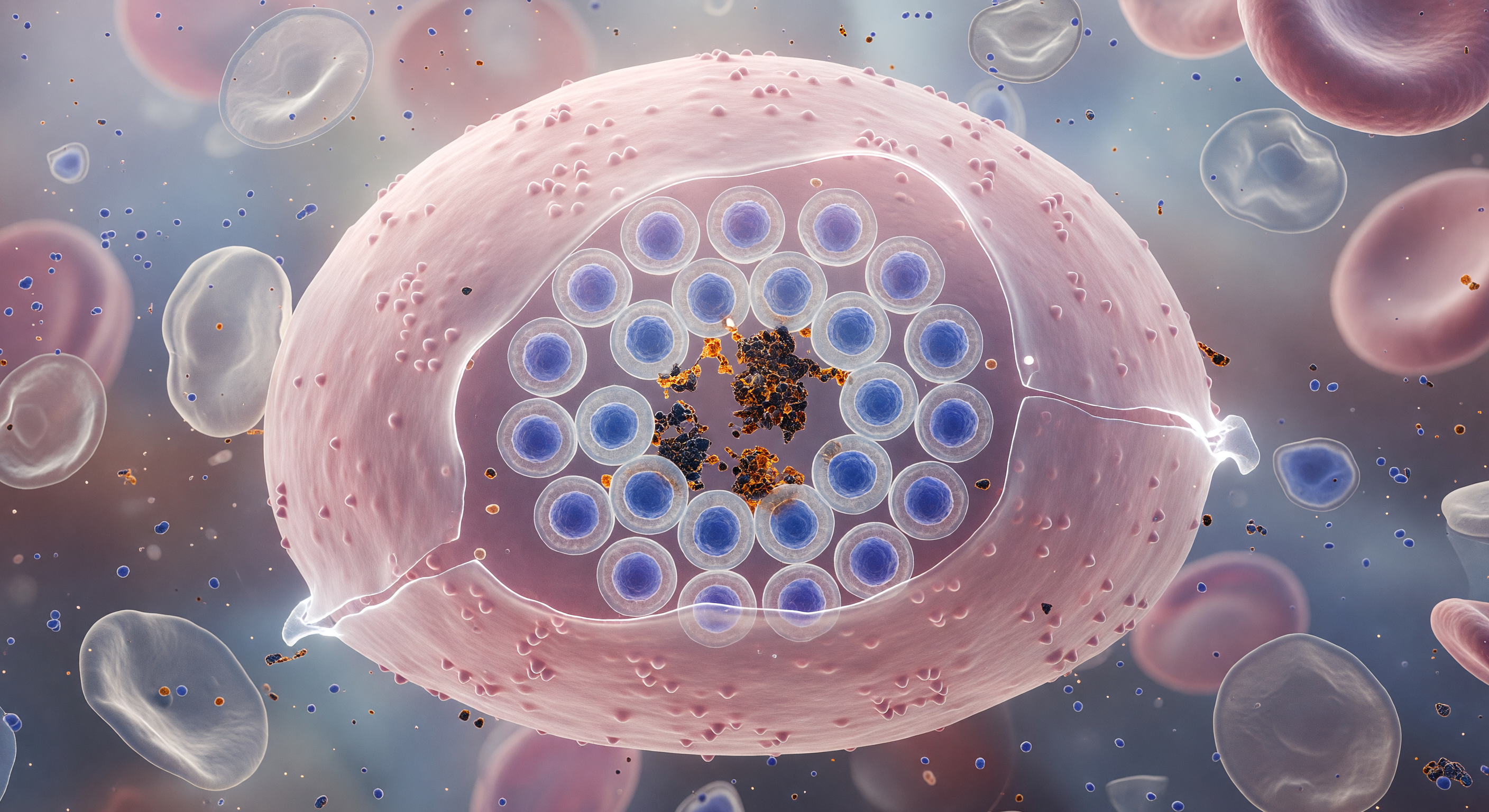
The surface pressing against your imaginary body is the outer membrane of a human red blood cell swollen far beyond its normal discoid shape — a vast pale-rose vault stretched to mechanical near-failure, its lipid bilayer thinned at intervals to a luminous, almost white translucency through which the catastrophic geometry inside is faintly visible. Within, twenty-four *Plasmodium falciparum* merozoites have arranged themselves into a schizont rosette, each parasite a compact ovoid with a cobalt-blue nucleus stained by Giemsa chemistry, the entire wheel-like assembly radiating outward from a central cairn of hemozoin — crystallized heme detoxification byproduct, chemically inert iron-porphyrin polymer, refracting the diffuse biological backlight into brief amber glints against the prevailing blue-violet cold. The host erythrocyte has been entirely hollowed: its hemoglobin digested, its cytoskeleton remodeled from within by exported parasite proteins that have pushed up dense knobby protrusions across the outer membrane surface, each knob an anchor point for cytoadherence to blood vessel walls. Osmotic pressure has been building for roughly 48 hours of intraerythrocytic development, and the membrane is now at mechanical failure — the contrast between its warm salmon-rose and the dense jewel-indigo of merozoite nuclei pressing outward reads as both exquisitely beautiful and functionally violent, the entire scene suspended in the last instant before rupture releases twenty-four invasion-competent daughters into the surrounding plasma.
Other languages
- Français: Rosette de Plasmodium Sur le Point d'Éclater
- Español: Rotura Inminente de Roseta de Plasmodium
- Português: Roseta de Plasmodium Prestes a Romper
- Deutsch: Plasmodium Rosette Kurz vor dem Platzen
- العربية: وردة بلازموديوم على وشك الانفجار
- हिन्दी: प्लाज्मोडियम रोसेट विस्फोट आसन्न
- 日本語: マラリア原虫ロゼット崩壊寸前
- 한국어: 말라리아 원충 로제트 파열 임박
- Italiano: Rosetta di Plasmodium in Procinto di Rompersi
- Nederlands: Plasmodium Rozet Breuk op Komst