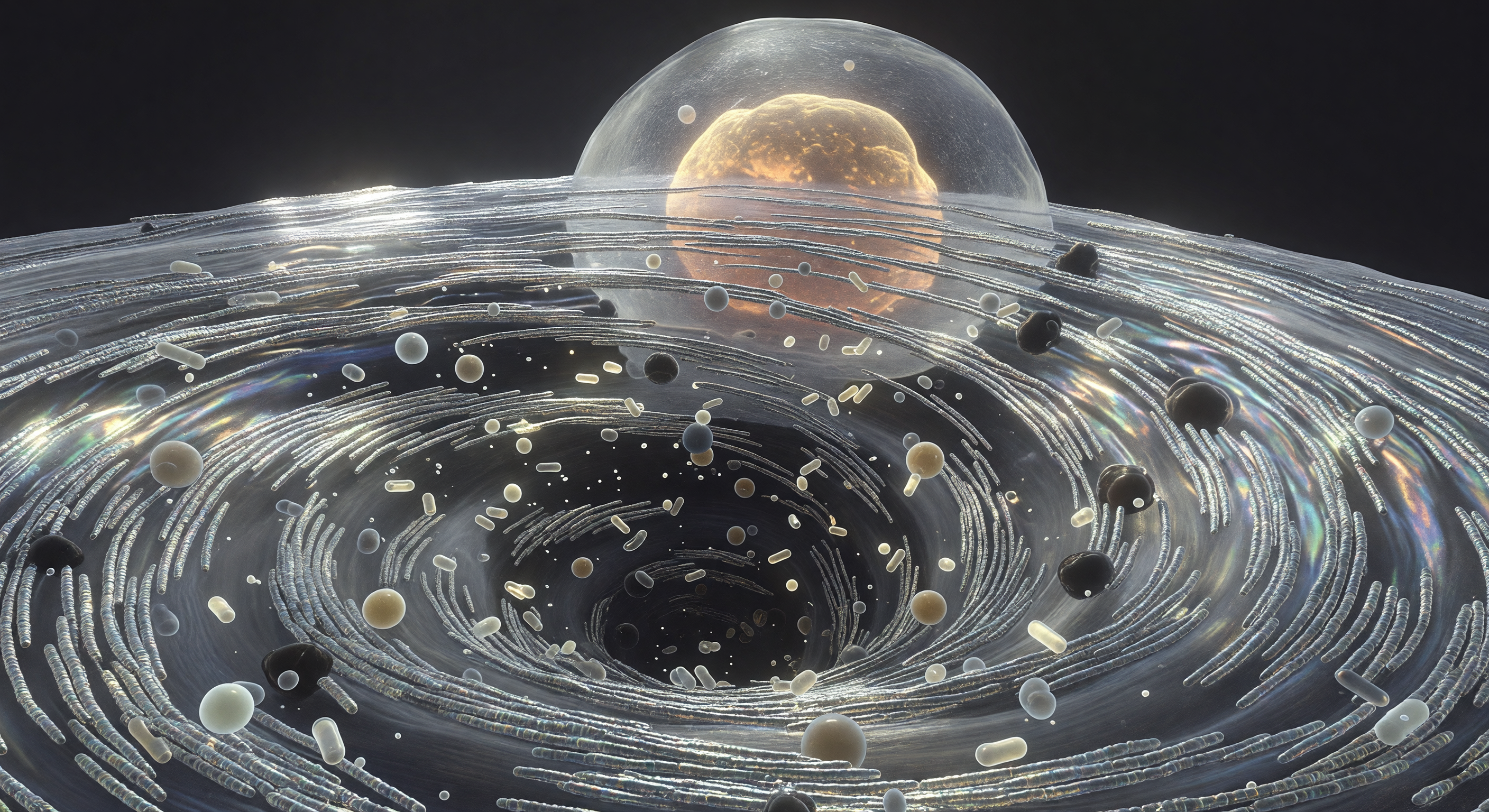
You float at the rim of an enormous spiraling canyon, its walls curving away in both directions like the interior of a living amphitheater — the oral groove of a single *Paramecium caudatum*, a structure no wider in reality than a few dozen micrometers yet rendered here as a vast descending ramp of biological architecture. The pellicle beneath you catches the phase-contrast illumination as a faintly metallic, striated membrane, its longitudinal protein ridges running in parallel bands across the ectoplasm, the entire surface shimmering in stark chiaroscuro — brilliant silver-white edged with ghostly diffraction halos against a deep charcoal void. Along the groove walls, thousands of compound ciliary organelles — membranelles and cirri packed in overlapping rows — beat in thundering metachronal waves that roll like slow luminous breakers down toward the cytostomal pit below, a pulsing aperture of absolute blackness where membrane trembles with the continuous business of phagocytotic engulfment. Rod-shaped bacteria tumble helplessly in the induced vortex current, glowing faintly gold-white where refracted light passes through their lipid membranes, spiraling inward and clustering as the groove narrows and flow accelerates — each one destined to be sealed inside a food vacuole and digested over the next several minutes by lysosomal enzymes. Above and behind you, the cell's body wall arches like frosted glass, and through it the macronucleus glows in warm amber — a massive kidney-shaped organelle that controls the vegetative metabolism of this single cell, a sovereign world operating entirely on chemistry, pressure, and the ceaseless mechanical labor of ten thousand coordinated cilia beating at up to forty strokes per second.
Protists & protozoa