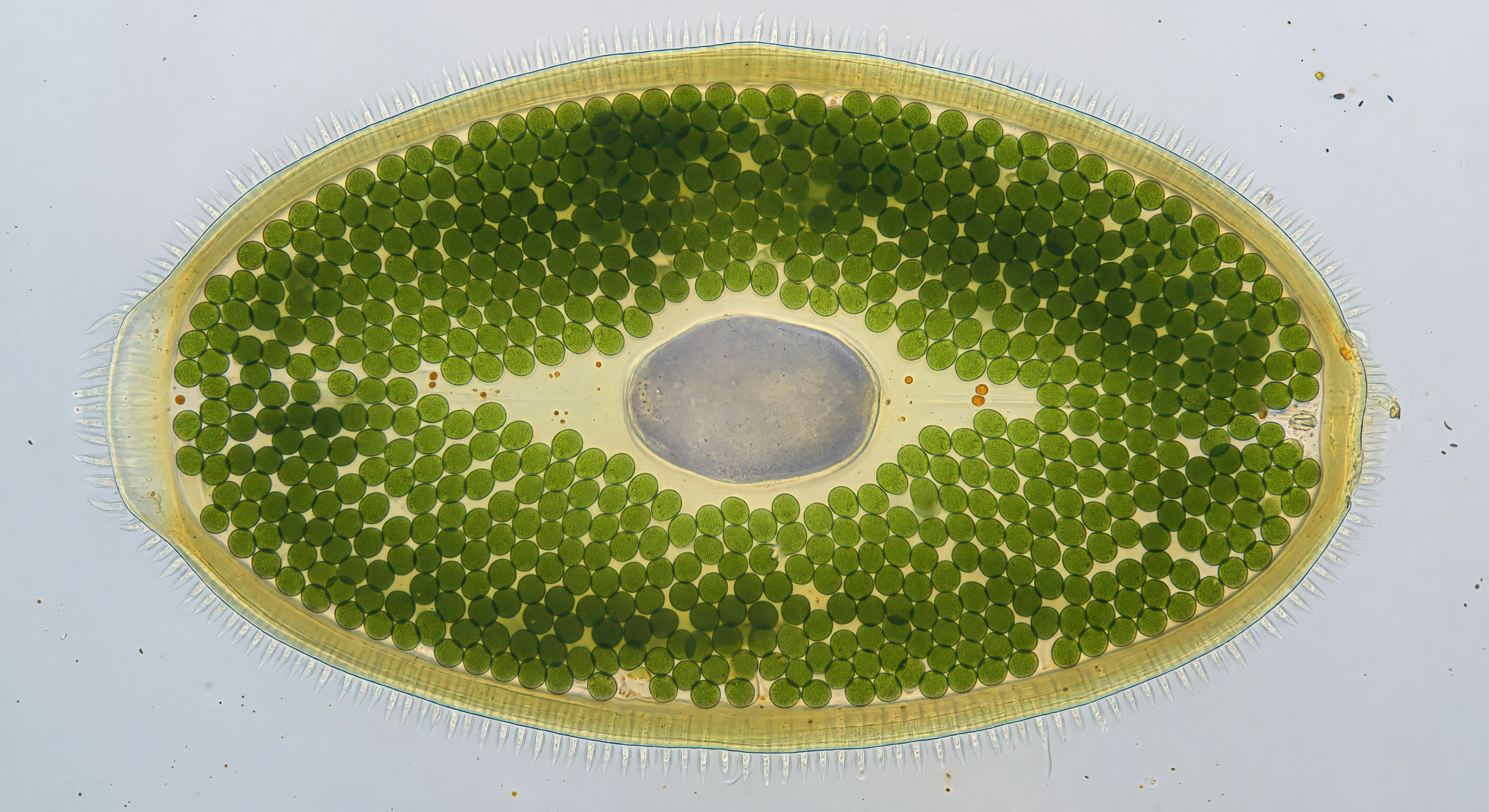
The view fills entirely with living green — you are pressed against the outer wall of a single *Paramecium bursaria*, the cell's transparent pellicle curving away in every direction like the hull of an illuminated lantern, its fine longitudinal ridges catching transmitted light as bright silver seams in the pale amber membrane. Beyond that thin architectural boundary, hundreds of *Chlorella* endosymbionts crowd the cytoplasm in an almost unbroken mosaic, each a compact chlorophyll-loaded disc roughly four micrometres across, their boundaries nearly touching so that the interior reads as a continuous forest canopy — a dense, layered ceiling of saturated green pressing outward to the cell's margins and receding inward through progressive shadow and softening focus. These are not passive passengers: *P. bursaria* maintains its symbionts through a suppression of the normal lysosomal digestion that would destroy ingested algae, while the *Chlorella* repay the arrangement with photosynthetic sugars, making the whole organism a self-contained greenhouse that migrates toward light as a single behavioral unit. Deep within the green mass, the macronucleus floats as a kidney-shaped clearing of pale grey-lavender, its smooth boundaries luminous against the particulate darkness around it — the polyploid somatic nucleus that governs the cell's daily housekeeping while a much smaller micronucleus, invisible in this crowd, holds the germline in reserve. At the outermost margin, the cilia fringe the pellicle as a continuous silver halo of backlit filaments, each individual hair beyond clean resolution but the whole array shimmering with the coordinated metachronal wave that drives this green, inhabited vessel through its aqueous world.
Other languages
- Français: Serre Vivante Paramécium
- Español: Invernadero Vivo Paramecio
- Português: Estufa Viva Paramécio
- Deutsch: Lebendes Gewächshaus Paramecium
- العربية: بيت زجاجي حي بارامسيوم
- हिन्दी: पैरामीशियम जीवित ग्रीनहाउस
- 日本語: ゾウリムシ生きた温室
- 한국어: 살아있는 온실 짚신벌레
- Italiano: Serra Vivente Paramecio
- Nederlands: Levend Broeikas Paramecium