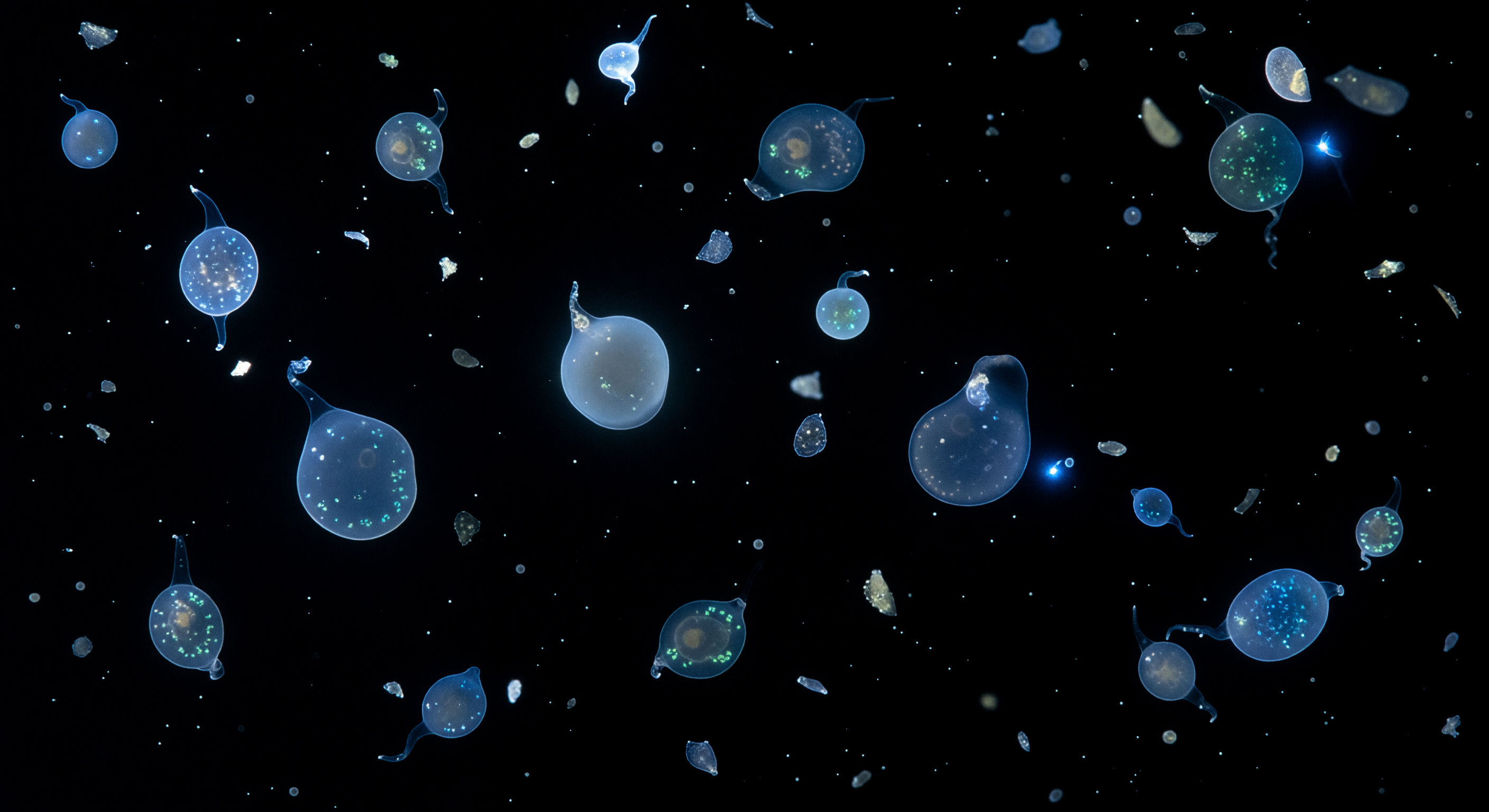
The darkness here is not metaphorical — it is the true optical zero of open ocean water at night, a medium that presses with the slight viscous drag of a fluid too dense to ignore, carrying its cargo of dissolved salts and slow-sinking flakes of marine snow past your bacterium-scaled body. Then the first Noctiluca scintillans cell detonates its bioluminescent discharge twenty micrometers away: a cold, precise burst at 490 nanometers that lasts a tenth of a second and in that interval reveals a gelatinous sphere roughly a millimeter across — vast from where you float — its plasma membrane bending its own emitted blue-green light into a brief aureole while luciferin-laden vesicles at the cytoplasmic periphery dim from blue-white to teal as the chemical substrate exhausts itself. The flash is confiscated rather than extinguished, and the darkness that replaces it is total, but before any adjustment is possible a second cell fires three body-lengths away, then a third behind it, the chain reaction propagating through mechanical pressure waves in the water as each new discharge prints a cerulean afterimage: a crescent of transparent cell wall, the shadow of a food vacuole containing a half-digested diatom, a trailing tentacle catching cold light like a wet filament. Marine snow drifts into one burst and scatters it into a foggy halo, and the cumulative strobing turns the water into something like a storm seen from inside a thundercloud — each interval of absolute blackness already collapsing under the weight of the next discharge, overlapping rings of cold fire propagating outward through oceanic infinity.
Other languages
- Français: Tempête Nocturne Bioluminescente
- Español: Tormenta Nocturna Bioluminiscente
- Português: Tempestade Noturna Bioluminescente
- Deutsch: Biolumineszenter Nachtsturm
- العربية: عاصفة ليلية بيولوميضية
- हिन्दी: नॉक्टिलुका जैव-प्रकाश रात्रि तूफान
- 日本語: 夜光虫の生物発光嵐
- 한국어: 야광충 생물발광 폭풍
- Italiano: Tempesta Notturna Bioluminescente
- Nederlands: Bioluminescente Nachtstorm