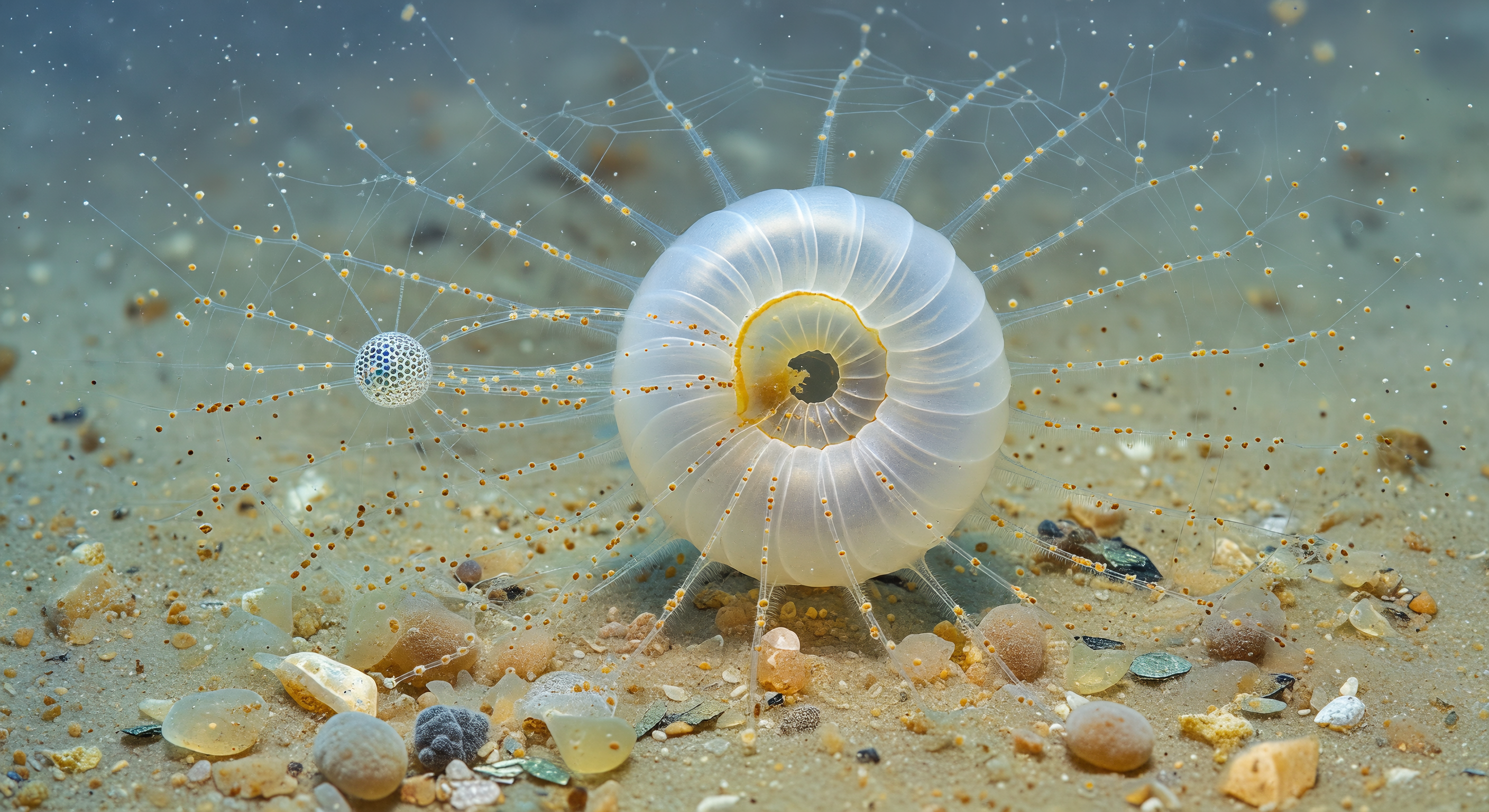
You hover above a silty seafloor like a ghost the size of a bacterium, the entire scene suffused with a sourceless blue-green transmitted light that turns the sediment into an ochre desert of mineral boulders and organic debris too vast to step over. Before you, the calcite architecture of a living foraminifera rises as an overwhelmingly white and luminous spiral of globular chambers — each surface smooth and chalk-brilliant, each suture a precisely carved groove, the whole structure built by a single-celled organism that secretes calcium carbonate walls and adds new chambers across its lifetime in a logarithmic sequence guided by no blueprint but chemistry and membrane geometry. Radiating outward from its aperture in every direction across that sediment surface is the reticulopod network: a web of anastomosing, ghost-thin cytoplasmic strands nearly invisible against the blue-green haze, betraying their existence only through the amber streams of organelle granules flowing bidirectionally along them — inward convoys of captured nutrition, outward flows of exploratory cytoplasm, the whole traffic system driven by myosin motors walking actin tracks within filaments barely wider than a few hundred nanometers. To your left, a diatom frustule — its silica walls perforated by pore arrays that scatter faint prismatic light — is gripped by converging strands and drawn imperceptibly inward, prey caught in a trap whose geometry is legible only by watching what moves through it, a living net spun not from silk but from the organism's own extended body.
Other languages
- Français: Piège Fantôme du Réticulopode
- Español: Trampa Fantasma del Reticulópodo
- Português: Armadilha Fantasma do Reticulópodo
- Deutsch: Geisternetz der Foraminifere
- العربية: فخ شبكة الثقبيات الشبحية
- हिन्दी: फोरामिनिफेरा जाल का भूत
- 日本語: 有孔虫の幽霊網罠
- 한국어: 유공충 망상위족 유령 덫
- Italiano: Trappola Fantasma del Reticulopodo
- Nederlands: Spooknet van het Foraminifeer