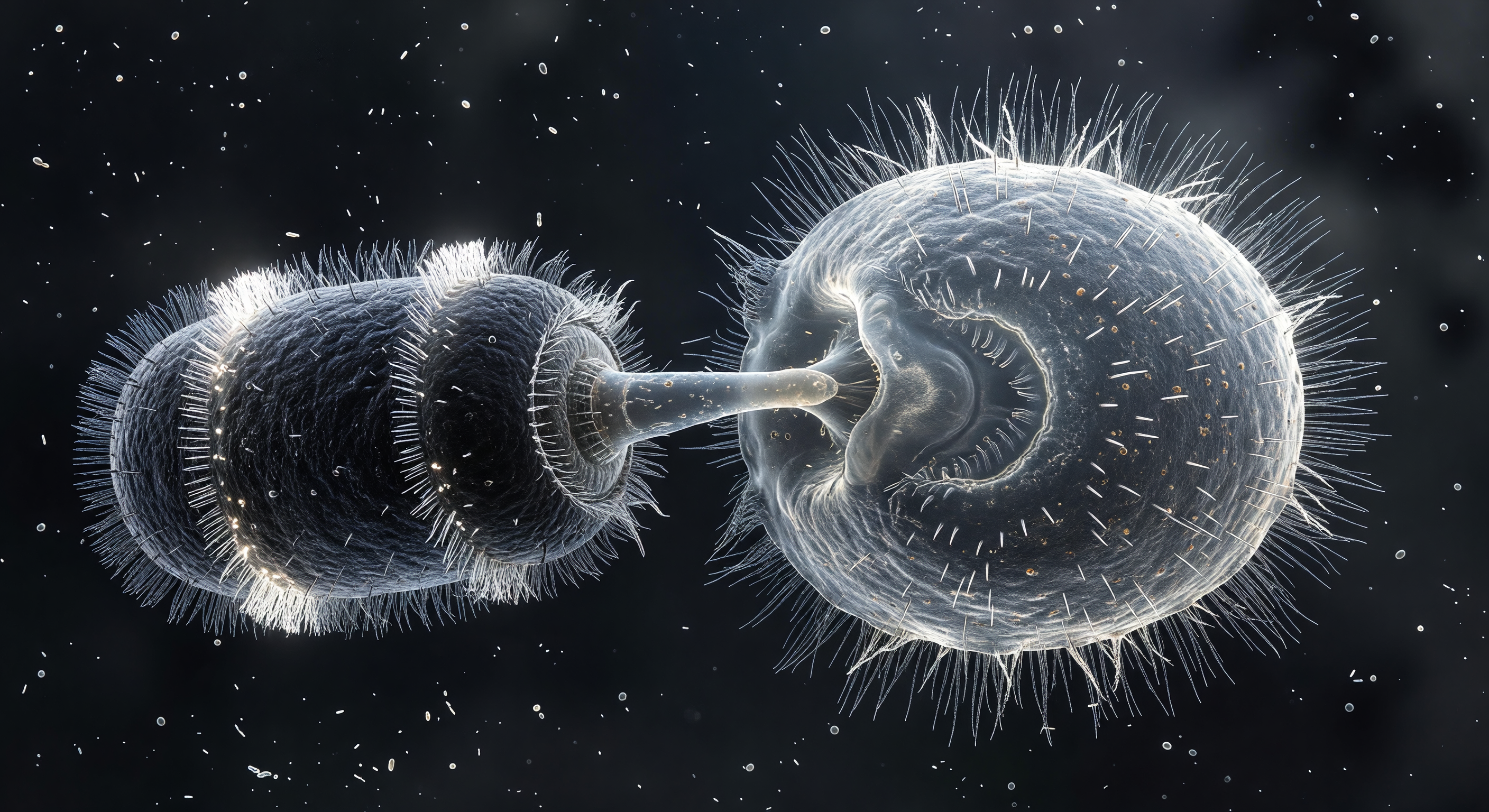
At the moment frozen here, a compact barrel-shaped predator occupies the left of the scene, its dark cylindrical body encircled by two luminous coronets of beating cilia — the Didinium nasutum in full attack posture, its muscular proboscis pressed against the flanking membrane of a Paramecium three times its size. The point of contact has become a crushed, glowing concavity where the Paramecium's pellicle — that semi-rigid alveolar cortex normally holding the cell's football form — is caving inward under a focused mechanical thrust that neither organism can reverse. Across the entire Paramecium surface, thousands of trichocyst filaments have discharged in the same instant, each a protein thread extruded at explosive speed from a cortical capsule, the collective result a radiant corona of spun-glass strands extending deep into the bacterial haze — a last-resort chemical and physical defense now clearly arriving too late, as the proboscis tip has already committed the pellicle to irreversible deformation. Inside the Paramecium's translucent body, food vacuoles at varying stages of digestion glow amber and brown against the hyaline ectoplasm, and the cilia ringing the cell have shattered from their normal metachronal wave into a disordered defensive bristle, the coordinated swimming machinery overwhelmed by a distress signal propagating through the cortex faster than the beat cycle can compensate. The surrounding medium reads as a near-black continuum alive with drifting bacterial rods and cocci at varying focal depths, a reminder that this arena of predation operates entirely within the viscous, inertia-free physics of low Reynolds number flow, where force is transmitted directly and instantly through the aqueous film, and where the compressed geometry of two colliding cells at this scale carries the visual and physical weight of a collision between much larger worlds.
Other languages
- Français: Didinium Frappe Sa Proie
- Español: Didinium Ataca Con Probóscide
- Português: Didinium Golpeia Com Probóscide
- Deutsch: Didinium Sticht Mit Rüssel
- العربية: ضربة خرطوم الديدينيوم
- हिन्दी: डिडिनियम प्रोबोसिस प्रहार क्षण
- 日本語: ディディニウム吻突撃の瞬間
- 한국어: 디디니움 주둥이 공격 순간
- Italiano: Didinium Colpisce Con Proboscide
- Nederlands: Didinium Slurf Aanval Moment