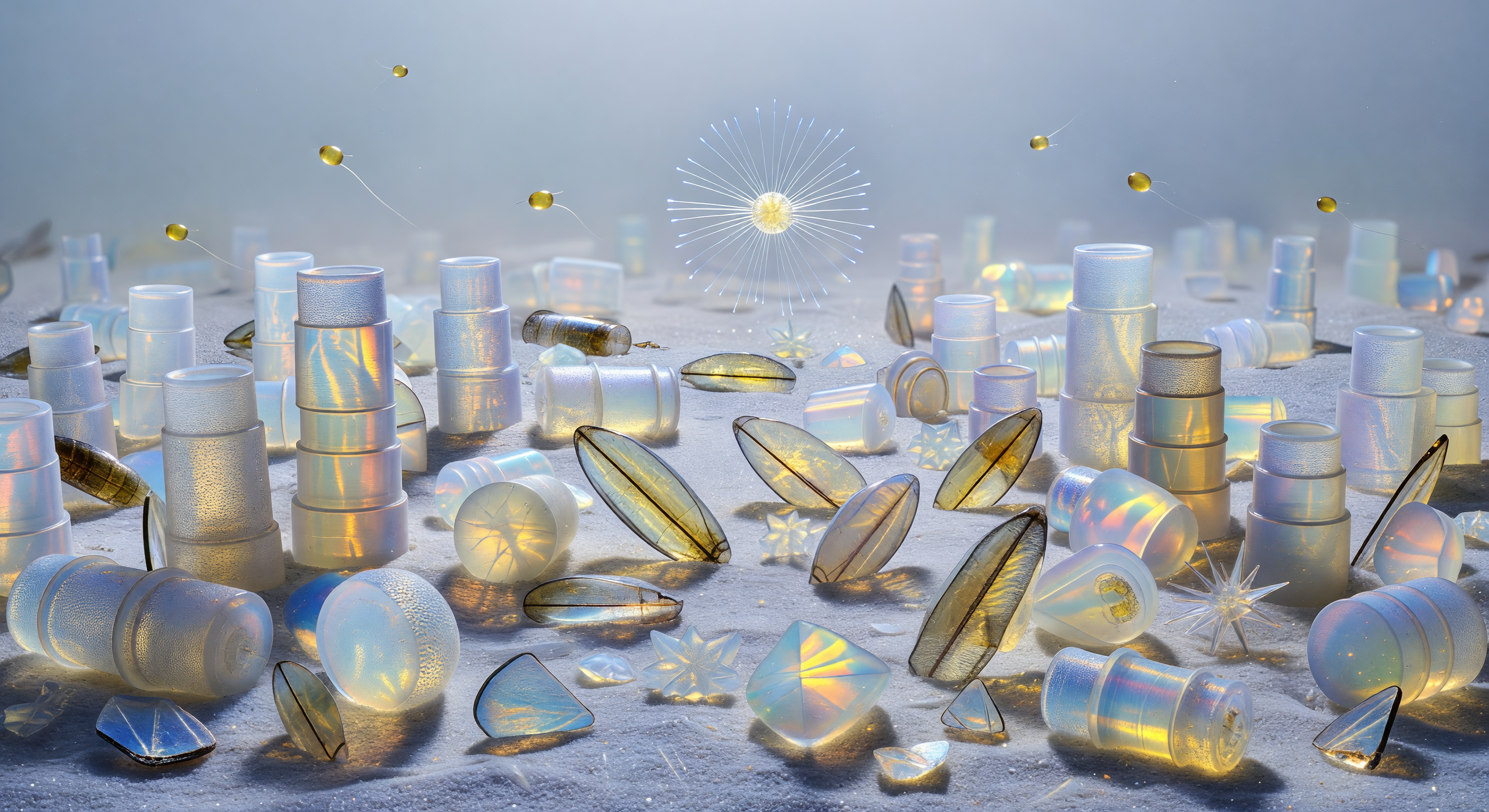
We drift just above a sediment floor of collapsed geometry — cylinders of ribbed silica toppled against boat-shaped keels, triangular shields propped at angles against star-form fragments, every surface perforated with pore arrays so fine they exist at the boundary of visible resolution. The material is diatom frustule, amorphous biogenic opal secreted valve by valve during the organisms' lives and now accumulating in layer after compacting layer, each piece between twenty and a hundred and fifty microns across, its silica body neither fully transparent nor opaque but possessed of the milky internal depth of polished moonstone. Transmitted light pours through every fragment and refracts at each striation boundary into interference fringes — cobalt, pale gold, rose — so that the sediment surface shifts its entire color register when our perspective moves by even a hair, a spectral mosaic generated entirely by nanometer-scale periodicity in the pore geometry rather than by any pigment. Out beyond the nearest ruins, where collapsed frustule columns open into corridors of stacked debris receding into blue-white depth-haze, an Actinophrys heliozoan hangs suspended in the water column like a living chandelier, its axopods — needle-straight rods stiffened internally by organized microtubule bundles — radiating outward in all directions and capturing transmitted light along their length, glowing like fiber-optic filaments above a crystal ruin field that extends, layer beneath layer, in all directions without a visible end.
Other languages
- Français: Ruines Cristallines de Diatomées
- Español: Campo de Ruinas Cristalinas Diatomeas
- Português: Campo de Ruínas Cristalinas Diatomáceas
- Deutsch: Diatomeenschalen Kristallruinenfeld
- العربية: حقل أطلال بلورات الدياتومات
- हिन्दी: डायटम क्रिस्टल खंडहर क्षेत्र
- 日本語: 珪藻殻の水晶廃墟野
- 한국어: 규조 수정 폐허 들판
- Italiano: Campo di Rovine Cristalline Diatomee
- Nederlands: Diatomee Kristallen Ruïneveld