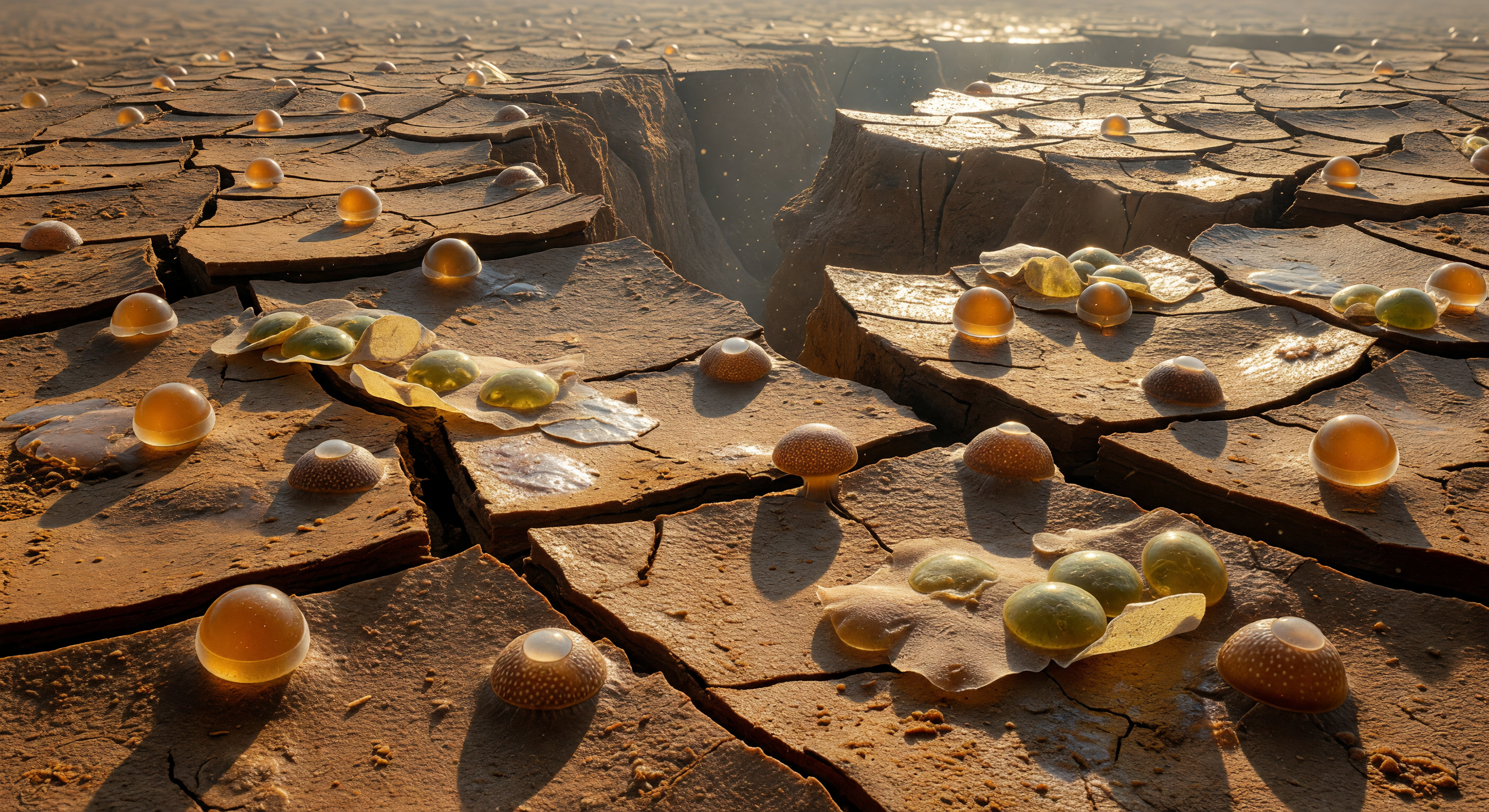
Across a vast fractured plain of desiccated clay, warm oblique light rakes over a mosaic of polygonal mud plateaux separated by shadowed crevasses, illuminating the scattered survivors of a vanished pond: amber spheres and chitin domes of dormant protist cysts that rest against the granular substrate like polished beads dropped on broken stone. Each Colpoda cyst is a masterpiece of biological engineering — a double-walled chitinous capsule roughly 15 micrometres across, its outer wall chemically hardened against osmotic assault and UV damage, enclosing a metabolically arrested cell that has shut down nearly all biochemical activity and can persist in this state for years, even decades, through cycles of freeze, desiccation, and chemical stress. The Arcella tests nearby are domed helmets of self-secreted organic material, their apertures sealed with a translucent plug, their surfaces bearing a fine geometric lattice of protein subunits — each one a biological vault whose inhabitant has withdrawn entirely from the world. Between the solitary cysts, collapsed sheets of dried Euglena palmella mucilage catch the raking light with a faint biological sheen, their olive tints betraying dormant chloroplasts still holding their pigment inside cells that have surrendered motility and individuality for collective encystment in a communal gel. Everything here is suspended in a kind of deep biological time, waiting — each smooth, perfected form a stark, luminous anomaly against the fractured geological disorder of the substrate — for the chemistry of water to return and unlock them.
Other languages
- Français: Kystes Dormants dans la Boue Craquelée
- Español: Quistes Dormidos en Barro Agrietado
- Português: Cistos Dormentes no Barro Rachado
- Deutsch: Zysten im Rissigen Schlamm
- العربية: أكياس راكدة في الطين المتشقق
- हिन्दी: दरारदार मिट्टी में पुटी सुप्तता
- 日本語: ひび割れた泥の中の休眠シスト
- 한국어: 갈라진 진흙 속 휴면 포낭
- Italiano: Cisti Dormienti nel Fango Screpolato
- Nederlands: Cysten in Gebarsten Modder