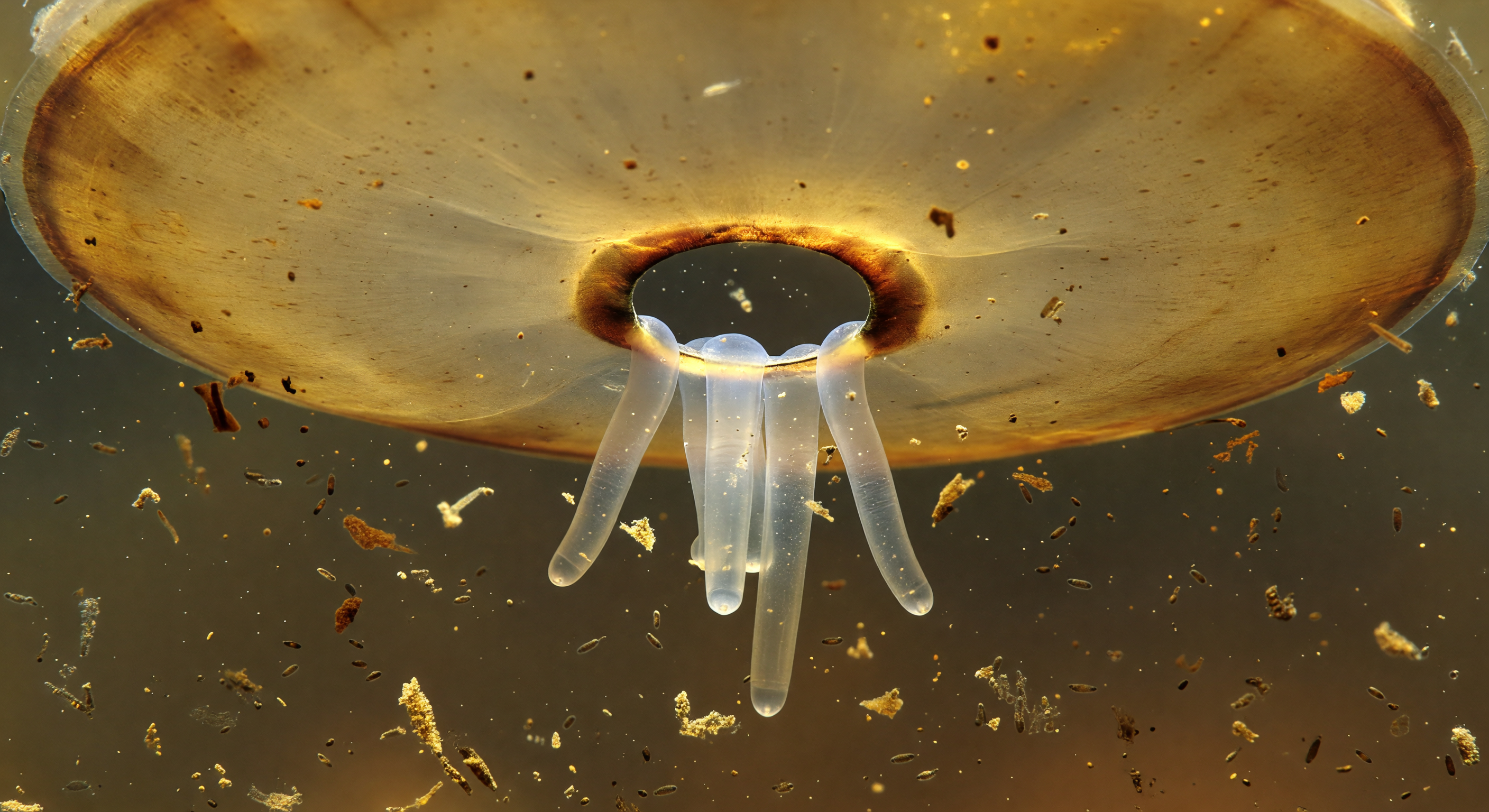
You are suspended in murky freshwater just below the sediment surface, gazing upward into a space dominated almost entirely by the curved amber ceiling of an *Arcella vulgaris* test — a secreted chitinous dome perhaps 100 to 200 micrometers across, its semi-transparent walls transmitting light as a warm honey-gold stain, thickening toward the equatorial rim into deep amber-brown like centuries-old lacquered resin. At the precise center of this vaulted ceiling, the aperture opens downward as a dark circular portal ringed by a sharp chitinous lip, and from it descend four lobopodia — thick, blunt-tipped cylinders of hyaline ectoplasm, utterly transparent yet structurally substantial, extending with the glacial slowness of pseudopodial flow at the low Reynolds numbers that govern all motion at this scale, where viscosity overwhelms inertia and every movement is a negotiation with the fluid itself. These extensions of living cytoplasm carry faint internal granules drifting in the streaming endoplasm, and where they catch transmitted light they glow a cold blue-white against the dome's warmth, each one a probe reaching into the particulate world below — a world of drifting bacterial rods, fragments of decaying plant material, and colloidal organic matter that renders the water itself luminous and dense with chemical information. The entire scene conveys the reality that this single-celled organism, armored in its self-built organic shell, is actively engaging its environment through coordinated cytoplasmic extensions while anchored safely within its amber vault.
Other languages
- Français: Dôme Arcella Ouverture Dessous
- Español: Vista Cúpula Arcella Abertura
- Português: Vista Cúpula Arcella Abertura
- Deutsch: Arcella Kuppel Öffnung Unten
- العربية: قبة أرسيلا من الأسفل
- हिन्दी: आर्सेला गुंबद द्वार दृश्य
- 日本語: アルセラ殻底面開口部
- 한국어: 아르셀라 돔 개구부 전망
- Italiano: Vista Cupola Arcella Apertura
- Nederlands: Arcella Koepel Opening Zicht