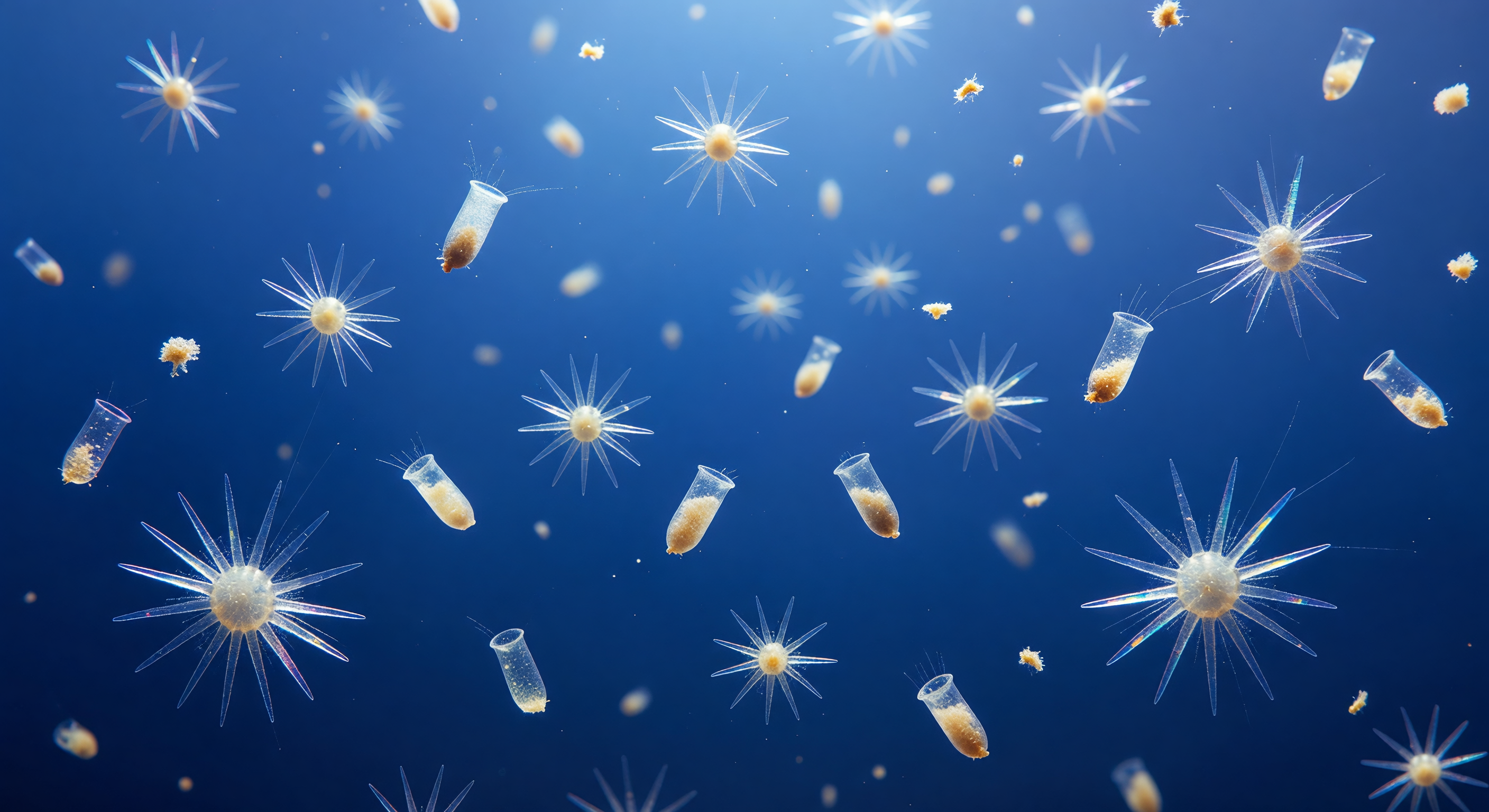
You are suspended in the open ocean at twenty meters depth, looking upward through a column of water that has filtered sunlight down to its last surviving wavelength — a saturated cobalt blue near 460 nanometers that fills the entire visual field like the interior of a luminous gem. Throughout this column, Acantharia drift at multiple focal depths, each one a starburst of twenty strontium sulfate crystal spicules arranged in the precise geometric symmetry of Müller's law, their birefringent shafts shattering the downwelling light into prismatic coronae of ice-white and pale violet that bloom outward like cold halos — these crystals are among the only biological hard parts on Earth built from strontium sulfate rather than silica or calcium carbonate, and they dissolve completely when the organism dies, leaving no fossil trace. Scattered among them, tintinnid ciliates hang at oblique angles within their hyaline lorica vases — tapered tubes of agglutinated coccoliths that transition from amber at the base to near-perfect transparency at the open rim, where a barely-resolved fringe of cilia marks the threshold between organism and ocean. Between all these crystalline architectures, soft flocs of marine snow — mucus aggregates, colonial debris, and detrital particles — drift across the frame, their warm amber and cream surfaces a quiet counterpoint to the mineral precision of the spicules, everything suspended together in a water column that functions not as empty space but as a living medium, faintly particulate, chemically complex, and threaded through with dissolved organic matter that gives the blue its almost electric warmth.
Other languages
- Français: Étoiles Acanthaires en Colonne Bleue
- Español: Estrellas Acantarias en Columna Azul
- Português: Estrelas Acantárias na Coluna Azul
- Deutsch: Acantharia-Sterne in Blauer Wassersäule
- العربية: نجوم الأكانثاريا في العمود الأزرق
- हिन्दी: नीले समुद्र में एकैंथेरियन तारे
- 日本語: 青い海中のアカンサリア星
- 한국어: 푸른 바다 기둥 속 아칸타리아 별
- Italiano: Stelle Acantarie nella Colonna Blu
- Nederlands: Acantharia Sterren in Blauwe Waterkolom