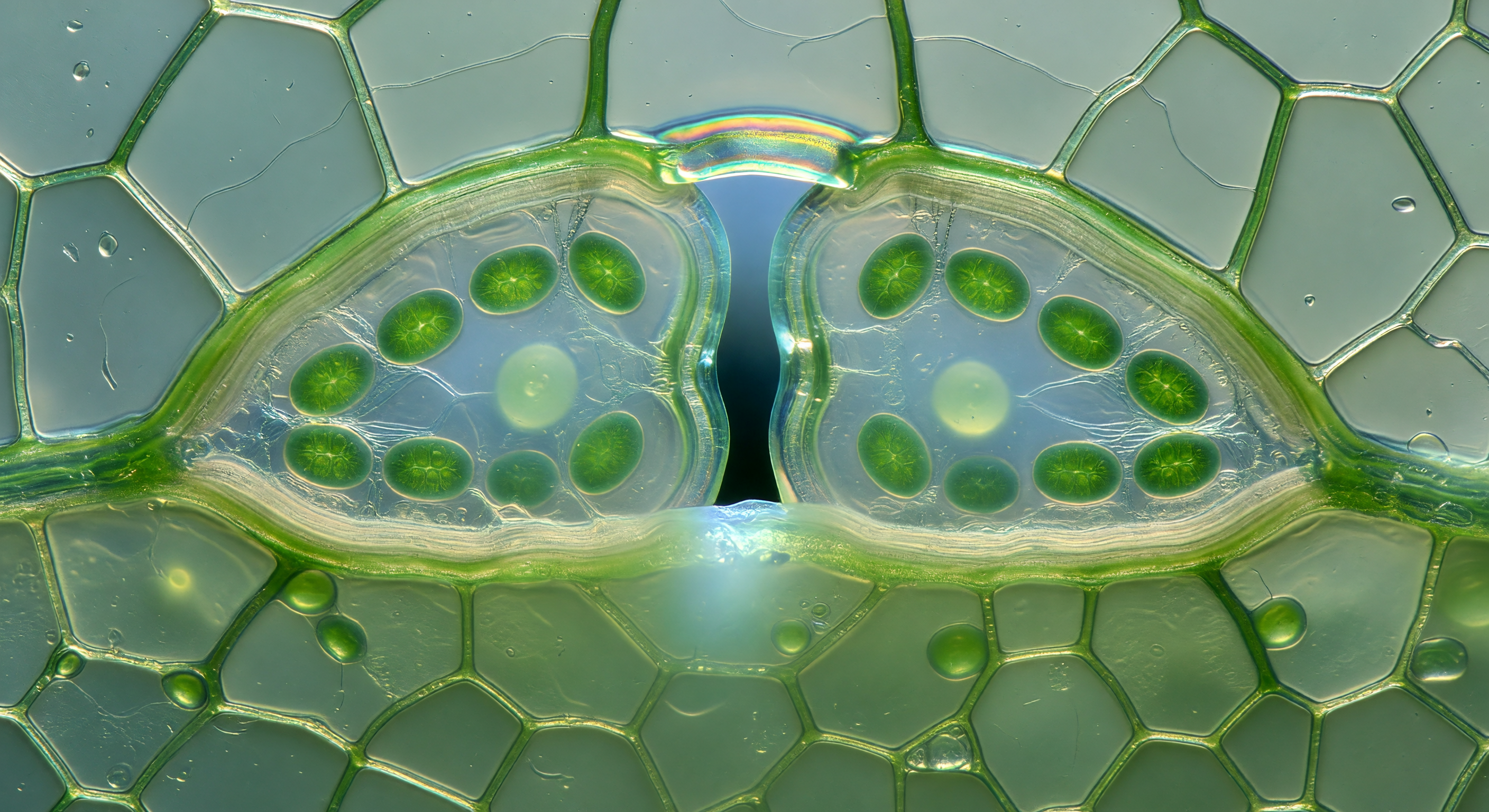
Looking upward from the substomatal cavity, you find yourself suspended inside a living architectural vault — two kidney-shaped guard cells arch overhead like the keystones of a cathedral door, each one swollen taut with osmotic pressure, their surfaces gleaming with an aqueous film that transforms oblique light into long specular ridges of wet jade. The inner walls of these cells are visibly thickened, their cellulose microfibrils packed into pale ivory laminations whose structural asymmetry is the sole mechanical reason the pore gapes open rather than collapsing — a seven-micron slit of cold blue-white sky visible at the apex, backlit by open atmosphere and sharply contrasting with the warm chlorophyll-green pressing in from either side. Along the inner face of each guard cell, twelve chloroplasts are marshalled in a loose procession, lens-shaped bodies four to six microns long, their photosynthetic membranes glowing with an almost self-generated luminescence, pressed there by the very turgor pressure that holds the stoma open — a feedback written directly into the cell's geometry, since the same osmotic engine that drives guard cell inflation also energizes the chloroplasts performing the photosynthesis that fuels it. Around this incandescent frame, the surrounding epidermal pavement cells recede as pale, featureless panes, large-vacuolated and nearly colorless, while below your vantage point the substomatal cavity dissolves into a spongy mesophyll labyrinth where wet cell surfaces catch condensed vapor into gleaming meniscus films and scatter light into a soft biological fog.
Other languages
- Français: Valve Stomatique Vue Dessous
- Español: Válvula Estomática desde Abajo
- Português: Válvula Estomática por Baixo
- Deutsch: Spaltöffnung von Unten
- العربية: صمام ثغري من الأسفل
- हिन्दी: नीचे से रंध्र द्वार
- 日本語: 気孔弁を下から見る
- 한국어: 아래에서 본 기공 밸브
- Italiano: Valvola Stomatica dal Basso
- Nederlands: Huidmondje van Onderen