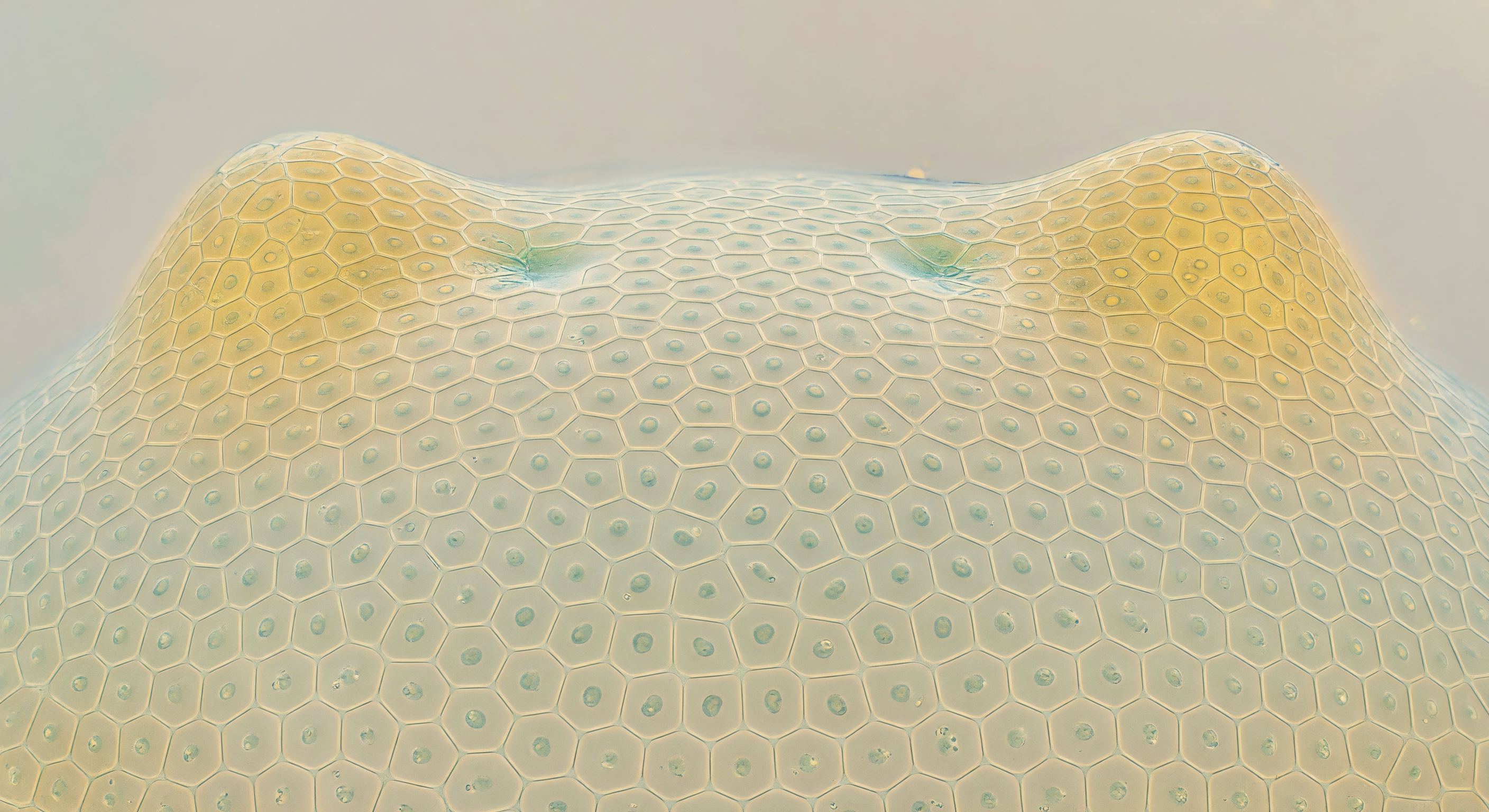
You are suspended weightless above a gently convex hemisphere roughly the width of a human hair, its surface tiled in a near-perfect honeycomb of isodiametric cells — each about twelve micrometers across — whose cellulosic primary walls form a mint-ivory lattice, translucent enough that diffuse light scatters through them like fog through rice paper, illuminating each facet from within without casting a single hard shadow. At the center of every hexagonal tile, a dark oval nucleus presses against the frosted interior like a smooth river stone seen through glass, betraying the extraordinary density of these cells: barely vacuolate, packed with ribosomes and organelles, their cytoplasm a faintly granular amber-gel that leaves no empty space, because these are among the youngest cells the organism will ever produce. This is the shoot apical meristem, the organism's generative summit — a dome of pluripotent initials whose division planes are still fresh, sustaining a pool of stem-like cells in the central zone while the peripheral zone recruits founder cells outward, a living geometry of potential continuously consuming and renewing itself. At the flanks, two leaf primordia swell upward like warm-gold foothills, their cells already elongating along a directional axis, the regular honeycomb giving way to a brick-course geometry across a gradient zone just two or three cells wide — the boundary where identity negotiates itself in real time. The entire scene carries the quality of something both ancient and perpetually unfinished, a summit that has never stopped building itself outward into form.
Other languages
- Français: Dôme Méristème Nid d'Abeille
- Español: Cúpula Meristema Panal Cumbre
- Português: Cúpula Meristema Favo Topo
- Deutsch: Meristem Kuppel Wabengipfel
- العربية: قمة قبة الميريستيم النحلية
- हिन्दी: मेरिस्टेम गुंबद मधुकोश शीर्ष
- 日本語: 頂端分裂組織ハニカム頂点
- 한국어: 정단분열조직 벌집 정상
- Italiano: Cupola Meristema Nido d'Ape
- Nederlands: Meristeem Koepel Honingraat Top