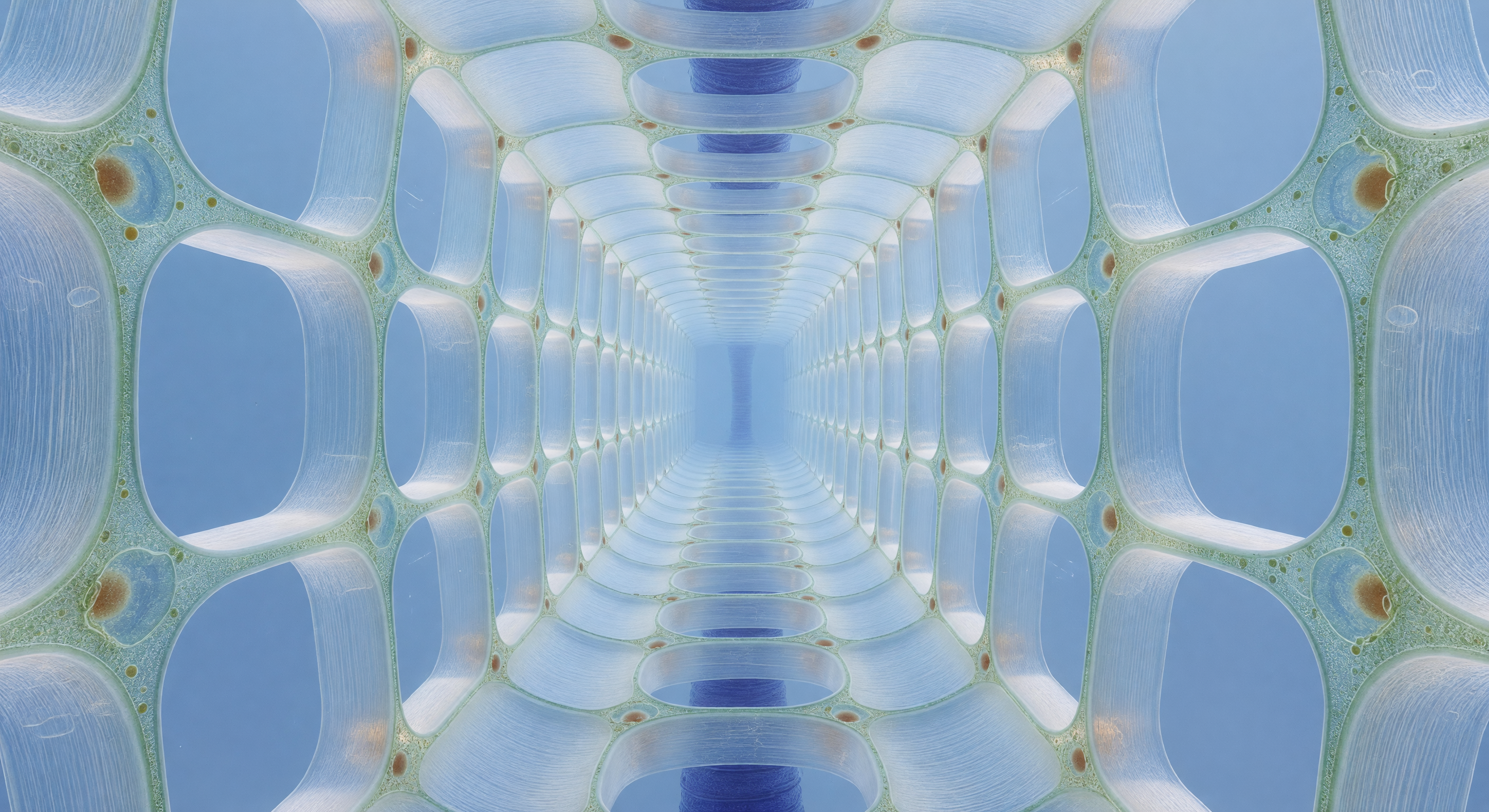
You stand inside a living cathedral of water and pressure, a corridor of stacked vacuolar chambers stretching ahead into a pale cerulean infinity, each cell towering roughly two hundred and fifty micrometres from floor to ceiling, its interior almost entirely consumed by a single vast vacuole — a volume of colourless, optically perfect fluid held under such hydraulic tension that the surrounding cellulose walls bow gently outward, glowing a translucent blue-white under transmitted light like frosted sea-glass under a shallow tropical sun. Life itself has been pushed to the absolute margins: the living cytoplasm survives only as a gossamer pale-green film pressed against the interior face of each wall, interrupted occasionally by a small amber-tinted nucleus roughly ten micrometres across, a dense sphere drifting at the edge of an ocean that makes the surrounding vacuolar space feel vertiginous by comparison. This is the root elongation zone in full hydraulic extension, a region where cells are no longer dividing but instead inflating — importing water through aquaporins, building turgor pressure that can exceed several atmospheres, and using that force to drive irreversible cell wall loosening and elongation through the coordinated action of expansins and xyloglucan endotransglycosylases acting on the cellulose microfibril network. Far down the luminous corridor, fifty cell-lengths into the aqueous haze, the central stele appears as a deep indigo axial column — the vascular core, dense with lignifying proto-xylem, absorbing rather than transmitting the light that pours through everything else around it, a structural spine marking the hydraulic highway that will eventually carry this water column upward toward the canopy.
Other languages
- Français: Couloir Vacuolaire d'Élongation Racinaire
- Español: Corredor Vacuolar de Elongación Radicular
- Português: Corredor Vacuolar de Elongação Radicular
- Deutsch: Vakuolen-Korridor der Wurzelstreckung
- العربية: ممر فجوات منطقة استطالة الجذر
- हिन्दी: मूल दीर्घीकरण रिक्तिका गलियारा
- 日本語: 根の伸長帯液胞回廊
- 한국어: 뿌리 신장대 액포 통로
- Italiano: Corridoio Vacuolare di Elongazione Radicale
- Nederlands: Vacuolair Kanaal van Wortelstrekking