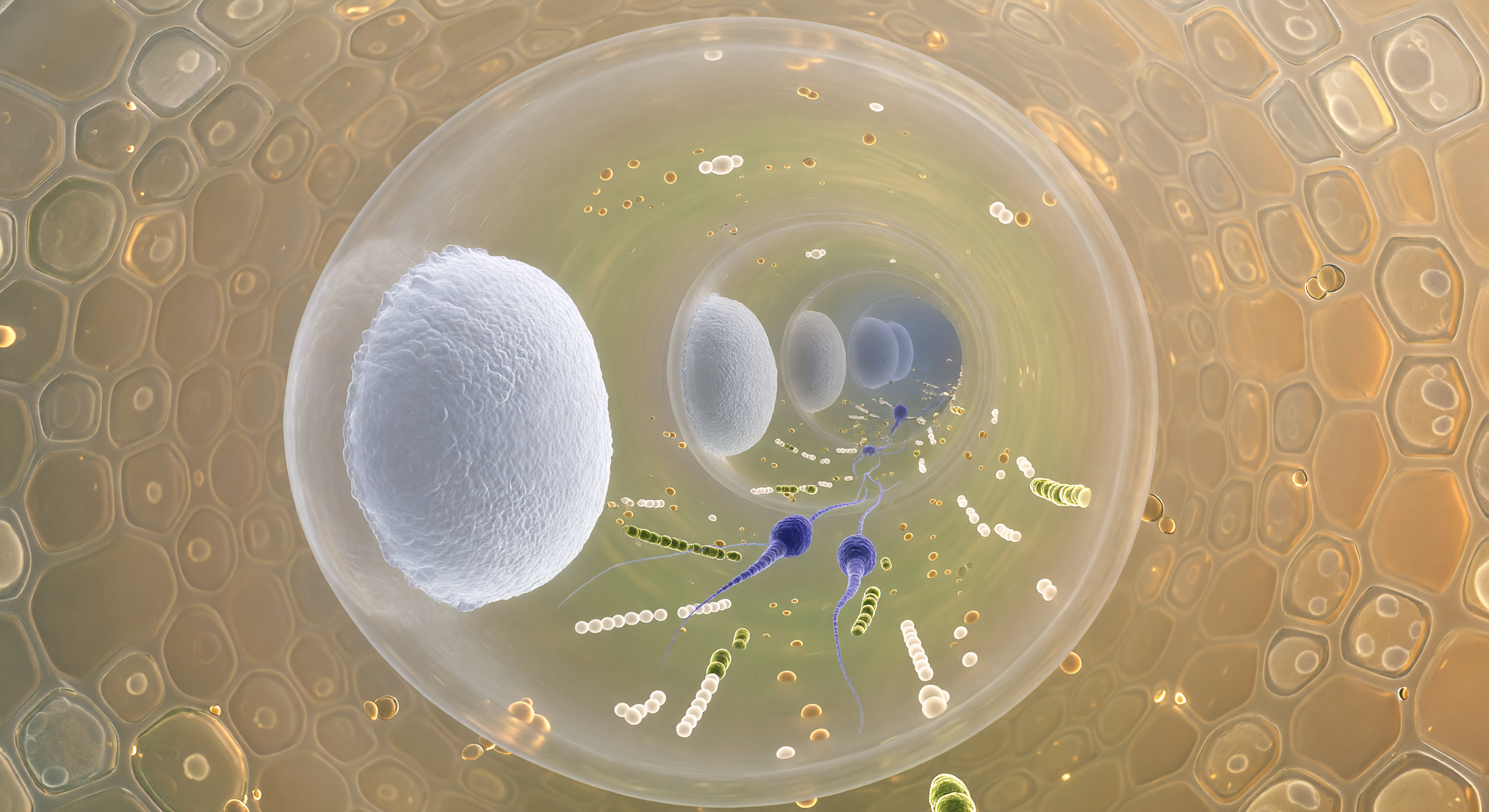
The view plunges forward through a living corridor barely twelve micrometres wide, its curved amber-tinted wall enclosing a world compressed beyond ordinary intuition — ahead, the nearest callose bulkhead rises like a frosted porthole of compacted polysaccharide gel, its surface resolving into braided microfibrils that glow a cool porcelain white, while beyond it the next plug hangs as a dimmer disc, and beyond that another, the whole colonnade receding toward the invisible growing tip in diminishing rings of pale light. Between the nearest two septa, the cytoplasm is dense with traffic: lipid droplets, mitochondria, and chains of pale vesicles crowd an axial river of streaming protoplasm, and at the centre of this flow two sperm cells — fusiform, indigo-violet, their chromatin condensed to near-opacity — ride forward without effort, trailing wisps of endoplasmic reticulum like silk ribbons caught in a current. The callose plugs themselves are not passive architecture but active seals, deposited in rhythmic succession as the tube elongates, each one isolating the older compartments behind it while the living machinery of fertilisation presses on ahead. Beyond the tube wall, the stylar transmitting tissue crowds close as a mosaic of pale gold secretory cells embedded in an adhesive polysaccharide matrix, their refractive secretions diffusing a warm amber glow through the wall and transforming this microscopic passage into something that feels simultaneously intimate and purposeful — a pressurised corridor navigated entirely by chemistry, turgor, and the directional urgency of reproduction.
Other languages
- Français: Procession de bouchons callosiques
- Español: Procesión de tapones de calosa
- Português: Procissão de plugues de calose
- Deutsch: Kallosepfropfen im Pollenschlauch
- العربية: موكب سدادات الكالوز
- हिन्दी: पराग नलिका कैलोज प्लग शोभायात्रा
- 日本語: 花粉管カロースプラグの行列
- 한국어: 화분관 칼로스 마개 행렬
- Italiano: Processione di tappi callosi
- Nederlands: Callosepluggen in pollenbuisje