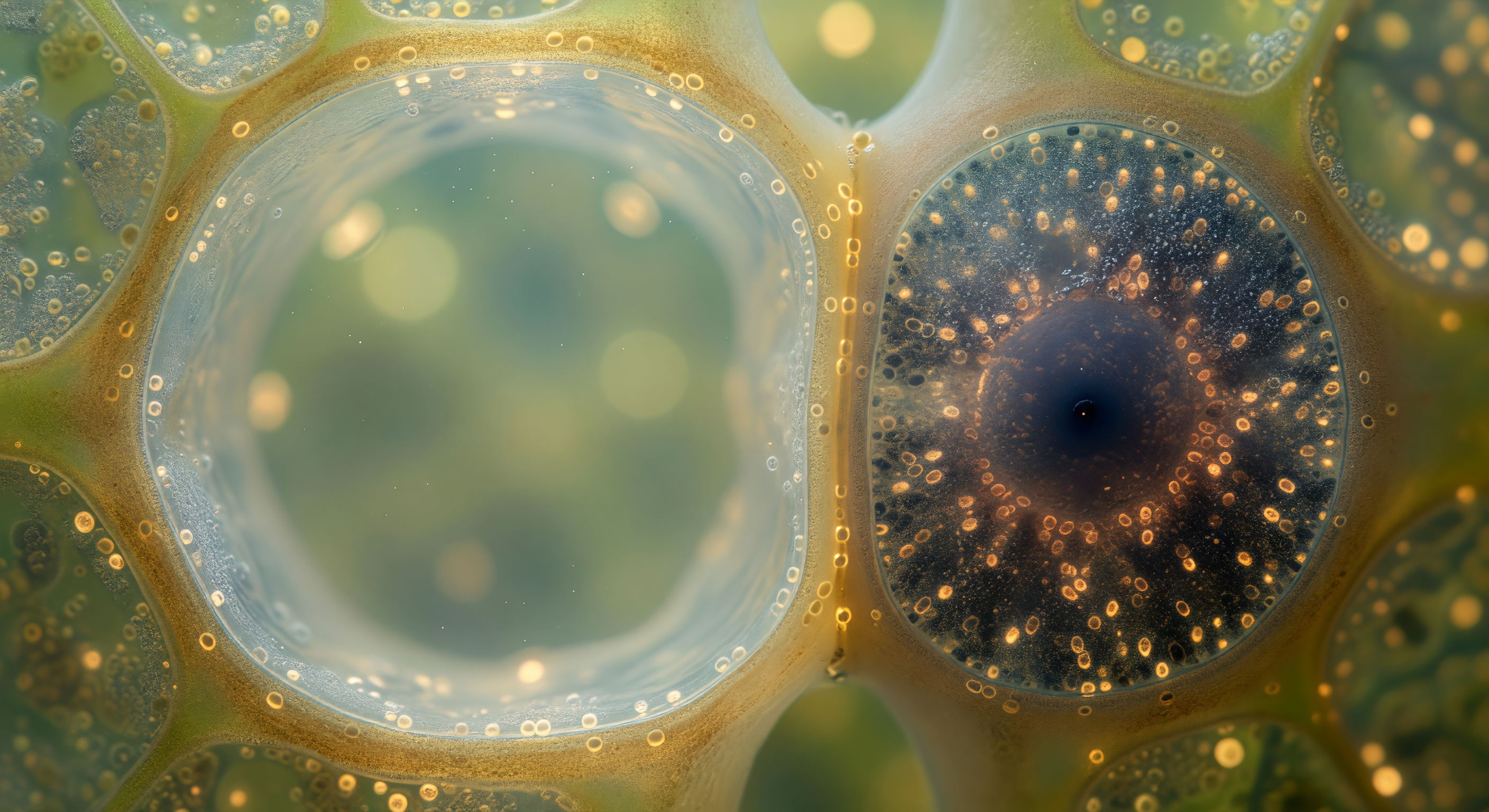
You are suspended at the living interface between two of the most functionally opposed cells in the plant kingdom, where the contrast is not metaphorical but absolute and structural. To your left, the sieve tube element extends like a flooded nave — its lumen stripped of nearly all organelles during maturation, an act of cellular self-sacrifice that leaves a patent, low-resistance conduit through which dissolved sucrose flows at roughly a meter per hour, driven by osmotic pressure gradients established between leaf sources and root sinks in a process described by Münch's pressure-flow hypothesis. Pressed against it to your right, the companion cell has compensated entirely for its neighbor's metabolic nakedness: this single small cell expresses the full transcriptional machinery, drives active sucrose loading through symplastic plasmodesmata and apoplastic H⁺-ATPase-coupled transporters, and sustains the sieve tube energetically through the very nanoscale channels — those faint amber perforations visible at the shared wall — that stitch the two cells into a functional unit despite their radical cellular asymmetry. The intensity of that dark, ribosome-dense, mitochondria-crowded companion cytoplasm is not incidental but obligatory: it is running the metabolism of two cells in the volume of one, a biological forge maintaining the slow sweet river next door.
Other languages
- Français: Obscurité Cellule Compagne Phloème
- Español: Oscuridad Célula Acompañante Floema
- Português: Escuridão Célula Companheira Floema
- Deutsch: Phloem Geleitzelle Dunkelheit
- العربية: ظلام خلية رفيقة اللحاء
- हिन्दी: फ्लोएम सहचर कोशिका अंधकार
- 日本語: 師部伴細胞の暗闇
- 한국어: 체관부 동반세포 어둠
- Italiano: Oscurità Cellula Compagna Floema
- Nederlands: Floëem Geleidecel Duisternis