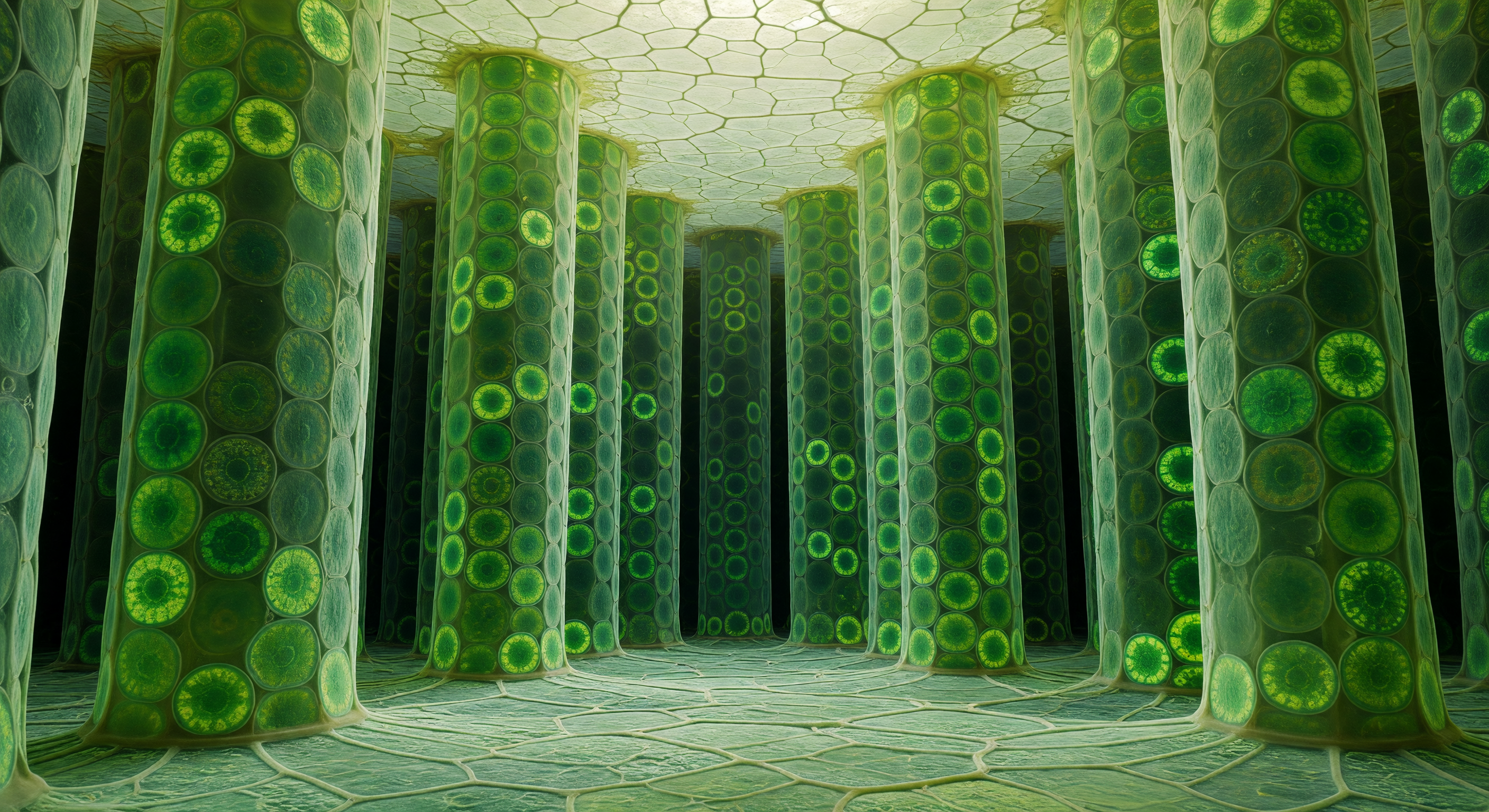
You stand at the base of a vertical world, looking up through a living cathedral whose green columns rise seventy micrometers overhead — palisade mesophyll cells packed wall to wall, their semi-translucent amber-green surfaces studded with hundreds of chloroplasts pressed flat against the inner face like emerald tiles in a Byzantine mosaic, biconvex and deep viridian at their cores, each one a self-contained solar collector whose stacked thylakoid grana are just visible as darker internal banding when the light strikes obliquely. Above, the upper epidermis glows like ground frosted glass, its waxy cuticle diffusing the incoming solar radiation into a luminous, near-shadowless downpour that slides between columns in soft curtains, catching the aqueous film on every cell wall as a faint specular gleam before deepening into charcoal in the intercellular crevices — those narrow black alleyways between towers that open laterally into the spongy mesophyll beyond, a labyrinthine gas-exchange network through which carbon dioxide diffuses toward the chloroplast-lined walls and oxygen drifts outward. The sheer density of chloroplasts transforms every wall into a continuous cold-green stained-glass panel, overlapping jade shadows layering one upon the next as lens after lens bends and re-emits the light, and where two chloroplasts nearly touch across an air gap their lime-bright margins glow like neon tubing against absolute blackness. Looking straight up along the canyon between two adjacent columns, the walls converge sharply, the ceiling brightens, and the perspective collapses into a dizzying vertical tunnel — this is photosynthesis not as chemistry but as architecture, a structure of pigment and cellulose quietly converting every photon that survives the journey through the cuticle into the molecular currency of life.
Other languages
- Français: Forêt palissadique de chloroplastes
- Español: Bosque palizado de cloroplastos
- Português: Floresta paliçada de cloroplastos
- Deutsch: Palisadenwald der Chloroplasten
- العربية: غابة خلايا العمادية الخضراء
- हिन्दी: क्लोरोप्लास्ट का पैलिसेड वन
- 日本語: 柵状葉肉の葉緑体林
- 한국어: 책상 엽육의 엽록체 숲
- Italiano: Foresta palizzata di cloroplasti
- Nederlands: Palissadewoud van chloroplasten