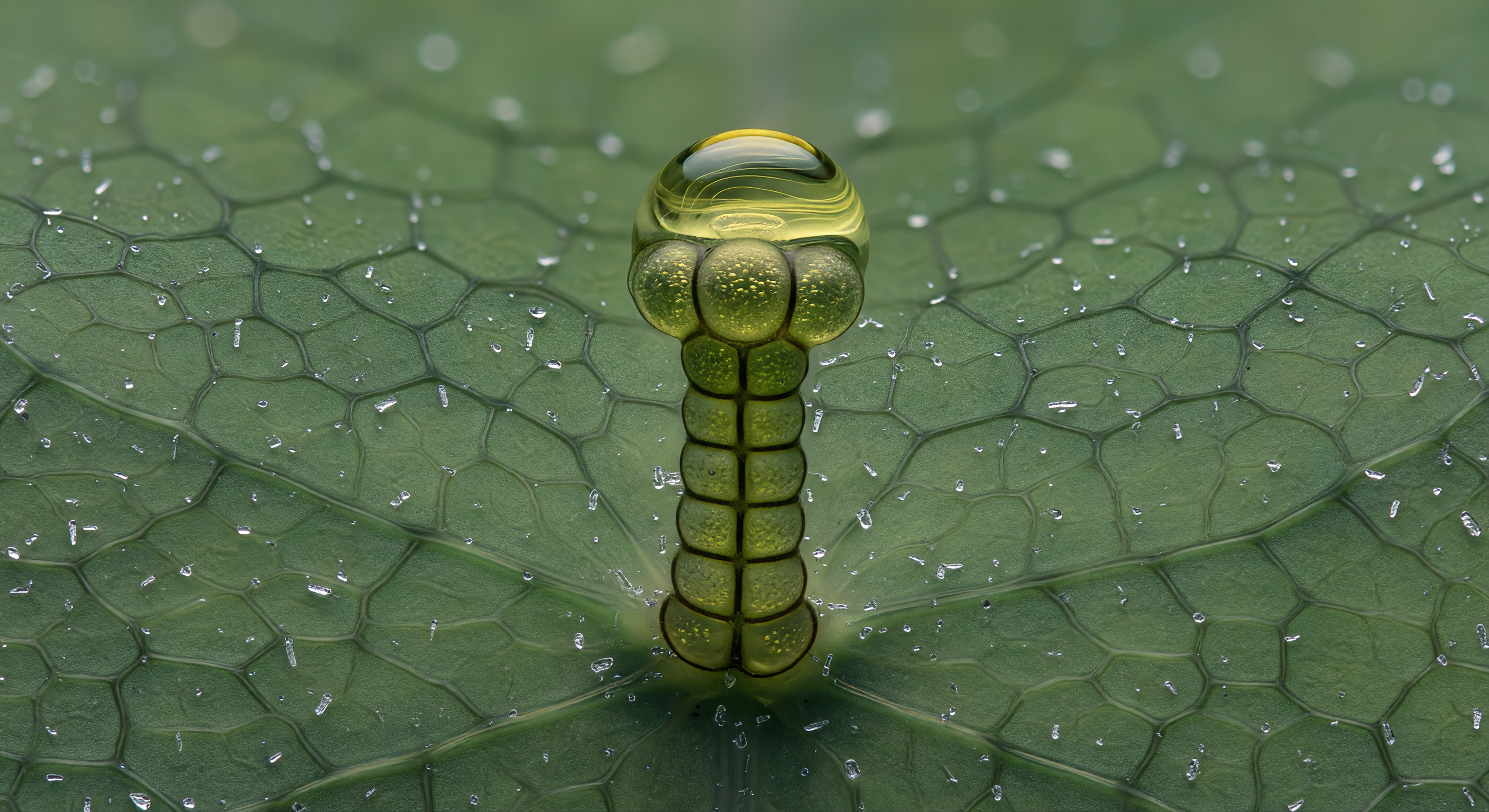
Before you hovers an architectural wonder of botanical chemistry — the glandular secretory head of a tomato trichome, its four disc-shaped cells arranged in a low crown, each one a slightly flattened dome of translucent green-gold cytoplasm pressing faintly against the inner face of a cuticle that has been forced outward into a taut, amber-tinted blister of accumulated essential oils, refracting oblique light across its equator in a slow liquid shimmer, poised at the threshold between containment and release. Within that blister, fine density gradients betray the layered secretion of different terpenoid compounds — monoterpenes, sesquiterpenes, and volatile phenolics synthesized in the leucoplasts of the stalk cells below and actively transported upward through the crown cells into this subcuticular reservoir, where hydrostatic pressure builds until the cuticle ultimately ruptures or an organism brushes against it. The six-tiered stalk descends below the crown in diminishing cellular tiers, each pair of cells anchored by thickened pectin-cemented primary walls, the whole column rooted in a reinforced base cell splayed into the surrounding epidermis — a dicot surface of jigsaw-puzzle anticlinal walls glazed with rod- and plate-form wax crystals that cast hard shadows across a matte bluish cuticle, making the luminous blister above blaze in contrast against an otherwise muted, textured terrain of translucent walls and epicuticular frost.
Other languages
- Français: Ampoule Huileuse du Trichome
- Español: Ampolla de Aceite Tricoma
- Português: Bolha de Óleo Tricoma
- Deutsch: Trichom Ölblase Drüse
- العربية: بثرة زيت الشعيرة الغدية
- हिन्दी: ग्रंथि ट्राइकोम तेल बुलबुला
- 日本語: 腺毛の油脂水疱
- 한국어: 선모 오일 수포
- Italiano: Vescica d'Olio Tricoma
- Nederlands: Klier Trichoom Olieblaas