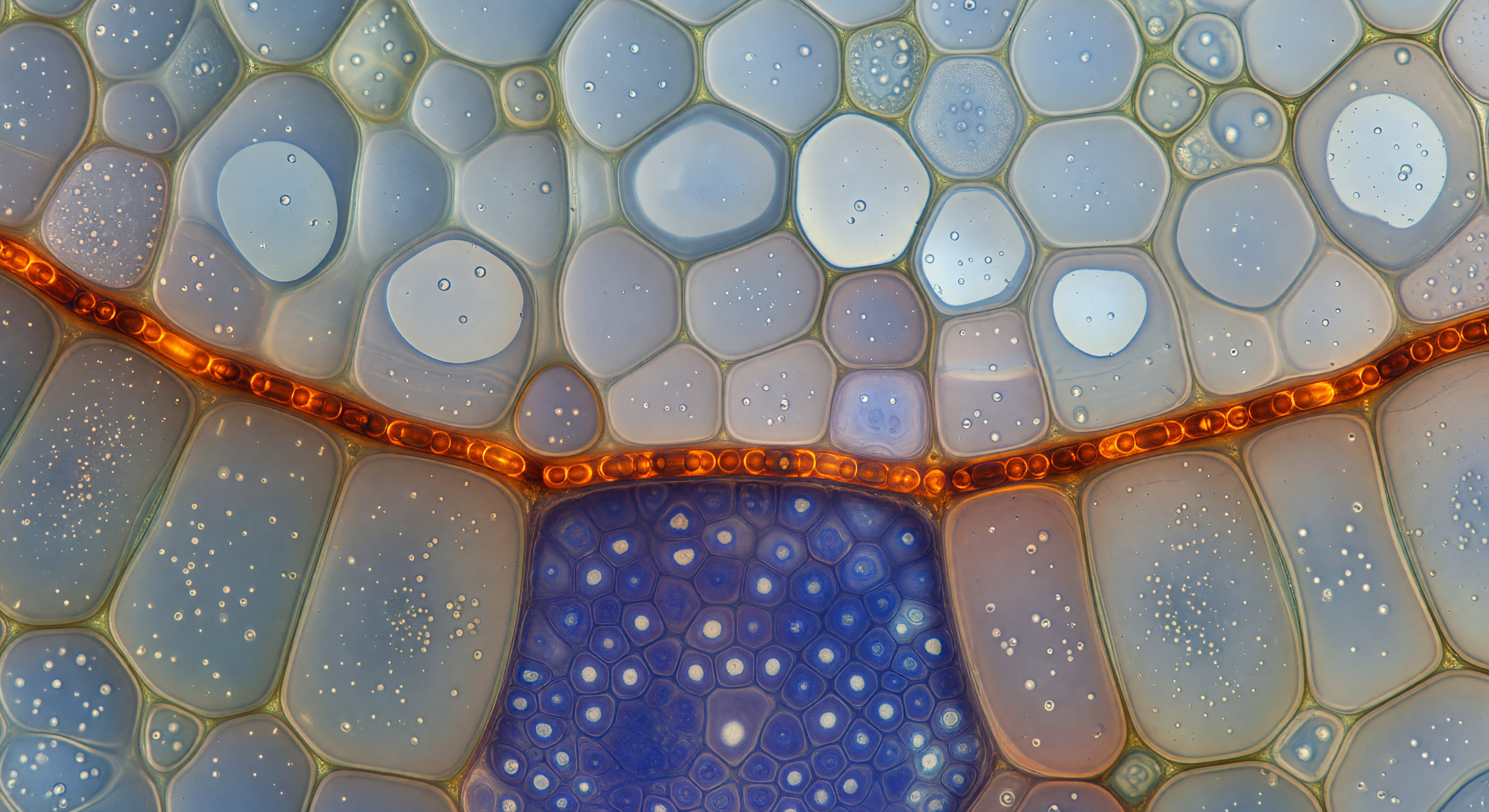
You are suspended at the exact threshold where the living root enforces its most absolute law: nothing passes this border unchecked. Looking along the curve of the endodermal cell file, you see prismatic chambers pressing close on every side, their translucent walls glowing faintly greenish-ivory, and running continuously through each shared radial wall — cell to cell without interruption — a belt of amber-orange fire, the Casparian strip, composed of suberin and lignin deposited with geometric precision into the wall midline, forming an unbroken luminous necklace that encircles the entire vascular cylinder. Behind you the cortex opens into a looser, cooler architecture of pale parenchyma with generous intercellular air spaces, while ahead the stele compresses into a dense indigo and violet mass of procambial cells, their nuclei prominent, the whole structure reading as a jewel of biological intensity — the chromatic contrast between the warm amber seal and the cold blue interior making the functional boundary visible as pure sensation. This strip is not decorative: it forces all water and dissolved ions moving from soil into the vascular system to pass through the plasma membrane of the endodermal cell itself, bypassing the leaky apoplastic route through the cell walls, so that the plant exercises molecular-level selectivity over every ion that enters its circulation — a living checkpoint encoded in the chemistry of a single, precisely positioned band of wall material no more than a few hundred nanometers thick.
Other languages
- Français: Ceinture Strié Endodermique
- Español: Banda Casparia Endodérmica
- Português: Faixa Caspária Endodérmica
- Deutsch: Kasparischer Streifen Endodermis
- العربية: حزام الشريط الكاسباري
- हिन्दी: एंडोडर्मिस कैस्पेरियन पट्टी
- 日本語: カスパリー帯の輝く環
- 한국어: 카스파리 대상 내피
- Italiano: Banda Casparia Endodermica
- Nederlands: Caspariaanse Strook Endodermis