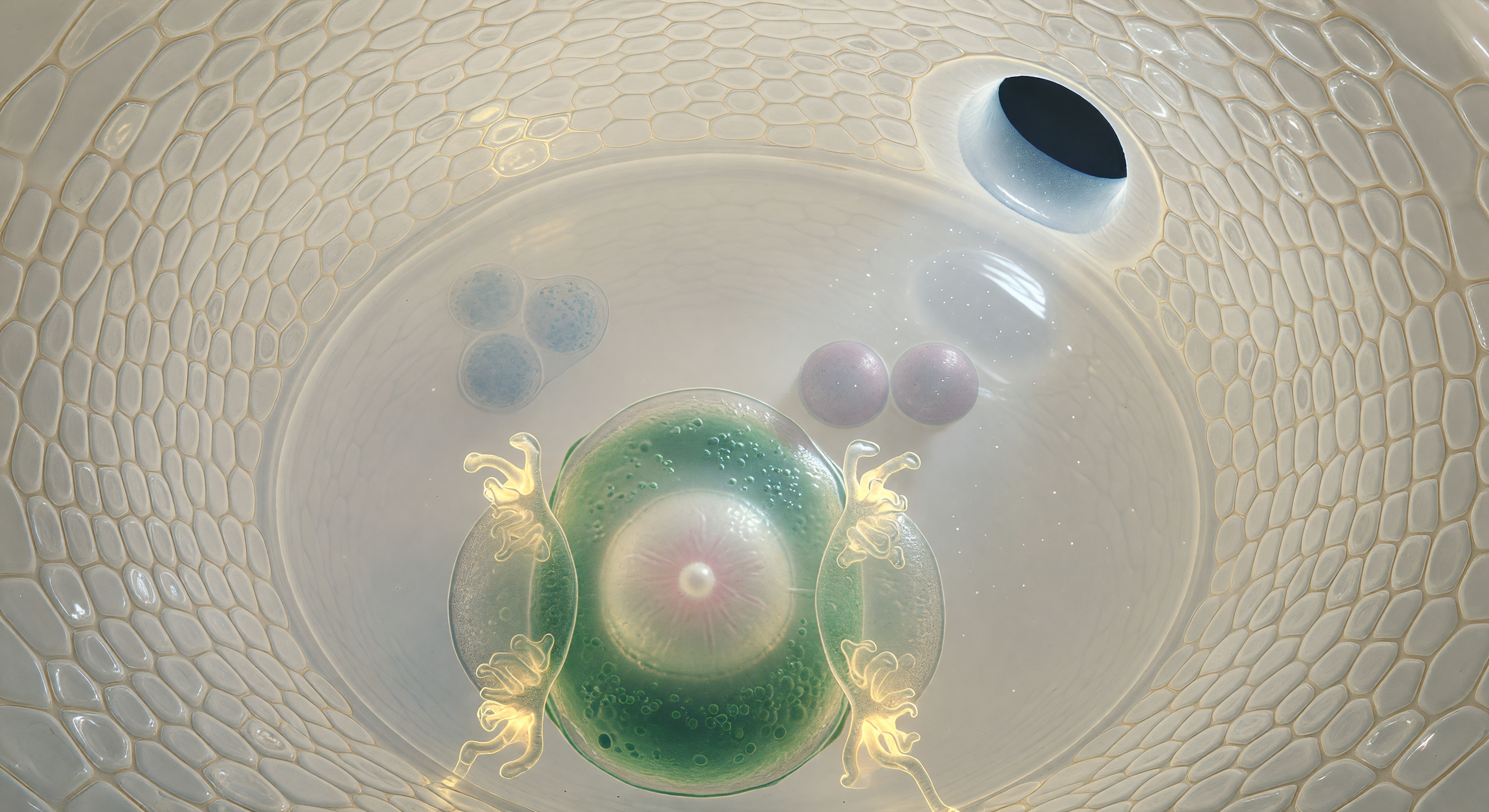
You are suspended within the embryo sac of a flowering plant's ovule, drifting perhaps forty micrometres from the egg cell's pale convex surface — a chamber so optically pure it reads less as a cell than as a room filled with water. The curved integument layers arch around you like the walls of an ivory grotto, their tightly pressed cells seamed with amber, the whole structure suffused with a warm translucency that admits a single soft shaft of light filtering through the micropyle at upper right — a passage barely fifteen micrometres across, the narrowest gateway through which a pollen tube will one day force its way to deliver the male gametes that trigger double fertilization. In the foreground the egg cell bulges close, jade-green and organelle-dense at its periphery, cradling a nucleus like alabaster veined with rose, flanked by the two synergid cells whose filiform wall ingrowths glow amber-gold at their tips — specialized membrane folds whose enormous surface area is thought to facilitate the uptake and guidance of the arriving pollen tube, charged with signaling molecules that the synergids must intercept and relay. Behind the egg, the vast central cell opens into translucent stillness, and near its center two lilac-grey polar nuclei float like paired moons awaiting the second sperm cell that will fuse with them to form the triploid endosperm — the nutritive tissue destined to feed an embryo not yet conceived — while far at the chalazal pole three antipodal cells dissolve into dim granular shadow, their function in most flowering plants still incompletely understood, the furthest reaches of a living architecture poised at the threshold of an entirely new organism.
Other languages
- Français: Sac Embryonnaire Translucide
- Español: Saco Embrionario Transparente
- Português: Saco Embrionário Translúcido
- Deutsch: Transparenter Embryosack
- العربية: كيس الجنين الشفاف
- हिन्दी: पारदर्शी भ्रूण कोश
- 日本語: 透明な胚嚢の内部
- 한국어: 투명한 배낭 내부
- Italiano: Sacco Embrionale Trasparente
- Nederlands: Transparante Embryozak