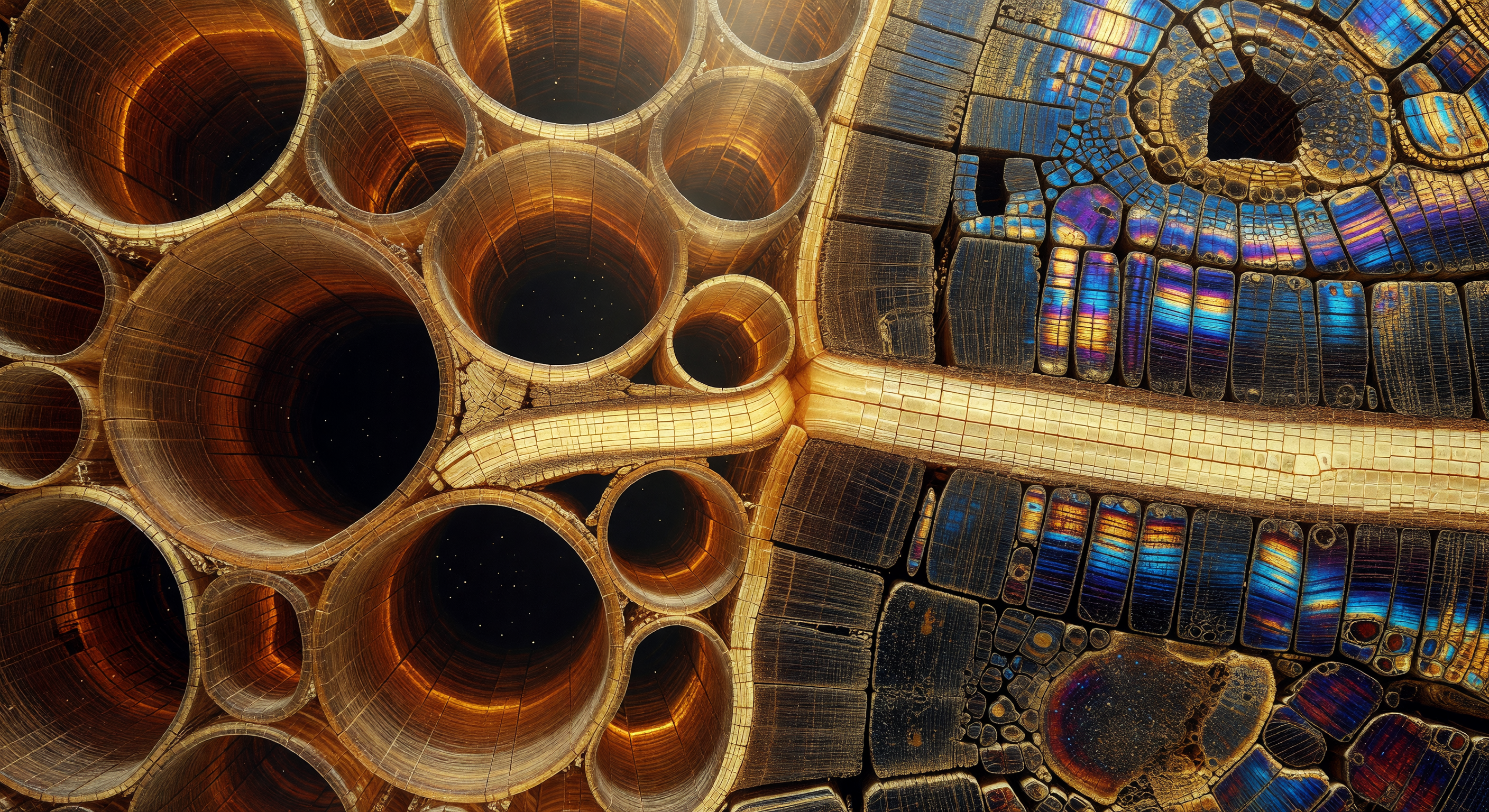
You are suspended at the threshold between two utterly different architectures — to your left, enormous vessel lumens gape open like the mouths of sea caves, each hollow nearly 250 micrometers across, their bordered-pit walls catching polarized light as faint amber rims etched into lignified tawny walls; to your right, the latewood closes without gradation into near-solid matter, thick-walled libriform fibers packed so densely that only slit-like apertures 15 micrometers wide survive, their cellulosic secondary walls exploding under polarized illumination into electric cobalt and burnished gold — the optical signature of helically wound crystalline microfibrils storing mechanical energy in compression. This abrupt boundary marks the annual rhythm of the vascular cambium: earlywood formed in spring under hormonal signals favoring wide, low-resistance conduits for rapid water flux, latewood assembled in summer as auxin levels fall and cell expansion is curtailed, each regime written permanently into the wood as a record of seasonal physiology. Threading horizontally across the entire boundary, ribbons of ray parenchyma — pale honey-gold, their brick-shaped cells two to four cells wide — run in continuous radial bands that ignore the earlywood-latewood divide, carrying sugars and signals laterally through a tissue otherwise dedicated to vertical transport. The scene reads simultaneously as living geology and stained-glass architecture: crystalline, monumental, and encoded with decades of atmospheric memory pressed into amber and iron.
Other languages
- Français: Frontière des Cernes Ligneux
- Español: Límite de Anillo Leñoso
- Português: Fronteira do Anel Anual
- Deutsch: Früh-Spätholz Jahresringgrenze
- العربية: حدود حلقة الخشب السنوية
- हिन्दी: प्रारंभिक-पश्च काष्ठ वलय सीमा
- 日本語: 早材晩材の年輪境界
- 한국어: 조재-만재 나이테 경계
- Italiano: Confine Anello Legno Precoce
- Nederlands: Vroeg-Laathout Jaarring Grens