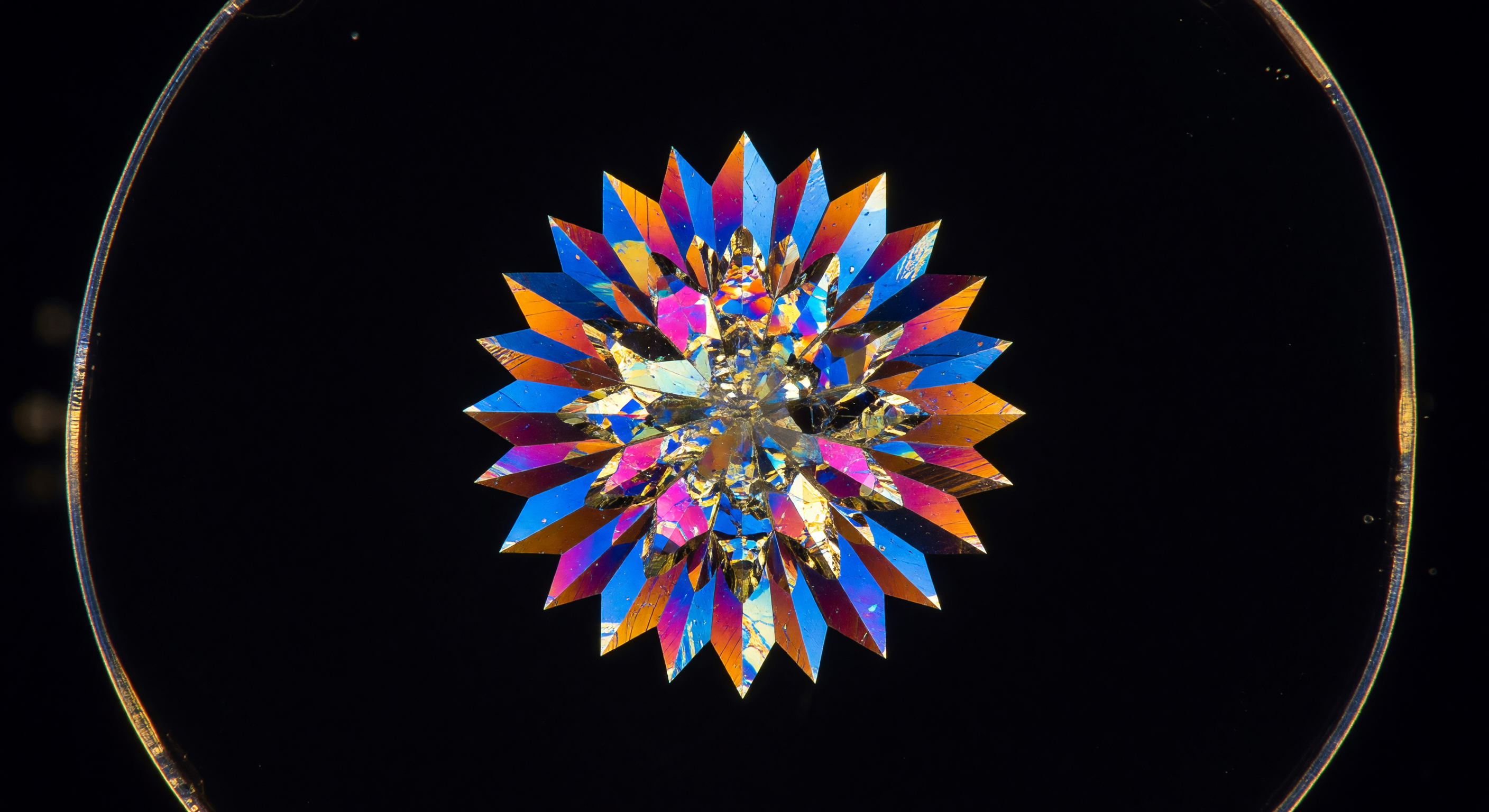
A star-burst fortress of calcium oxalate fills the entire visual field, its forty individual facets radiating from a dense central nucleus like the blades of a rose window carved from living mineral — each spike tapering to a stiletto point that dissolves into absolute darkness. This is a druse crystal, roughly 55 micrometers across, precipitated inside a parenchyma vacuole when dissolved calcium and oxalate ions reached saturation and cascaded outward from a seed nucleus in a burst of crystallographic inevitability; the plant uses such inclusions to sequester excess calcium, neutralize organic acids, and deter herbivores, locking metabolic waste into insoluble geometry. Under crossed polarizers, the surrounding aqueous vacuolar contents vanish into a perfect void, and only the birefringent crystal generates color — deep cobalt blue across the broadest faces where light retardation is maximal, burning through burnt sienna and raw amber at oblique angles, erupting into near-incandescent gold along the razor ridgelines where constructive interference stacks wavelengths from two adjacent facets simultaneously. At the very periphery of this black cathedral, a faint pale-gold curve betrays the parenchyma cell wall — compressed cellulose microfibrils forming a laminate fortification whose own birefringence is a whisper against the mineral spectacle at center stage — a reminder that this entire blazing structure exists sealed and motionless inside a single living cell, a frozen record of ion chemistry pulsing with color in the biological dark.
Other languages
- Français: Cristal Druse Polarisé Noir
- Español: Cristal Drusa Polarizado Vacuola
- Português: Cristal Drusa Polarizado Vácuo
- Deutsch: Druse Kristall Polarisiert Dunkel
- العربية: بلورة دروز مستقطبة مظلمة
- हिन्दी: ध्रुवीकृत ड्रूज़ क्रिस्टल रिक्तिका
- 日本語: 偏光ドルーズ結晶液胞
- 한국어: 편광 드루즈 결정 액포
- Italiano: Cristallo Drusa Polarizzato Vuoto
- Nederlands: Druse Kristal Gepolariseerd Vacuole