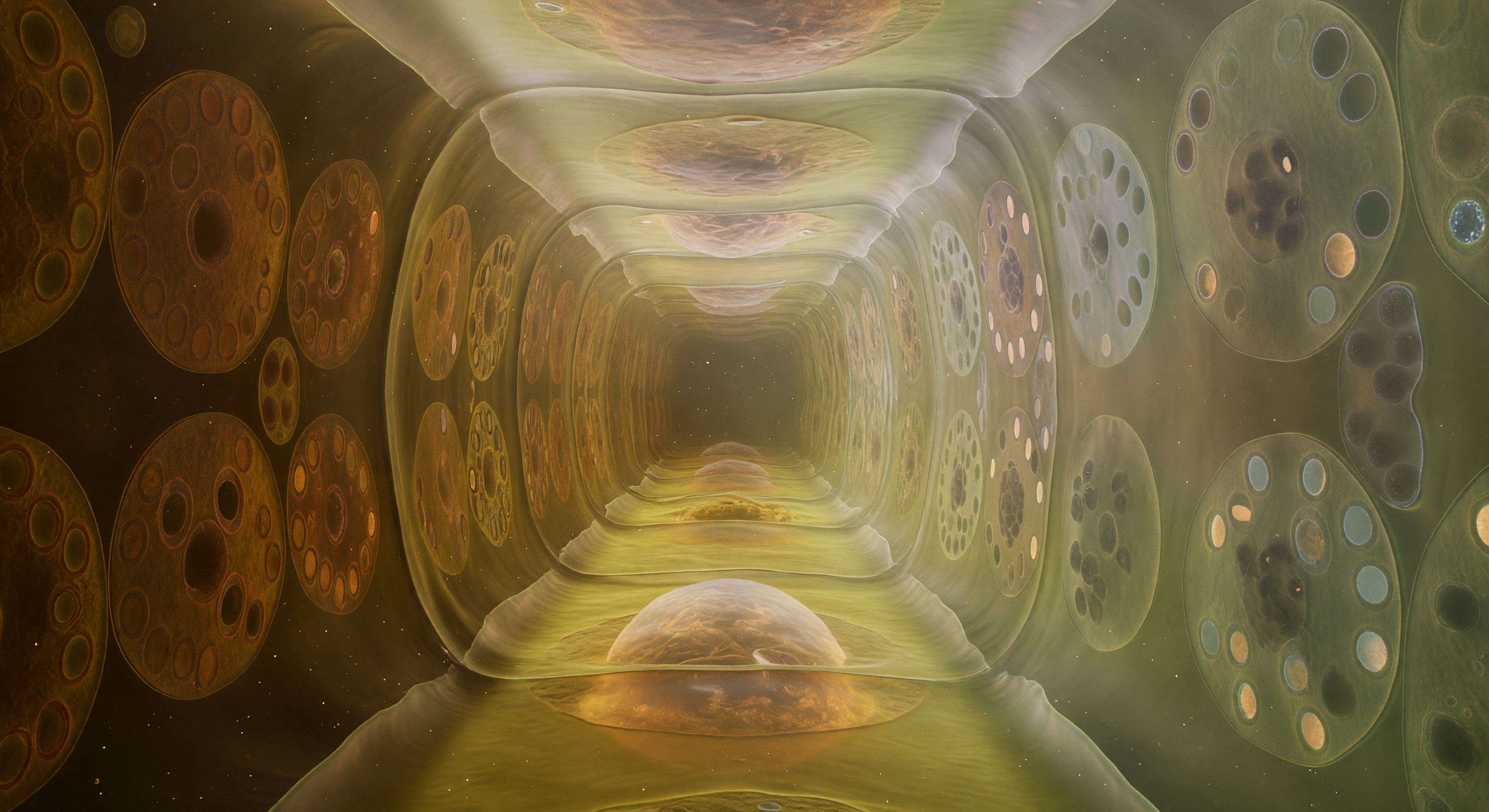
You stand suspended inside the vascular cambium at the peak of spring's generative surge, enclosed within a corridor of cells so attenuated they seem less like walls than suggestions of enclosure — each fusiform initial stretching before you like the nave of a submerged cathedral, its pale straw-yellow cytoplasm glowing with a lantern's diffuse warmth, its nucleus a large opalescent sphere drifting mid-cell through amber haze. This is the vascular cambium, a single meristematic layer of fusiform initials poised between two diverging fates: to your left, daughter cells already committed to xylem are armoring themselves with concentric bands of lignified secondary wall, the amber deepening cell by cell into tawny ochre as living protoplasm is replaced by hollow, engineered tubes built for water under tension; to your right, nascent sieve elements dissolve themselves purposefully — nuclei fading, cytoplasm thinning to a permeable gel, callose halos forming around sieve plate pores as each cell surrenders its individuality to become a conduit for photosynthate flowing at nearly a meter per hour. The compression between these two solidifying empires is immense and quiet: the cambium itself is under mechanical stress from expanding xylem on one side and the bark's resistance on the other, yet these cells — barely twenty micrometers across — sustain the division rates that will build an entire season's growth, their walls so thin they register less as surfaces than as the living membrane of a world caught perpetually between becoming wood and becoming flow.
Other languages
- Français: Initiales fusiformes cambium printemps
- Español: Iniciales fusiformes cambium primavera
- Português: Iniciais fusiformes câmbio primavera
- Deutsch: Kambium Spindelinitiale Frühling
- العربية: خلايا مغزلية كامبيوم ربيعية
- हिन्दी: कैम्बियम तर्कु आरंभिक वसंत
- 日本語: 形成層紡錘形始原細胞春
- 한국어: 형성층 방추형 원기 봄
- Italiano: Iniziali fusiformi cambio primavera
- Nederlands: Cambium spoelvormige initialen lente