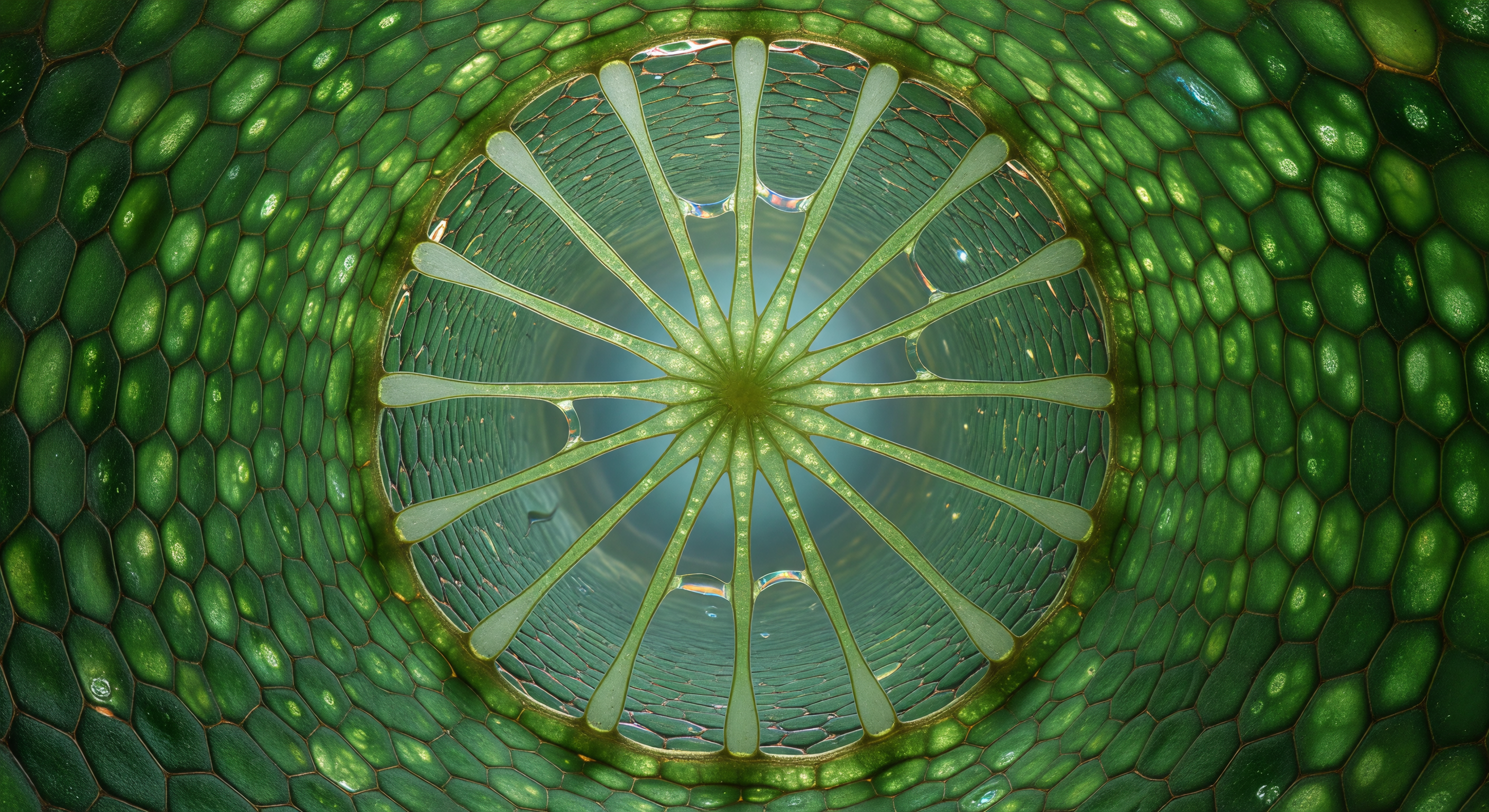
You hover suspended in warm, saturated air at the heart of a vast cylindrical corridor — the aerenchyma canal running the length of a water lily petiole, its curved wall an unbroken mosaic of swollen chlorenchyma cells roughly 200 µm across, each one a chlorophyll-dense chamber whose shared cellulose partitions glow faintly amber at the edges and whose inner faces burn a deep, mottled emerald. Aerenchyma tissue like this is not incidental architecture but an evolutionary solution to aquatic life: these gas-filled lacunae form a continuous internal atmosphere connecting leaf to root, allowing oxygen produced by photosynthesis to diffuse downward through flooded sediment where it would otherwise be unavailable. Spanning the full 800-µm breadth of the canal directly ahead, a diaphragm floats like a lace medallion cast in living glass — a stellate array of arm-shaped cells radiating from a central hub, their tapering tips stopping just short of the wall and of one another, leaving open polygonal gaps large enough to drift through, the whole structure back-lit by diffuse light filtering along the canal so that each arm is rimmed with a golden-green halo and the intervening voids frame receding views of the tunnel beyond. These diaphragms are thought to provide structural reinforcement against the collapse of such large air spaces while preserving gas continuity — a compromise between mechanical integrity and atmospheric openness, solved here with extraordinary cellular economy. Thin iridescent films of water tremble across some of the gaps, casting violet and copper interference colors against the green mosaic walls, and in both directions the canal dissolves into a teal-blue atmospheric haze, the cellular texture fading to unresolvable fineness like city lights seen through fog — an immensity contained entirely within the stem of a single leaf.
Other languages
- Français: Dentelle d'aérenchyme lacunaire
- Español: Encaje de diafragma aerénquima
- Português: Renda do diafragma aerênquima
- Deutsch: Aerenchym Diaphragma Spitze
- العربية: دانتيل حجاب الهواء النباتي
- हिन्दी: वायु ऊतक जाल पर्दा
- 日本語: 通気組織隔壁の透かし模様
- 한국어: 통기 조직 격막 레이스
- Italiano: Pizzo diaframma aerenchima
- Nederlands: Aerenchym Diafragma Kant