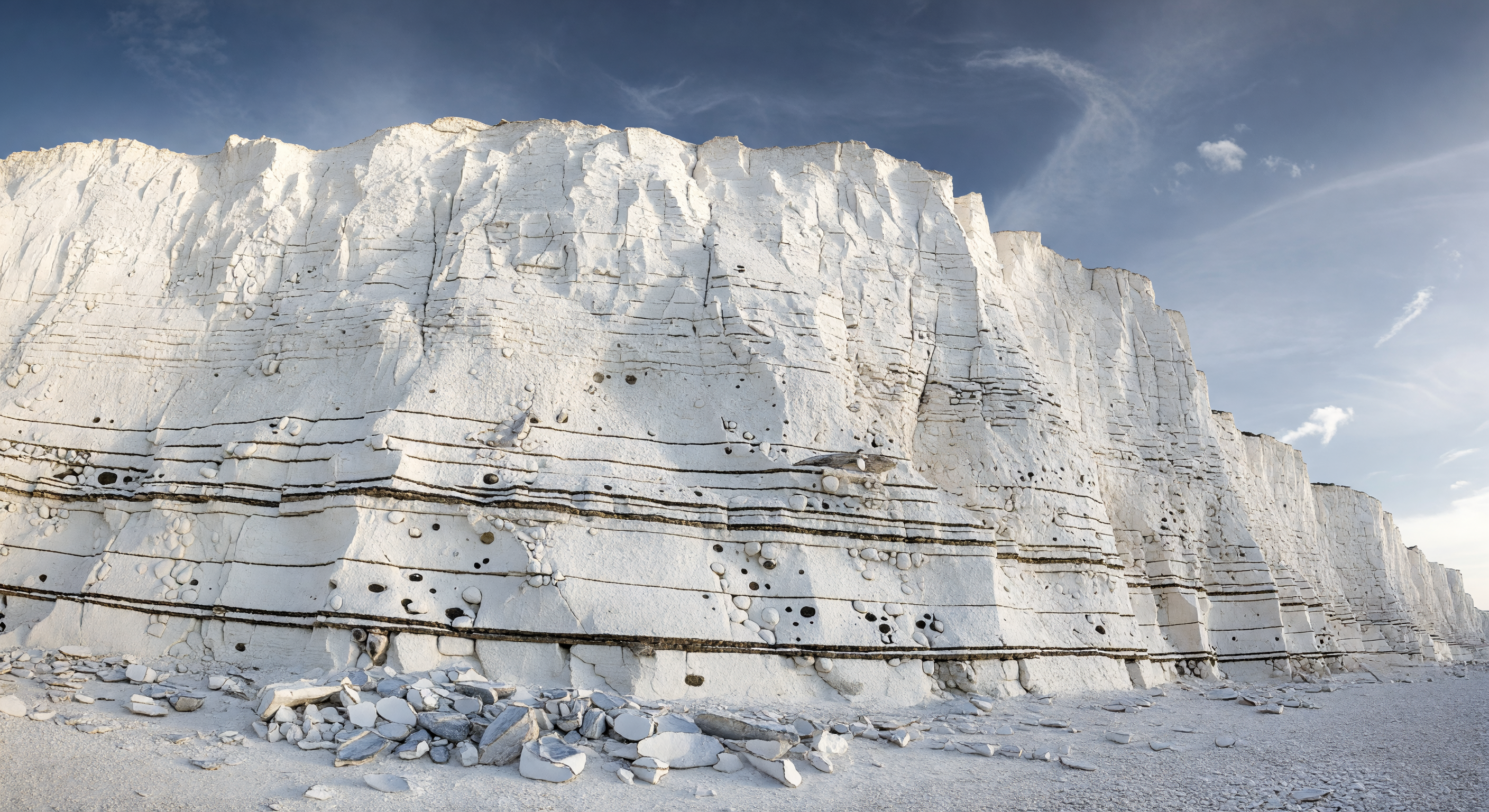
You stand at the base of a vertical white world that rises until it becomes sky, the chalk face blazing under raking afternoon light so intensely that the stone seems luminous from within, each pale surface a compressed biography of ancient ocean life. What appears as smooth white rock is in fact the accumulated calcite remains of countless generations of microscopic algae — coccolithophores no larger than a fraction of a hair's width — whose calcite plates sank through Cretaceous seas over tens of millions of years, layer upon patient layer, until burial and pressure transformed biological snow into this cathedral of biogenic limestone. The dark flint bands slicing horizontally across the cliff face at irregular intervals are chemical signatures of that same seafloor, zones where silica migrated through the sediment during diagenesis, each band a compressed moment of deep time locked in glassy stone against the surrounding chalk. A single fulmar resting on a narrow ledge halfway up suddenly makes the scale vertiginous and real — the bird a centimeter of apparent size against hundreds of meters of geological record, its living warmth pressed against the cold archive of a billion dead blooms. To stand here is to be dwarfed not by rock alone but by biological time itself, the cumulative weight of organisms that photosynthesized and calcified and sank in an ocean that no longer exists, their invisible geometry dissolved by pressure yet their mass forming everything you see.
Other languages
- Français: Archives géologiques des falaises blanches
- Español: Archivo geológico de acantilados blancos
- Português: Arquivo geológico dos penhascos brancos
- Deutsch: Geologisches Archiv der Weißen Klippen
- العربية: أرشيف الجرف الأبيض الجيولوجي
- हिन्दी: श्वेत चट्टान भूवैज्ञानिक अभिलेख
- 日本語: 白い崖の地質記録
- 한국어: 백색 절벽 지질 기록
- Italiano: Archivio geologico delle scogliere bianche
- Nederlands: Geologisch archief witte kliffen