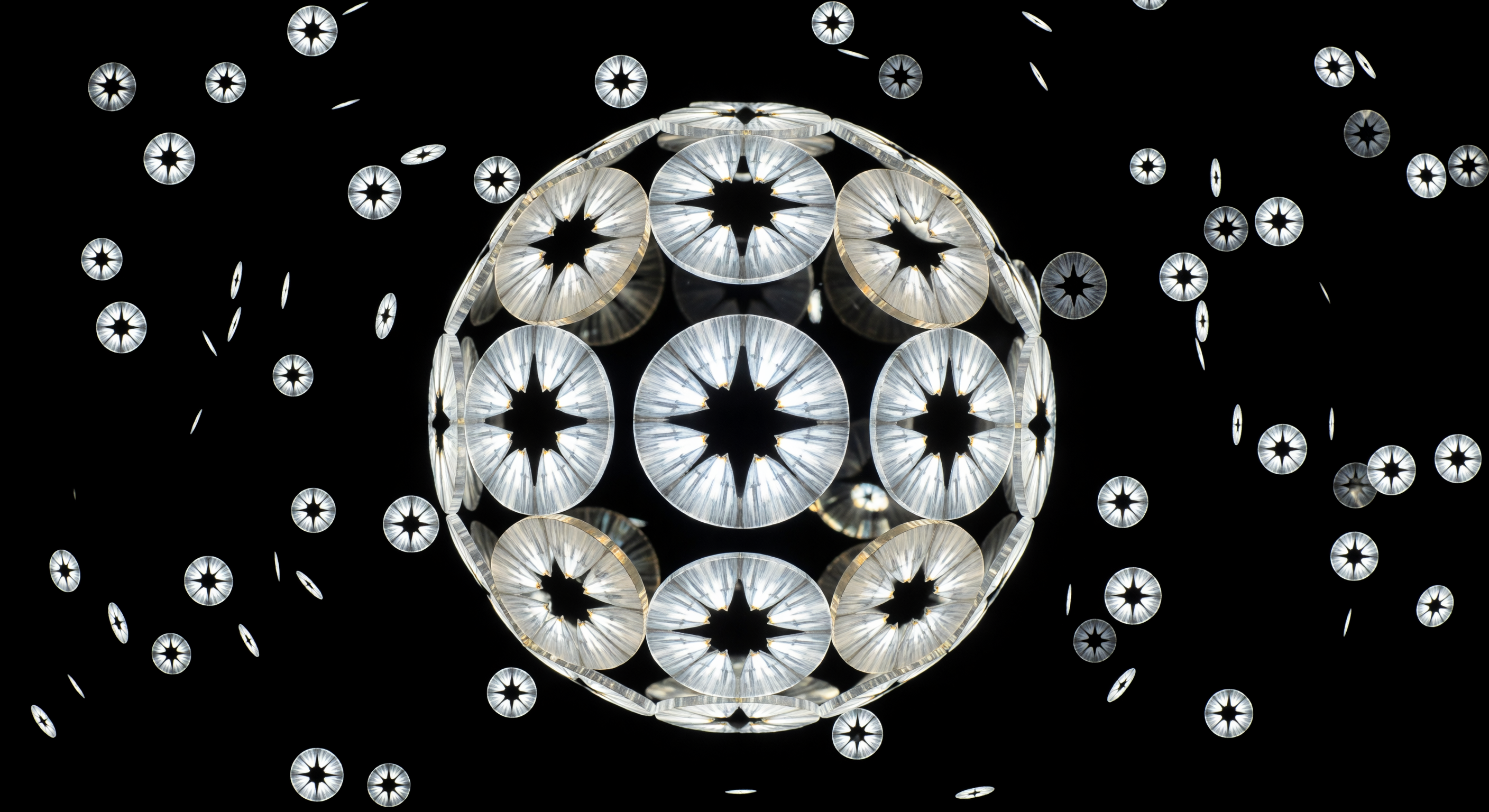
Before you, suspended in a void of absolute black, a coccosphere blazes like a captured star — fifteen interlocking calcite wheels arranged into a near-perfect sphere, each coccolith erupting with birefringent fire under cross-polarized light, the classic Maltese cross extinction pattern sweeping across every plate in velvety black while the surrounding crystal domains burn in first-order white of almost physical density. At the thickened spoke rims and raised distal shield edges, thin-film interference lifts the palette fractionally into pale champagne and warm ivory-gold, the only concession to color in an otherwise achromatic spectacle. Drifting outward in every direction, shed coccoliths tumble in imperceptible Brownian drift — each an elliptical calcite wheel just a few micrometers across, architecturally ornate, some edge-on as luminous slivers, others face-on to reveal the full crystallographic symmetry of their spoke geometry, their open central area framing what reads as a window into a microscopic cathedral. These plates are not passive shells but biologically precipitated calcite, grown one calcium carbonate ion at a time inside specialized vesicles within the living cell, the crystal orientation of each radial unit genetically controlled to produce precisely this optical signature. You float among them with no body and no instrument — only attention — adrift inside a chandelier assembled by a single-celled organism in cold, dark water, its geometry encoding both a life strategy and, grain by grain across geological time, the raw material of chalk cliffs.
Other languages
- Français: Cirque de Cristaux Polarisés
- Español: Circo de Cristales Polarizados
- Português: Circo de Cristais Polarizados
- Deutsch: Polarisiertes Kristallzirkus
- العربية: سيرك الكريستال المستقطب
- हिन्दी: ध्रुवीकृत क्रिस्टल सर्कस
- 日本語: 偏光クリスタルサーカス
- 한국어: 편광 크리스털 서커스
- Italiano: Circo di Cristalli Polarizzati
- Nederlands: Gepolariseerd Kristalcircus