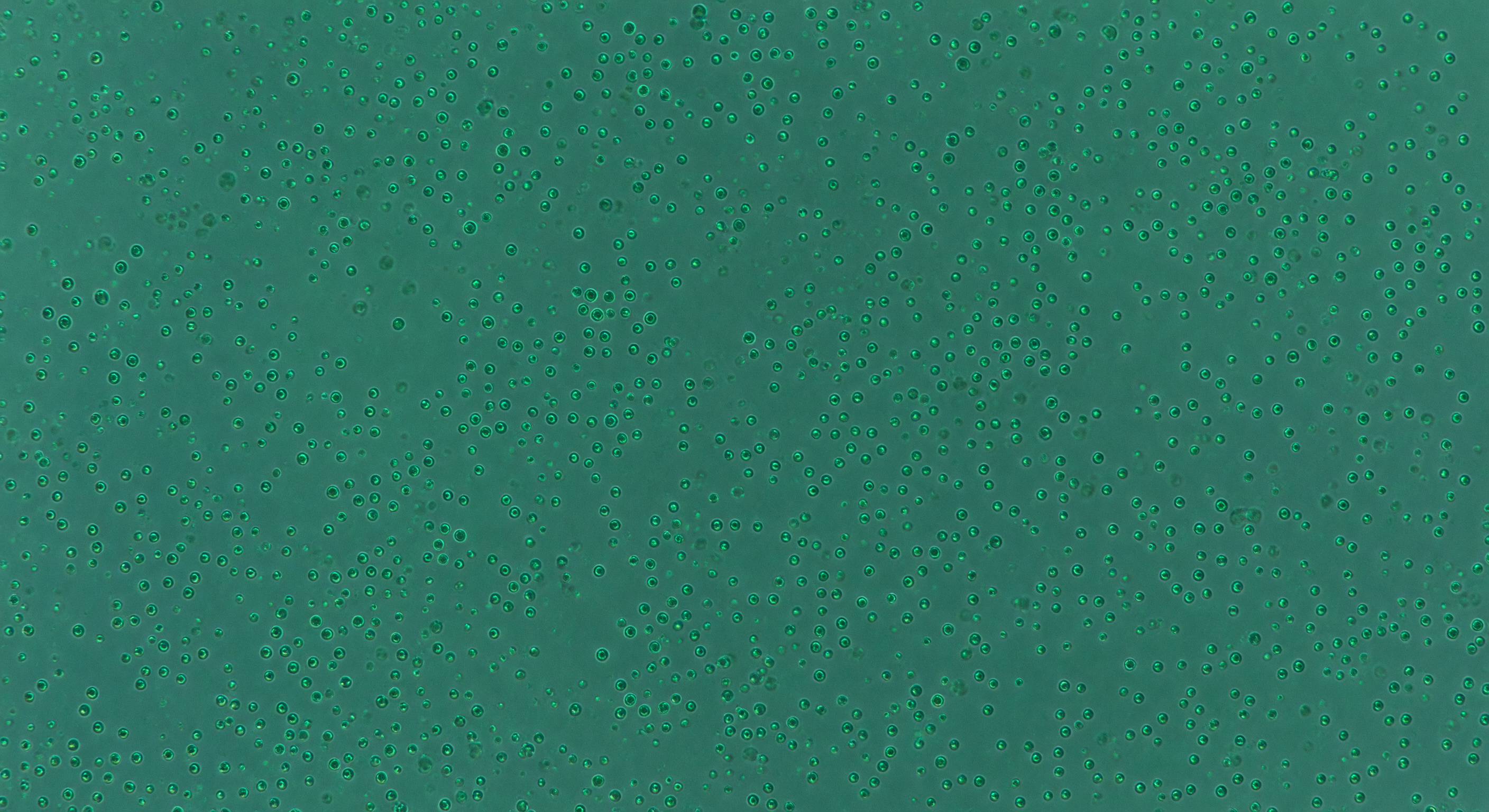
You are suspended inside what appears to be a living medium, a jade-green suspension so densely packed with *Ostreococcus tauri* cells that the fluid itself has taken on color, each cell a near-perfect sphere barely larger than the wavelength of visible light, trembling constantly on Brownian thermal currents with no surface, no floor, no orientation to anchor you. These are among the smallest known eukaryotes on Earth — 0.8 micrometers across, yet fully equipped with a nucleus, a single chloroplast that nearly fills the entire cell body, and a lipid membrane just 7 nanometers thick that nonetheless catches light as a discrete optical surface, producing a faint iridescent halo before rotating away into the fog. The suspension is so optically dense that photons scatter before they can travel the length of a few cells, meaning depth dissolves into color saturation rather than perspective — nearby cells resolve as distinct viridian spheres with dark chloroplast inclusions, while those two or three micrometers distant blur into the collective jade luminescence, their individuality surrendered to the aggregate. In ocean surface waters, blooms of picophytoplankton like *Ostreococcus* contribute disproportionately to global primary production precisely because their extraordinary surface-area-to-volume ratio makes them ruthlessly efficient at harvesting diffuse photons and assimilating dissolved nutrients in oligotrophic waters where larger cells starve. Here, immersed in their billions, the boundary between organism and medium has effectively ceased to exist — the water is the life, and the life is the water.
Other languages
- Français: Brume verte Ostreococcus
- Español: Niebla verde Ostreococcus
- Português: Névoa verde Ostreococcus
- Deutsch: Grüner Ostreococcus-Nebel
- العربية: ضباب أوستريوكوكوس الأخضر
- हिन्दी: ओस्ट्रियोकोकस हरित कोहरा
- 日本語: オストレオコッカスの緑霧
- 한국어: 오스트레오코쿠스 녹색 안개
- Italiano: Nebbia verde Ostreococcus
- Nederlands: Ostreococcus groene mist