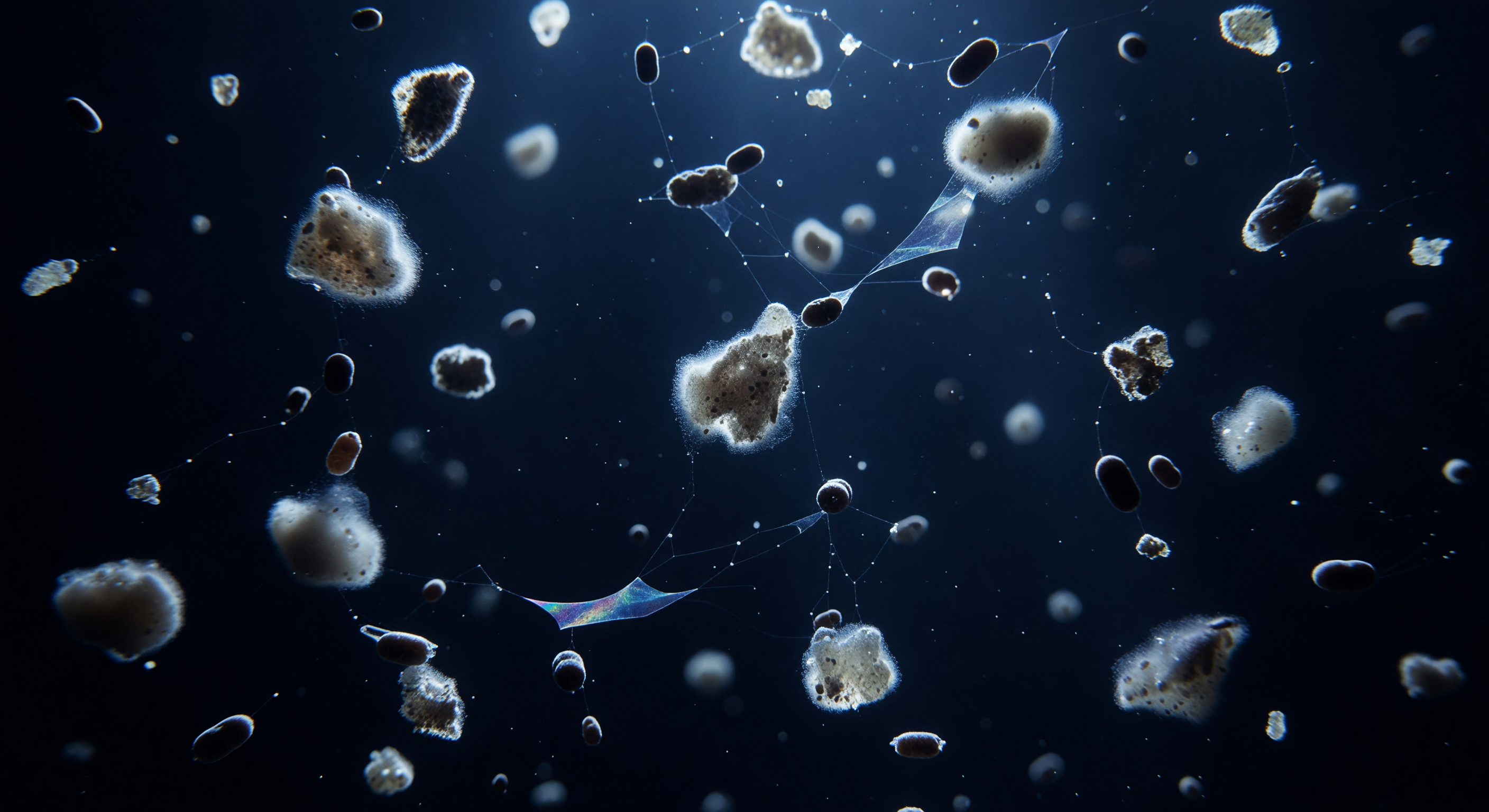
You are suspended in the mesopelagic twilight at 200 meters depth, immersed in an indigo-black water column where the last attenuated photons from the sunlit zone above barely register — and yet they are enough to illuminate a slow, ceaseless blizzard descending around you. Marine snow aggregates, each a loose confederation of coccolithophore armor plates, diatom frustules, mucus strands, and digested cellular debris compacted over days of aggregation, drift downward as cottony gray-white masses ranging from a few millimeters to the size of a small plum, their embedded calcite fragments catching residual blue-white light at 450–490 nanometers and igniting into a faint, ghostly halo at each floc's margins. Between them, compact dark-brown fecal pellets — dense cylinders ejected by copepod grazers in the waters above — fall three to ten times faster, punching silently through the aggregate field, while nearly invisible sheets of transparent exopolymer particles (TEP), secreted by phytoplankton as overflow products of carbon fixation, trembles in gossamer webs between the flocs, catching the sparse light only at their thinnest edges. This is the biological pump made visceral: each descending aggregate is a carbon archive, a compressed record of photosynthesis, grazing, death, and mineral ballasting, obeying gravity in a procession so slow it reads as geological — yet in aggregate, across the world ocean, this blizzard transfers hundreds of millions of tonnes of organic carbon to the deep seafloor every year, regulating atmospheric CO₂ on timescales that dwarf human civilization.
Phytoplankton & coccolithophores