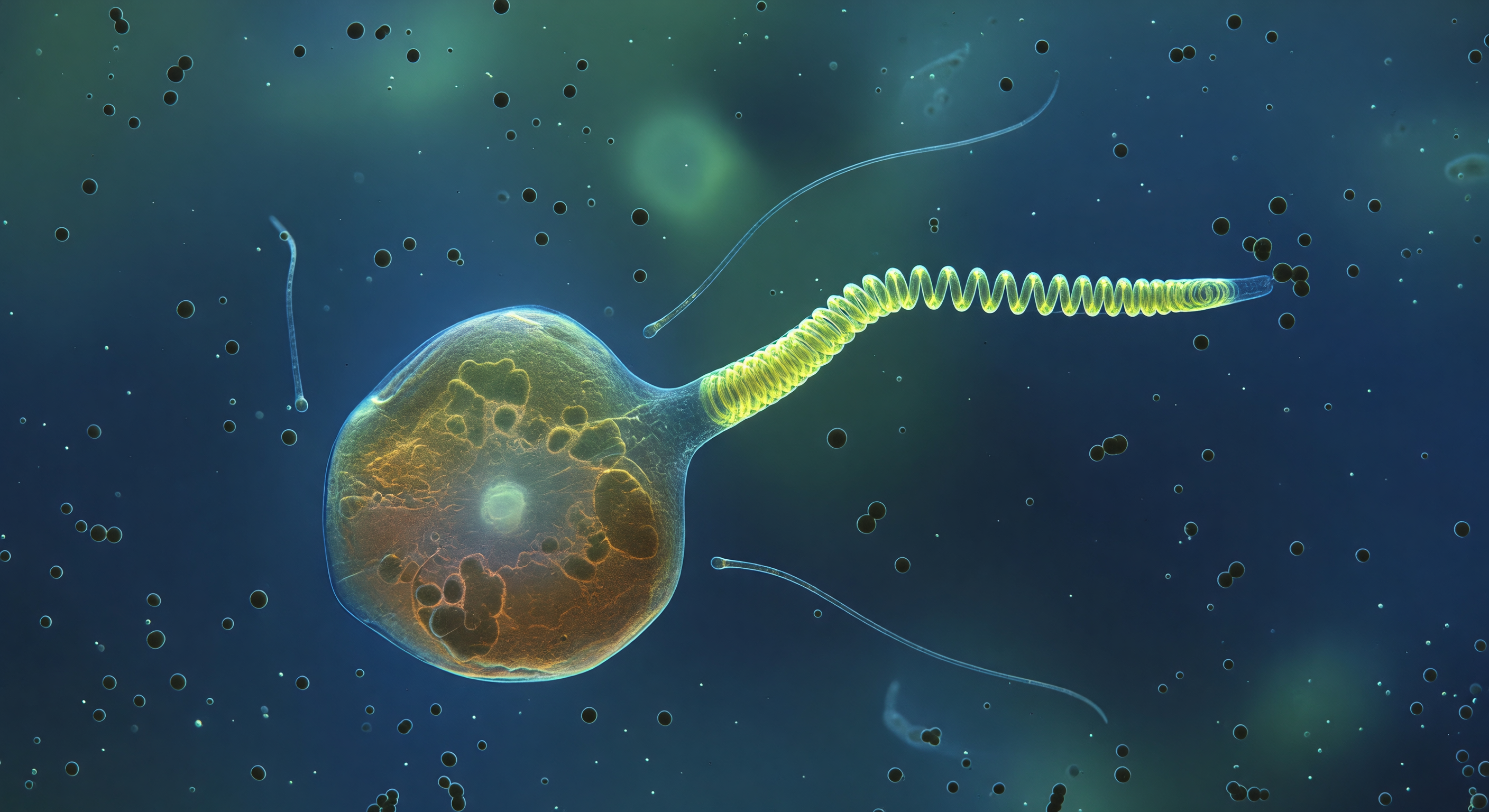
You are suspended inside a moment of microscopic violence, watching a single *Chrysochromulina* cell — roughly the size of a small house at this magnification — hold the center of a cold blue-green world as its haptonema tears itself between two geometries. The proximal coil has already snapped into a tight fluorescent helix, dense and spring-loaded, while the distal portion still trails as a stiffening rod caught mid-buckle at the transition zone, the entire structure blazing yellow-green against the deep sapphire medium like a neon filament under tension. The haptonema is not a flagellum but a separate organelle entirely — a microtubule-reinforced appendage unique to haptophyte algae, capable of recoiling in milliseconds through a calcium-triggered conformational cascade, likely used to capture bacterial prey or anchor the cell to surfaces. Dark charcoal spheres — bacteria roughly a tenth the cell's diameter — cluster near the thrashing tip, drawn into the chemical gradient radiating from the larger organism, while two ghostly flagella drift loosely to either side of the amber-translucent cell body, utterly indifferent to the snap occurring beside them. The surrounding water carries its own quiet density: particulate scatter, membrane vesicles, dissolved organics lending a faint milky luminosity to the background before it dissolves into oceanic black, the distance communicating itself not through any visible horizon but through the way the bacterial spheres simply fade and vanish into the ambient blue before the eye finds an edge.
Other languages
- Français: Recul du Haptonème
- Español: Retroceso del Haptonema
- Português: Recuo da Haptonema
- Deutsch: Haptonema Federrückstoß
- العربية: ارتداد الهابتونيما
- हिन्दी: हैप्टोनीमा स्प्रिंग प्रत्यावर्तन
- 日本語: ハプトネマの収縮跳ね返り
- 한국어: 합토네마 스프링 반동
- Italiano: Rimbalzo della Haptonema
- Nederlands: Haptonema Veer Terugslag