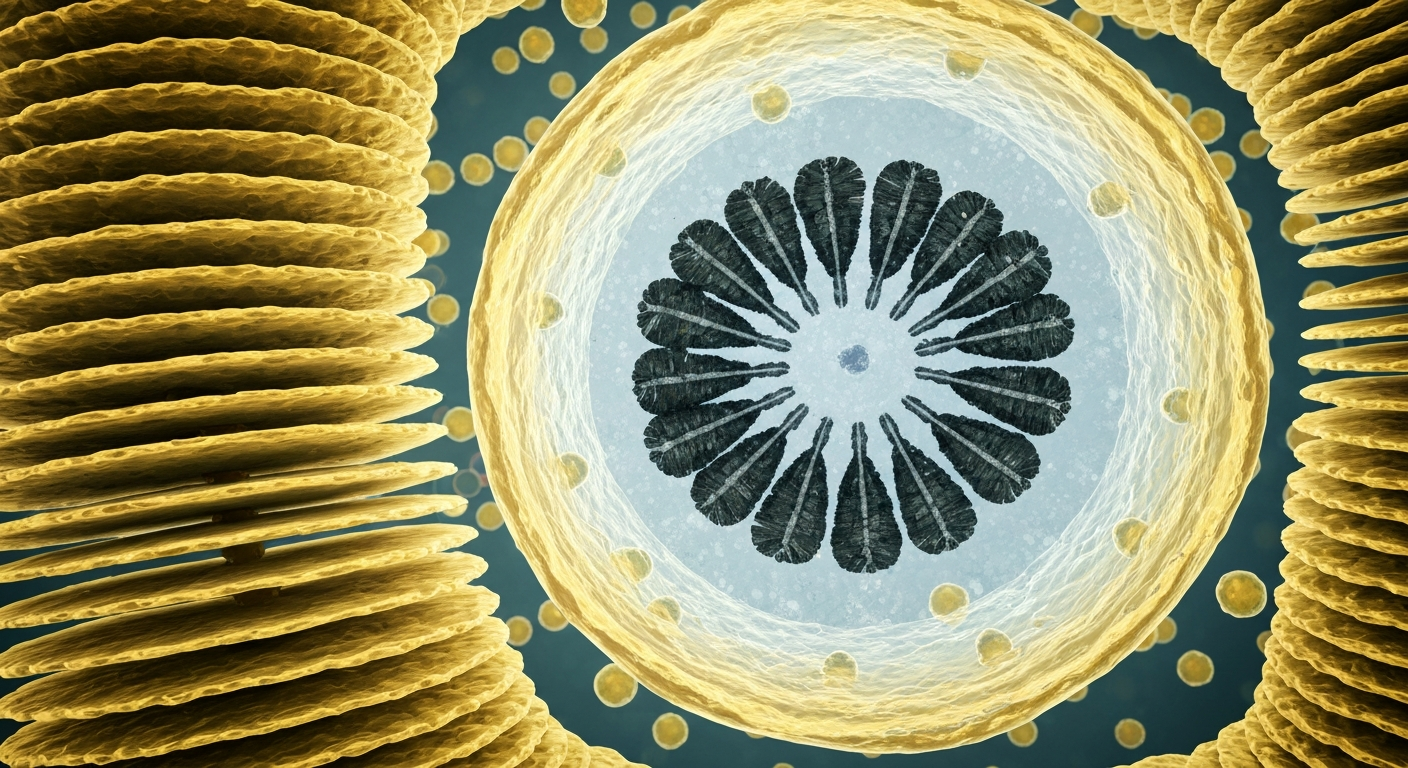
You are standing inside a living cell, surrounded by stacked sheets of membrane that rise around you like tiers of hammered amber glass — the Golgi cisternae, each bilayer only a few tens of nanometers thick, curving at their rims into swollen vesicular buds that pinch free and drift through the cytoplasm like warm lanterns, each one ferrying calcium and carbonate precursors toward the great assembly chamber ahead. Every surface in this crowded interior is studded with ribosomes, tiny dark granules arrayed in dense constellations across the pale gray-green skin of the endoplasmic reticulum, giving each membrane a velvety roughness as though the organelles themselves are breathing. Dominating the view like an industrial dome, the coccolith vesicle swells — its translucent amber wall enclosing a dim aqueous interior suffused with cold blue-gray light, where a nascent calcite ring assembles against a ghostly polysaccharide base plate, thirty-odd dark charcoal prisms interlocking in a radial wheel with a precision that feels engineered, one quadrant still open, its terminal crystals jagged where mineralization is actively proceeding, calcium ions arriving in invisible pulses through the membrane. This is *Emiliania huxleyi* building its armor from seawater chemistry alone — a molecular construction project whose product, one calcite plate just a few micrometers across, will eventually drift to the seafloor and, across geological time, become chalk.
Other languages
- Français: Intérieur de l'Usine Golgienne
- Español: Interior de la Fábrica Golgi
- Português: Interior da Fábrica Golgi
- Deutsch: Golgi-Fabrik Innenraum
- العربية: داخل مصنع غولجي
- हिन्दी: गॉल्जी कारखाने का भीतर
- 日本語: ゴルジ体工場の内部
- 한국어: 골지체 공장 내부
- Italiano: Interno della Fabbrica Golgi
- Nederlands: Golgi Fabriek Interieur