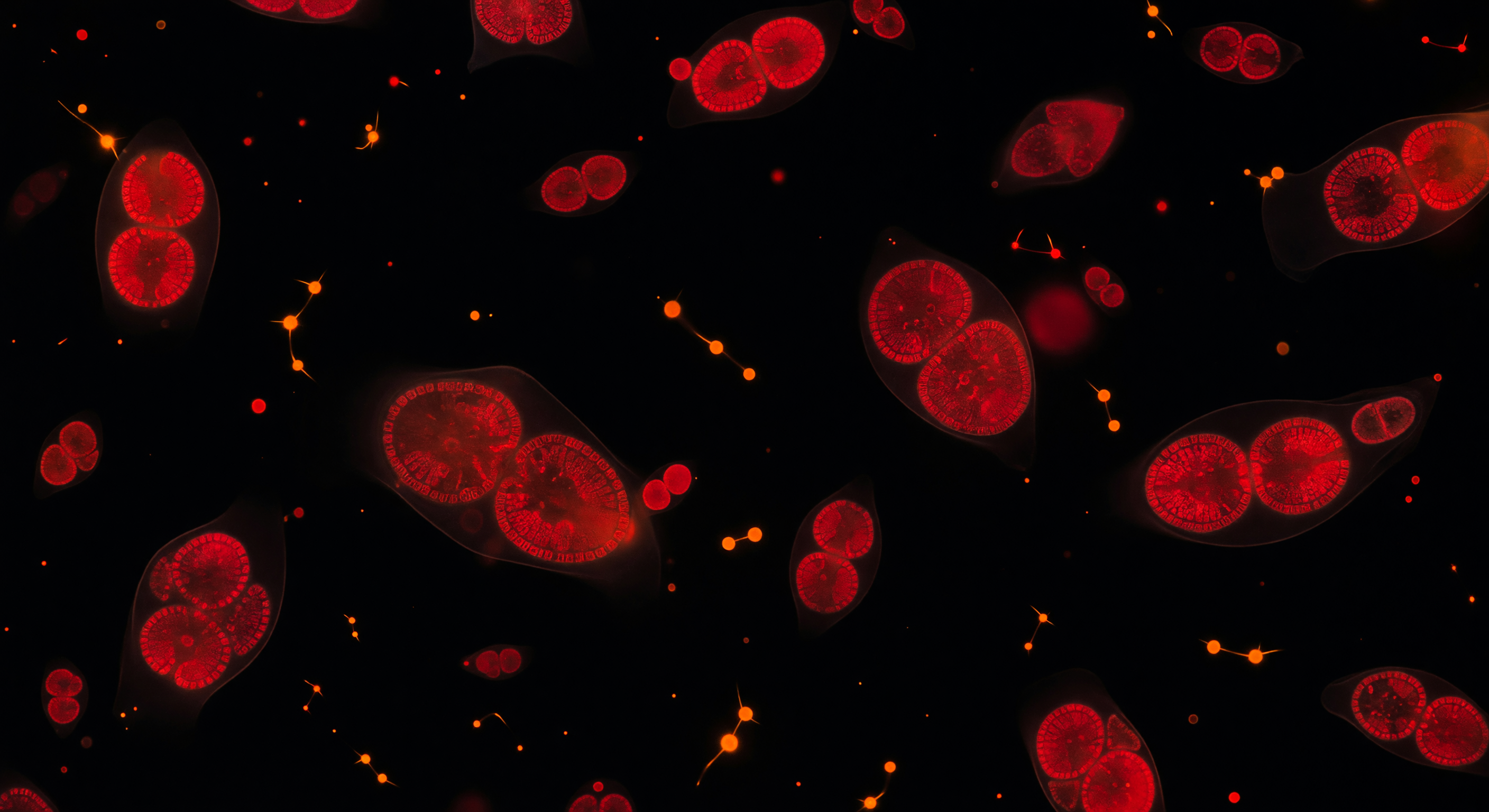
Suspended in absolute darkness, you find yourself adrift in a world measured in millionths of a meter, surrounded by dozens of phytoplankton cells burning as deep crimson embers — their chlorophyll molecules fluorescing at 680 nm, a wavelength they normally harvest to drive photosynthesis, here radiating outward as self-generated scarlet light with no external source to supplement them. Inside the nearest cells, double-lobed chloroplasts resolve as paired kidney forms dense with stacked thylakoid membranes, the molecular machinery of oxygenic photosynthesis compressed into structures just a micron or two across, their pigment concentration so high that the innermost folds deepen toward burgundy. Scattered among the crimson masses, cyanobacteria punctuate the void as sharp tangerine-orange sparks — prokaryotic cells carrying phycoerythrin rather than chlorophyll, evolutionarily ancient organisms whose ancestors first oxygenated Earth's atmosphere some 2.7 billion years ago, now burning a visibly different color in the same dark medium. The fluid itself is invisible yet present, its viscosity absolute at this scale — inertia here is essentially meaningless, Brownian thermal drift the only motion — and faint aureoles of scattered light around the nearest cells confirm you are suspended in ocean water rather than vacuum, a single microliter of sea surface that, multiplied across hemispheres, constitutes the base of nearly all marine food webs and produces roughly half of Earth's atmospheric oxygen.
Other languages
- Français: Champ d'étoiles fluorescentes cramoisies
- Español: Campo estelar carmesí fluorescente
- Português: Campo estelar carmesim fluorescente
- Deutsch: Karmesinrotes Fluoreszenz-Sternenfeld
- العربية: حقل نجوم فلوري قرمزي
- हिन्दी: क्रिमसन प्रतिदीप्ति तारा क्षेत्र
- 日本語: 深紅蛍光星野
- 한국어: 크림슨 형광 별밭
- Italiano: Campo stellare fluorescente cremisi
- Nederlands: Karmozijnrood fluorescent sterrenveld